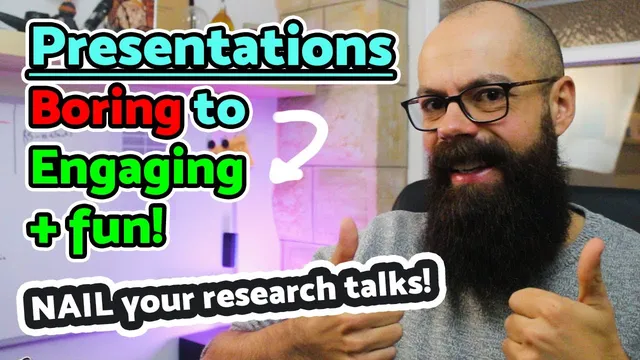
Deliver a KILLER research presentation! | PhD presentation skills and tips
Based on Andy Stapleton's video on YouTube. If you like this content, support the original creators by watching, liking and subscribing to their content.
Identify the audience’s knowledge level and expectations before writing slides, and match terminology density and technical detail accordingly.
Briefing
Great research presentations don’t live or die on perfect wording—they hinge on how the audience feels. The core takeaway is that people remember the emotional impact and confidence behind the message far more than the exact phrasing, so the job becomes designing a talk that reliably creates the right reaction: clarity about the stakes, relief through a solution, and energy at the start and finish.
That starts with audience targeting. Before building slides or rehearsing lines, the presenter should identify who will be in the room, what they already know, and what level of terminology and technical density fits. A five-person group of specialists can handle different jargon than an industry partner meeting where the goal is usually to “deliver the data and leave.” Conference audiences often tolerate more showmanship—funny slides or a bit of outlandish energy—because they’re sitting through many talks and need a jolt. But regardless of setting, the talk needs a story, a structure, and confidence; without those, audiences feel lost even when the content is strong.
The story structure recommended is the A-B-T method—“and,” “but,” “therefore.” The “and” portion supplies just enough background to make the problem legible, stitched together with concise context so the audience can follow the logic. The “but” is the emotional problem statement: the biggest, most urgent issue the research solves. The more the stakes feel personal or consequential, the more attention sticks—especially in humanities and social sciences, where emotional framing can hook the audience quickly. The “therefore” delivers the relief: the solution and what was created or discovered, tied directly to the problem. This framework is also used as a reset when the talk starts to feel muddled—return to background, then problem, then solution.
After the narrative spine is set, attention shifts to the talk’s energy curve. The opening should capture attention immediately, the middle can dip as technical details land, and the conclusion should rise again with an emotional, high-impact statement. Repetition is treated as a tool: the main take-home message should be highlighted and restated throughout, including by explicitly pointing out what a graph means and how it connects to the final claim. To keep the beginning and end emotionally sharp, the presenter even uses an online headline analyzer to check how emotive opening and closing lines are.
Nerves are reframed as performance fuel. Anxiety—heart pounding, racing thoughts, fear of forgetting or looking foolish—is treated as adrenaline that can power alertness and engagement once it’s interpreted as excitement. Visual support then needs discipline: slides and multimedia should support the spoken story, not replace it. High-quality, creative-commons images (e.g., from Unsplash) can set context, while graphs and tables must be redesigned for clarity—larger axis titles, higher contrast, and grayed-out or removed irrelevant data so the audience can instantly see what matters. The guiding rule is simple: if someone could follow the nuance without the speaker, the slide is overloaded; multimedia should make the message easier to grasp, not do the thinking for the audience.
Cornell Notes
A killer PhD presentation is built around audience fit and an emotional story structure, not memorized wording. Start by identifying who’s in the room, what they already know, and how technical the talk should be. Use the A-B-T story framework: “and” for brief background, “but” for the biggest problem (framed emotionally), and “therefore” for the solution and relief. Then shape delivery with an energy curve—high attention at the start, a controlled dip for technical content, and a high-energy, impactful conclusion. Finally, reframe nerves as excitement and design slides so they support the spoken narrative (clear, simplified graphs/tables; minimal text), since audiences remember how they felt more than the exact words.
How should a presenter decide what level of detail and terminology to use?
What is the A-B-T story structure, and what does each part do for the audience?
Why does repetition matter in a research talk?
How can a presenter use energy management to improve engagement?
What slide design rules prevent multimedia from taking over the story?
How can someone turn presentation nerves into a performance advantage?
Review Questions
- What audience assumptions should a presenter make when deciding terminology and technical density, and how would that change for a lab group versus industry partners?
- Use the A-B-T framework to outline a 3-sentence story for a research topic: what would be your “and,” your “but,” and your “therefore”?
- What specific changes should be made to a published graph before placing it on slides to ensure the audience can read it instantly?
Key Points
- 1
Identify the audience’s knowledge level and expectations before writing slides, and match terminology density and technical detail accordingly.
- 2
Build every talk around a clear story structure: “and” (brief background), “but” (the biggest emotional problem), and “therefore” (the solution and relief).
- 3
Design the talk’s energy curve with a high-attention opening, a controlled technical middle, and a high-energy, emotional conclusion.
- 4
Repeat the main take-home message and explicitly connect figures to the conclusion so the audience retains the thread.
- 5
Reframe nerves as excitement and use a practiced opening line to convert adrenaline into performance focus.
- 6
Use multimedia to support the spoken narrative—keep slides simple, and redesign graphs/tables for instant readability (contrast, axis size, and highlighted data).