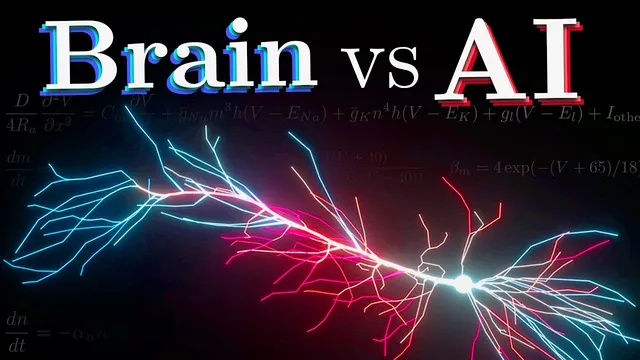
Dendrites: Why Biological Neurons Are Deep Neural Networks
Based on Artem Kirsanov's video on YouTube. If you like this content, support the original creators by watching, liking and subscribing to their content.
Voltage-gated sodium and potassium channels make action potentials thresholded and regenerative, but dendrites—not just the soma—determine how inputs are integrated.
Briefing
Biological neurons—especially their dendrites—are far more than simple “wires” that sum inputs. Voltage-gated ion channels and dendritic nonlinearities let single neurons perform computations long thought to require multi-layer artificial neural networks, including time-sensitive pattern processing and even XOR-like logic. That matters because it reframes how brains implement learning and inference: computation can happen inside one cell, not just across networks of many neurons.
The discussion starts by contrasting early machine-learning neuron models with real cellular physiology. A perceptron resembles a neuron’s output mechanism: voltage-gated sodium channels can create an all-or-none action potential once membrane voltage crosses a threshold, followed by potassium channels that restore the resting state. But the perceptron’s weakness is input handling. Traditional textbook descriptions treat dendrites as passive, leaky cables that attenuate signals and effectively weight synaptic inputs by distance and receptor strength. That picture breaks down once dendrites are recognized as electrically active structures packed with voltage-gated channels.
Dendrites contain sodium channels that support backpropagation—action-potential-like activity traveling from the axon region back into dendritic branches—helping drive synaptic plasticity. They can also generate local, small depolarizations that transiently amplify synaptic inputs. A key coincidence detector is the NMDA receptor: it opens only when both neurotransmitter is present and the membrane is sufficiently depolarized. Because NMDA channels allow calcium influx (along with sodium), they produce NMDA spikes on longer timescales (hundreds of milliseconds) and enable nonlinear integration.
Those nonlinearities give dendrites computational reach. Dendritic processing can discriminate the order of incoming spikes: sequential activation in one direction can yield a different electrical and chemical response than activation in reverse. The system is also sensitive to activation velocity, enabling sequence-selective outputs. Evidence is cited that NMDA-driven dynamics can enhance stimulus selectivity in the visual cortex of awake animals, linking dendritic computations to behaviorally relevant processing.
A highlight comes from a 2020 study led by Matthew Larkum, which reported dendritic calcium action potentials in human layer 2/3 pyramidal neurons. These calcium spikes appear only within a narrow “just right” range of excitatory input strength—too weak fails to reach calcium-channel activation thresholds, too strong prevents spikes—creating a built-in selectivity that supports logic-like operations. Using two synaptic input groups (A and B), the neuron can respond when either group alone triggers a dendritic spike, but not when both are activated together—an XOR pattern.
Finally, the transcript connects these biophysical mechanisms to deep learning. A separate paper, “Single cortical neurons as deep artificial neural networks,” builds a detailed biophysical neuron model and trains deep convolutional neural networks to predict its output spikes from synaptic inputs. The learned network needs roughly 5–8 layers when NMDA channels are included, but collapses to about one hidden layer when NMDA channels are removed—directly tying dendritic nonlinearities to the computational depth required. The convolutional model also generalizes to synaptic configurations it never saw, suggesting it can infer underlying biophysics from training data. The overall takeaway: single neurons can act like deep, nonlinear computational units, making dendrites central to how brains compute.
Cornell Notes
Dendrites are not passive “cables” that merely transmit and attenuate synaptic signals. Packed with voltage-gated ion channels—especially NMDA receptors and calcium-related mechanisms—dendrites perform nonlinear integration, including coincidence detection, order/velocity sensitivity, and XOR-like logic. Human cortical pyramidal neurons can generate dendritic calcium action potentials that fire only for an optimal input strength, enabling a response pattern consistent with XOR across two synaptic input groups. When detailed biophysical neuron models are mapped onto deep convolutional neural networks, the required network depth (about 5–8 layers with NMDA channels) drops sharply when NMDA channels are removed, showing how dendritic nonlinearities drive computational complexity. This reframes single cells as deep computational units, not just linear summators feeding downstream networks.
Why does a perceptron resemble a neuron’s output but fail to capture how inputs are processed?
How do NMDA receptors function as coincidence detectors, and why does that matter computationally?
What does dendritic order sensitivity mean, and what mechanism supports it?
What is special about dendritic calcium action potentials in human layer 2/3 pyramidal neurons?
How can dendritic spikes implement an XOR-like operation on two synaptic input groups?
How does deep learning quantify dendritic computational complexity?
Review Questions
- What specific ion-channel mechanisms turn dendrites from passive summing elements into active computational subunits?
- How does NMDA receptor gating (depolarization + neurotransmitter) change the timescale and nonlinearity of dendritic integration?
- Why does removing NMDA channels reduce the depth of the equivalent deep convolutional network needed to predict neuron output spikes?
Key Points
- 1
Voltage-gated sodium and potassium channels make action potentials thresholded and regenerative, but dendrites—not just the soma—determine how inputs are integrated.
- 2
Dendrites contain voltage-gated sodium channels that enable backpropagation, which supports synaptic plasticity and local amplification of inputs.
- 3
NMDA receptors act as coincidence detectors requiring both neurotransmitter and sufficient depolarization, enabling calcium-dependent NMDA spikes on longer timescales.
- 4
Dendritic NMDA-driven nonlinearities allow computations that depend on timing details, including order and activation velocity of incoming spikes.
- 5
Human layer 2/3 pyramidal neurons can generate dendritic calcium action potentials that fire only within an optimal input-strength window, enabling XOR-like input-output patterns.
- 6
A deep convolutional neural network can emulate a single neuron’s input-output mapping, but the required depth (about 5–8 layers) drops sharply when NMDA channels are removed, linking dendritic nonlinearities to computational depth.
- 7
Single neurons can function as deep, nonlinear computational units rather than simple linear summators feeding larger networks.