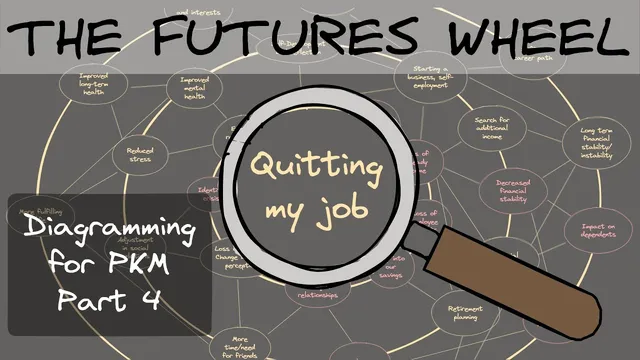
Diagramming for PKM: The Futures Wheel of Quitting my Job
Based on Zsolt's Visual Personal Knowledge Management's video on YouTube. If you like this content, support the original creators by watching, liking and subscribing to their content.
Use a Futures wheel to map quitting a job by placing the scenario in the center and listing primary, secondary, and tertiary consequences in three rings.
Briefing
Quitting a 9-to-5 job can bring immediate relief—especially from toxic office routines—but it also triggers a chain of financial, emotional, and identity consequences that can ripple for years. A Futures wheel diagram helps map those effects by separating outcomes into primary, secondary, and tertiary impacts, making it easier to see both opportunities and risks before acting.
The method starts with a single “focus scenario” placed in the center: quitting a job. Three concentric rings then capture likely consequences. In the primary ring, the most immediate hit is financial: losing steady income and employee benefits can quickly reduce financial stability and force adjustments like cutting back on spending, canceling subscriptions, and drawing down savings. That uncertainty often brings anxiety as the next paycheck becomes less predictable. Yet the same primary consequences can include upside—more free time to pursue what matters, plus emotional relief from work that feels misaligned with personal passion. Even when the workplace isn’t overtly hostile, office work can feel “toxic” simply because it consumes prime hours on tasks that aren’t fully aligned with one’s interests.
Primary impacts also include social and psychological costs. With the job gone—sometimes after a decade or more—many people face an identity crisis, because the role provided status, routine, and a sense of who they are. Giving up a “prestigious career” can also shift how others perceive them. And even if coworkers weren’t ideal, quitting often means missing at least some of the social atmosphere and relationships built at work.
The secondary ring extends those primary effects into downstream outcomes. Reduced financial stability can lead to more lifestyle tightening and deeper budgeting. It can also push people to search for additional income, often through starting a business or other self-employment. That path typically demands more time for self-development and reflection—both to acquire new skills and to avoid repeating the same misalignment that drove the decision to quit.
In the tertiary ring, the long-term consequences become clearer. Financial instability can strain relationships with children, a spouse, or parents. Self-employment can reshape a career path and professional identity, ideally toward something more fulfilling. Self-development can improve health outlook and expand interests, while spending more time with friends and family can strengthen relationships and shift lifestyle in a more positive direction.
The diagram isn’t meant to sell optimism. It explicitly encourages distinguishing threats from opportunities—such as coloring negative outcomes red—and even comparing a “happy scenario” wheel against a “doomsday scenario” wheel to spot gaps and mitigation strategies. The tool’s limitation is also acknowledged: it can’t predict the future, and its accuracy depends on the quality of the judgments used to build it. To counter that, the creator suggests using CH GPT-4 as a critique partner by pasting the diagram image and asking it to identify logical gaps. Finally, the approach can be extended into Obsidian by turning key impacts into linked notes, enabling ongoing brainstorming and action planning. The next step in the series is extracting overarching themes and turning the map into a practical road map using a Sunray transformation map.
Cornell Notes
A Futures wheel diagram organizes the consequences of quitting a job into primary, secondary, and tertiary impacts. Immediately after quitting, people often face lost income and benefits, leading to anxiety and financial adjustments, but they may also gain free time and emotional relief from misaligned work. Over time, reduced stability can strain relationships and drive a search for income, frequently through self-employment that requires new skills and reflection. Those same changes can also improve long-term health, relationships, and lifestyle—if the new path aligns with personal passions. The method also highlights uncertainty by encouraging red/green threat-opportunity marking and scenario comparison, then using CH GPT-4 and Obsidian links to refine and expand the plan.
What counts as a “primary” consequence in the Futures wheel for quitting a job, and why does it matter?
How do primary consequences generate secondary outcomes in the diagram?
What tertiary impacts are most likely to show up years after quitting?
Why does the diagram recommend coloring threats and opportunities, and what does that reveal?
What are the main limitations of the Futures wheel, and how can they be reduced?
How can the diagram be turned into actionable notes in Obsidian?
Review Questions
- If quitting removes income and benefits immediately, what specific secondary and tertiary outcomes could follow from that financial pressure?
- How would you build and compare a “happy scenario” wheel versus a “doomsday scenario” wheel to identify missing mitigations?
- What role does CH GPT-4 play in improving the quality of a Futures wheel, and what kinds of issues should it be asked to look for?
Key Points
- 1
Use a Futures wheel to map quitting a job by placing the scenario in the center and listing primary, secondary, and tertiary consequences in three rings.
- 2
Expect immediate financial instability and anxiety from lost income and benefits, even when quitting brings free time and emotional relief from misaligned work.
- 3
Plan for identity and social shifts after quitting, including potential loss of status and missing coworkers or office community.
- 4
Trace secondary effects like job-search behavior into likely paths such as self-employment, which then increases the need for skills-building and reflection.
- 5
Anticipate tertiary ripple effects years later, including relationship strain from financial instability and long-term changes in health, lifestyle, and professional identity.
- 6
Differentiate threats from opportunities by color-coding outcomes and comparing parallel scenario wheels to surface gaps and mitigation needs.
- 7
Counter the Futures wheel’s uncertainty by using CH GPT-4 to critique the diagram and by turning key impacts into linked Obsidian notes for ongoing action planning.