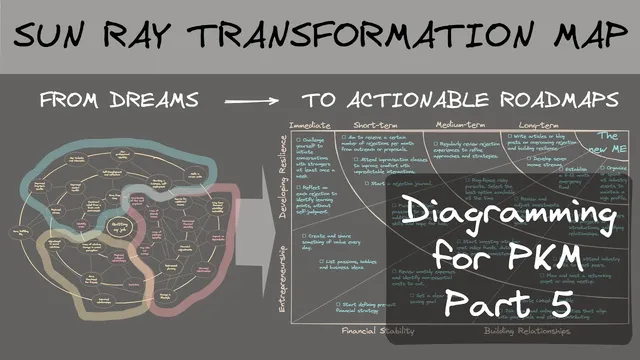
Diagramming for PKM: The Sun Ray Transformation Map for preparing to quit your 9-to-5 job
Based on Zsolt's Visual Personal Knowledge Management's video on YouTube. If you like this content, support the original creators by watching, liking and subscribing to their content.
Translate quitting into a Sun Ray Transformation Map with explicit time horizons and assigned work streams so actions don’t stay abstract.
Briefing
Quitting a 9-to-5 job becomes far more manageable when the “future self” is translated into a structured transformation map: clear time horizons, concrete work streams, and trackable actions that can be reviewed and adjusted. The core method centers on a Sun Ray Transformation Map that splits the path into immediate, short-term, medium-term, long-term, and a “future me” target—then assigns four work streams to those time bands: developing resilience, entrepreneurship, financial stability, and building relationships. The point is to stop treating quitting as a fantasy and instead build a roadmap that can survive real-world friction—expenses, rejection, and opportunity timing.
The map is built with a diagramming workflow in Excalidraw, including a reusable template, elliptical sections for time horizons, and a “split ellipse” script to cut shapes into the exact segments needed. A “future me” label sits in the top-right as a North Star, while three sunrays divide the space into the work-stream quadrants. To keep the plan actionable, the creator embeds a Futures Wheel alongside the transformation map so risks and drivers can be referenced later through linked backlinks.
Once the visual structure is in place, the plan is populated with three categories of challenge—financial, entrepreneurial, and relationship—and the most urgent risks are flagged in red. Financial guidance focuses on balancing passive income with burn rate, tightening monthly expenses by cutting non-essential costs, and setting a monthly savings target aligned with current income. In the short term, the roadmap recommends low-cost index funds (ideally automated) rather than single-stock selection, and it discourages day trading or ignoring investments entirely. It also calls for an emergency fund sized at roughly 6 to 12 months of expenses, with “more is better” to buy time for exploration and new ventures after leaving.
Entrepreneurial and resilience planning emphasizes preparing for rejection and failure, then building the ability to bounce back quickly. Tactics include initiating conversations with strangers to practice handling awkwardness, keeping a rejection journal to learn without self-judgment, and using improvisation classes or structured outreach to potential partners. The roadmap also suggests experimenting with passion projects inside a time box—then committing to the best option when the window ends—so the emergency fund doesn’t get depleted without a sustainable income path. As a fallback, it recommends considering less glamorous but more lucrative jobs (using plumbing as an example) to reduce the odds of getting stuck.
Relationship-building is treated as a luck multiplier: spending time with the right people, creating a LinkedIn presence, joining and contributing to communities, and attending or hosting industry events. The roadmap distinguishes reactive networking (late and unprepared), proactive networking (monitoring forums, arriving ready), and generative networking (planning and hosting meetups). It closes with a reminder that a plan must be revisited and revised—no strategy survives contact with reality unchanged—and that the transformation map is a visual thinking tool meant to guide personal action rather than serve as generic financial or life advice.
Cornell Notes
The Sun Ray Transformation Map turns the goal of quitting a job into a structured plan tied to a “future me” target. The layout divides time into immediate, short-term, medium-term, long-term, and then assigns work streams—resilience, entrepreneurship, financial stability, and relationships—across those horizons. Financial actions include cutting non-essential expenses, setting monthly savings goals, using low-cost index funds with automation, avoiding day trading, and building an emergency fund of 6–12 months. Relationship guidance treats networking as a luck multiplier through LinkedIn, communities, and event attendance or hosting. Resilience planning prepares for rejection via practice conversations, rejection journaling, and time-boxed experiments so risk doesn’t drain the emergency fund.
How does the Sun Ray Transformation Map convert a quitting goal into something operational?
What financial steps are prioritized before and after quitting?
Why is the plan so focused on resilience and rejection readiness?
How does the roadmap balance experimentation with financial safety?
What networking approach is emphasized, and how is it operationalized?
How are actions on the map made trackable inside Obsidian?
Review Questions
- What are the four work streams in the Sun Ray Transformation Map, and how do they relate to the time horizons?
- Which financial practices are recommended for reducing risk (including emergency fund sizing and investment approach), and what behaviors are discouraged?
- How do time-boxed experimentation and rejection journaling work together to protect both momentum and financial stability?
Key Points
- 1
Translate quitting into a Sun Ray Transformation Map with explicit time horizons and assigned work streams so actions don’t stay abstract.
- 2
Use a “future me” North Star to keep decisions aligned with the intended balance of financial success and pursuing dreams.
- 3
Treat financial readiness as runway management: cut non-essential expenses, set monthly savings targets, invest via low-cost index funds, and build a 6–12 month emergency fund.
- 4
Build resilience as a skill: practice uncomfortable interactions, journal rejections for learning, and use structured outreach to partners.
- 5
Network as a luck multiplier by combining LinkedIn presence, community contribution, and event attendance or hosting—prefer proactive or generative approaches.
- 6
Time-box risky experiments and commit when the window ends to avoid draining the emergency fund without a sustainable income path.
- 7
Revisit and revise the plan regularly because real-world conditions change faster than any diagram can predict.