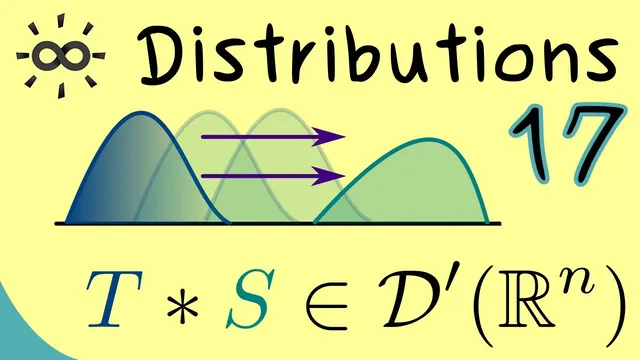
Distributions 17 | Convolution with Distributions of Compact Support
Based on The Bright Side of Mathematics's video on YouTube. If you like this content, support the original creators by watching, liking and subscribing to their content.
Convolution for distributions extends cleanly when one input is a compactly supported distribution S ∈ E′.
Briefing
Convolution for distributions becomes workable far beyond the “test function + distribution” setting once one input is restricted to have compact support. The key move is to define the convolution of an arbitrary distribution T with a compactly supported distribution S by shifting the convolution onto the test function side, where the operations are already well-defined. The payoff is substantial: the result of convolving T with such an S is always a smooth, compactly supported function—meaning the output lands back in the space of test functions rather than merely in a general distribution space.
The construction starts by recalling the earlier definition: when one factor is a test function P (smooth with compact support) and the other is a distribution T, the convolution P * T is defined through dual pairing by letting T act on a reflected convolution of test functions. That reflection is encoded by an operator S ↦ Š (a reflection in the spatial variable). The central question then becomes whether the convolution can be extended to two distributions, even when neither is a test function.
The answer hinges on compact support. By restricting the second input to distributions with compact support (denoted E′), the convolution can be defined for any distribution T and any S in E′. A new reflection (“check”) operation is introduced for distributions with compact support, defined by pushing the reflection onto the test function used in the dual pairing. For regular distributions (those represented by functions), this “check” operation matches the usual reflected function, and crucially it preserves compact support—only the location shifts, not the boundedness.
With this in place, the convolution T * S is defined by pairing T with the convolution of a test function f against the reflected compactly supported distribution Š. This definition is not just formal: it is shown to be compatible with the older convolution definition when T is itself regular. In that case, the dual pairing reduces to an integral, and the operations can be rearranged so the new formula collapses to the previous one.
Compact support also drives the regularity outcome. When both inputs are compactly supported in the appropriate sense, the convolution produces a regular distribution represented by a C∞ function. Because the compact support survives through the construction, the resulting function is not only smooth but also compactly supported—so the convolution lands in the test function space. This turns convolution into a tool that preserves “nice” behavior even when starting from generalized functions.
Finally, the convolution gains an algebraic anchor: convolving any distribution T with the Dirac delta distribution δ reproduces T. In other words, δ acts as a right identity (and, when the other factor has compact support, also as a left identity). That identity property matters because it mirrors multiplication-like behavior and provides a foundation for using convolution in analysis and, later on, partial differential equations.
Cornell Notes
The convolution of distributions can be extended once one factor is required to have compact support. For an arbitrary distribution T and a compactly supported distribution S (S ∈ E′), the convolution T * S is defined via dual pairing by pushing the convolution onto test functions and using a reflection (the “check” operation) for distributions. The “check” operation is defined so it matches the usual reflection for regular distributions and preserves compact support. This setup is compatible with the earlier convolution definition when T is regular. A major consequence is regularity: convolving with a compactly supported distribution yields a smooth, compactly supported function (a test function), and the Dirac delta δ acts as an identity element under this convolution.
Why does the definition of convolution for two distributions require one factor to have compact support?
How is the “check” (reflection) operation for distributions defined, and what property does it preserve?
What is the new convolution definition for T * S when S has compact support?
How is compatibility with the earlier convolution definition verified?
What regularity and support properties does the convolution T * S have when S has compact support?
What role does the Dirac delta δ play in this convolution framework?
Review Questions
- In the extended convolution definition, exactly where does the reflection (“check”) operation get applied, and why is that placement important?
- What changes in the convolution outcome when the second distribution has compact support (E′) compared with allowing arbitrary distributions?
- How does the identity property involving the Dirac delta δ follow from the convolution definition via dual pairing?
Key Points
- 1
Convolution for distributions extends cleanly when one input is a compactly supported distribution S ∈ E′.
- 2
The “check” (reflection) operation for distributions is defined through dual pairing by reflecting the test function instead of the distribution directly.
- 3
Reflection preserves compact support, which is the technical reason the extended convolution stays well-defined.
- 4
The extended convolution definition is compatible with the earlier test-function-based convolution when the first distribution is regular.
- 5
Convolving with a compactly supported distribution produces a smooth (C∞) function with compact support, so the result lies in the test function space.
- 6
The Dirac delta δ acts as an identity element under this convolution: T * δ = T (and δ also functions as a left identity when the other factor has compact support).