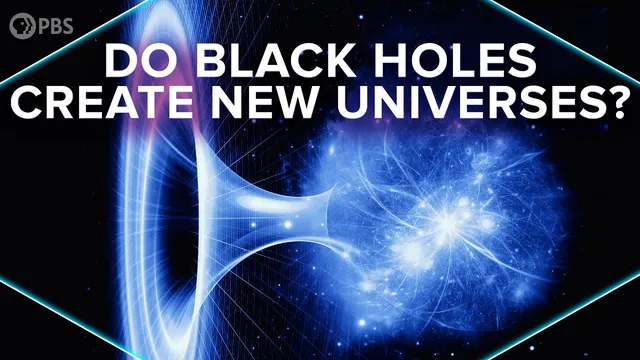
Do Black Holes Create New Universes?
Based on PBS Space Time's video on YouTube. If you like this content, support the original creators by watching, liking and subscribing to their content.
Cosmological natural selection proposes that black holes trigger new big bangs, creating daughter universes whose fundamental constants shift slightly from their parents.
Briefing
Cosmological natural selection proposes that black holes don’t just end stars—they help “reproduce” universes. In this framework, each black hole triggers a new big bang on the other side, creating daughter universes whose fundamental constants differ slightly from the parent. Over many generations, universes that make more black holes would outcompete others, gradually shifting cosmic “genetics” toward configurations that are better at producing black holes. Because making black holes often requires stars, the model also links—without invoking direct design—to why the universe’s conditions seem unusually well matched for life.
The appeal is that it tries to replace the anthropic principle’s “we’re here because we can be” reasoning with a Darwin-like mechanism. Biological evolution works because mutations sometimes improve survival and reproduction; cosmological natural selection claims a parallel: small random changes in constants, plus a selection effect favoring black-hole production, would make the ensemble of universes more efficient at generating black holes. The episode stresses that this is meant to be more than a story by asking two tests: whether black holes can plausibly create new universes, and whether the resulting selection leaves measurable fingerprints.
The first requirement is the most speculative. The idea traces back to Bryce deWitt, who suggested that when a black hole forms, its mass might not all vanish into an unreachable singularity. Instead, collapse could “bounce,” creating a new region of spacetime that behaves like a new universe, though the mechanism depends on unknown quantum gravity. John Archibald Wheeler added that the daughter universes might have different fundamental constants, potentially because extreme-energy conditions could alter the geometry of extra dimensions—an idea later adapted by Lee Smolin. Smolin’s key twist is that constants change only slightly between parent and child, like small genetic mutations, enabling an evolutionary process rather than a total reset.
Assuming the mechanism works, the model yields a concrete prediction: the constants governing black-hole production should be near-optimal in our universe, independent of whatever happens to make life possible. For black holes formed from massive stars, the episode points to the need for efficient star formation—gas cooling, shielding, and the presence of heavy elements and molecules. Carbon monoxide is highlighted as a particularly important coolant, while dust and chemistry help clouds collapse instead of staying too warm. The same general ingredients also matter for life, which creates the “coincidence” the theory tries to make natural.
The episode then considers alternative black-hole channels. Alexander Vilenkin proposed that in a universe lasting forever, quantum fluctuations could eventually generate black holes in huge numbers, with larger universes producing more of them. That would push selection toward rapid expansion driven by dark energy—something the episode notes doesn’t match the observed universe. Smolin counters that extrapolating physics to unimaginably long timescales is uncertain, and that different regions in the landscape of constants could optimize different black-hole pathways.
Finally, the episode describes what it calls a test. If selection favors black-hole production, then the physics separating neutron stars from black holes should be tuned to allow the maximum number of black holes. Smolin focuses on the mass of the strange quark, arguing that an optimized value would imply no neutron stars above about 2 solar masses. Observations complicate that: the most massive known neutron star is about 2.17 solar masses. Whether that discrepancy is within uncertainties or a genuine falsification is left as an open question.
Overall, cosmological natural selection is presented as a speculative but testable attempt to explain fine-tuning without leaning on anthropic reasoning—using evolutionary logic and predictions that could, in principle, fail.
Cornell Notes
Cosmological natural selection claims that black holes can “spawn” new big bangs, producing daughter universes whose fundamental constants differ slightly from their parents. If universes that make more black holes also tend to reproduce more efficiently, then cosmic evolution would favor constants that optimize black-hole production. Because star formation is tied to many black-hole formation routes, the same tuning that boosts black-hole numbers can also make life possible—without requiring life to be the target of selection. The idea is highly speculative because no confirmed theory shows black holes create new universes, but it offers testable consequences. One proposed test links the strange-quark mass to the maximum neutron-star mass; the observed record neutron star (~2.17 solar masses) may challenge the predicted cutoff near 2 solar masses.
What is the core mechanism behind cosmological natural selection, and how does it mimic biological evolution?
Why is the “black holes create new universes” step considered the weakest link?
What prediction follows if selection optimizes black-hole production independently of life?
How do alternative black-hole formation ideas affect the model’s expectations?
What is the proposed observational test involving neutron stars and strange quarks?
What critique is raised about the “life coincidence” problem?
Review Questions
- Which assumptions must hold for cosmological natural selection to be more than an analogy to biological evolution?
- How does the model connect the strange-quark mass to the maximum neutron-star mass, and what does the current observational record imply?
- What role do star-formation requirements (cooling, shielding, and molecular chemistry) play in the predicted tuning of fundamental constants?
Key Points
- 1
Cosmological natural selection proposes that black holes trigger new big bangs, creating daughter universes whose fundamental constants shift slightly from their parents.
- 2
Small, mutation-like changes plus a selection effect favor universes that produce more black holes, gradually optimizing cosmic parameters over generations.
- 3
The mechanism that turns black-hole collapse into a new universe is the most speculative part and depends on unknown quantum gravity details.
- 4
If black-hole production is optimized independently of life, the constants governing black-hole formation should be near-optimal in our universe, especially for stellar routes that require massive stars.
- 5
Star formation tuning matters because efficient cooling and chemistry—highlighted by carbon monoxide as a key coolant—support the creation of massive stars and thus many black holes.
- 6
Alternative black-hole formation scenarios (like quantum-fluctuation production in long-lived universes) could change what “optimized” constants should look like, and may conflict with observations.
- 7
A proposed falsifiable test links selection to the strange-quark mass and predicts a neutron-star maximum near 2 solar masses; the observed ~2.17 solar-mass neutron star is a potential challenge.