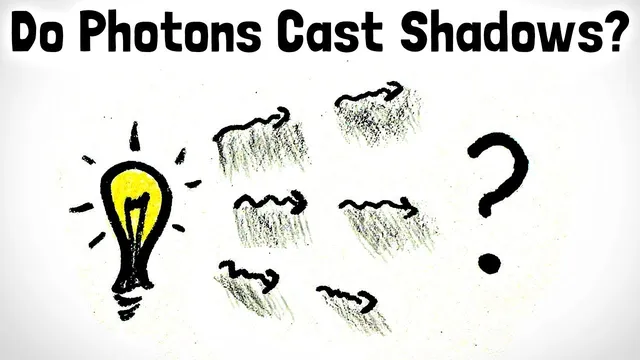
Do Photons Cast Shadows?
Based on minutephysics's video on YouTube. If you like this content, support the original creators by watching, liking and subscribing to their content.
Photons don’t cast ordinary shadows because electromagnetic waves generally pass through one another without direct interaction.
Briefing
Photons don’t cast shadows in the everyday, “light blocks light” sense—because light is made of electromagnetic waves that largely pass through one another without interacting. That expectation holds up under ordinary conditions: sunlight doesn’t block cell phone signals, and human vision doesn’t stop when photons overlap. Electromagnetic waves don’t naturally bounce off each other the way water waves can, so two beams crossing in empty space should keep going.
Still, photon-on-photon shadowing isn’t impossible; it just requires special physics. Three indirect interaction routes exist. First, a photon can scatter off an electron, and that electron can then interact with another photon—technically redirecting light, but only if an electron happens to be present at the right place and time, so it doesn’t describe photons acting alone. Second, photons carry energy and momentum, meaning they should gravitationally deflect other photons. In practice, the effect is far too small: even the most energetic photons measured so far produce a gravitational influence smaller than the field from a strand of DNA, making any shadow effect unobservable.
The third route is the real game-changer: at sufficiently high energies, photons can spontaneously convert into particle–antiparticle pairs (for example, an electron and positron) and then revert back. Those intermediate charged particles can absorb or scatter other photons, enabling genuine photon-on-photon scattering without needing a pre-existing electron. The catch is that photon-photon scattering is extremely rare. Even carefully controlled experiments using very high-power lasers struggle to detect any interaction between photons, which makes the idea of a visible shadow from two laboratory beams largely unrealistic.
There is, however, one concrete way photons do cast shadows on cosmic scales. The universe is filled with the cosmic microwave background radiation—an all-pervading bath of low-energy photons left over from the big bang. Super high energy gamma rays traveling through space eventually collide with these background photons. When that happens, the gamma rays are absorbed or deflected, effectively creating a “shadow” against their original direction. In other words, ultra-high-energy gamma rays are being shadowed by the leftover photons from the early universe.
So the answer depends on scale and energy. In everyday life, photons pass through each other and don’t block light. But in the extreme-energy regime—and over the long distances of intergalactic space—photon-photon interactions become possible, and the cosmic microwave background becomes the shadow-caster.
Cornell Notes
Photons generally do not cast shadows because electromagnetic waves pass through one another without direct interaction. Three indirect mechanisms exist: scattering via electrons (requires the right electron to be present), gravitational deflection (too tiny to matter), and high-energy pair production (photons convert into particle–antiparticle pairs that can scatter other photons). Photon-photon scattering is still extremely rare in controlled experiments, so visible “light blocking light” is unlikely in the lab. On cosmic scales, ultra-high-energy gamma rays do interact with the cosmic microwave background, effectively absorbing or deflecting them and producing a real shadow effect against their original path.
Why doesn’t light normally block light when two photon beams overlap?
What are the three indirect ways photons can influence other photons?
Why is photon-on-photon scattering hard to observe in experiments?
How does the universe provide a realistic “shadow-casting” mechanism for photons?
What energy and distance conditions make the shadow effect plausible?
Review Questions
- What distinguishes the high-energy pair-production route from the electron-mediated route in terms of whether photons need outside particles to interact?
- Why does gravitational deflection between photons fail to produce an observable shadow even at very high photon energies?
- Explain how the cosmic microwave background turns the abstract possibility of photon-on-photon scattering into a real, directional “shadow” for ultra-high-energy gamma rays.
Key Points
- 1
Photons don’t cast ordinary shadows because electromagnetic waves generally pass through one another without direct interaction.
- 2
Photon interactions can occur indirectly via electrons, but that requires the presence of an electron at the right time and place.
- 3
Gravitational deflection between photons is far too weak to produce any noticeable shadow effect.
- 4
At sufficiently high energies, photons can spontaneously produce particle–antiparticle pairs, enabling genuine photon-on-photon scattering.
- 5
Photon-photon scattering is extremely rare in laboratory conditions, making visible shadows from overlapping beams unlikely.
- 6
Ultra-high-energy gamma rays can collide with the cosmic microwave background photons, effectively creating a real shadow on cosmic scales.