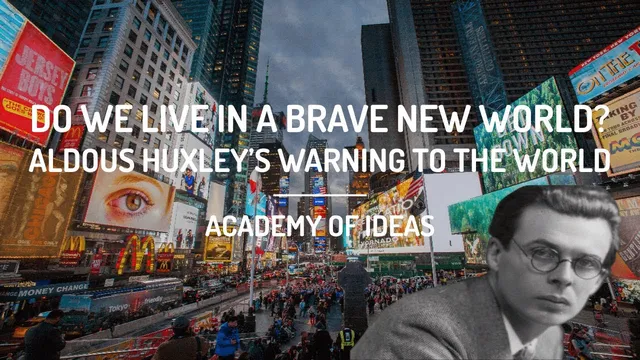
Do We Live in a Brave New World? - Aldous Huxley's Warning to the World
Based on Academy of Ideas's video on YouTube. If you like this content, support the original creators by watching, liking and subscribing to their content.
Huxley’s warning centers on engineered consent: citizens may accept domination because pleasure and conditioning make servitude feel preferable to freedom.
Briefing
Aldous Huxley’s central warning is that modern societies may lose freedom not through overt violence, but through engineered compliance—using psychology, technology, and carefully managed pleasure to make servitude feel desirable. In Brave New World Revisited, Huxley argues that the “ultimate revolution” is already underway: techniques are being developed to help a controlling oligarchy get people to “love their servitude,” leaving citizens unlikely to question or resist.
The transcript traces how that dystopian mechanism could be moving from fiction toward reality. It points to mid-20th-century research and commentary suggesting governments could gain deeper control over individual mentality as physiology and psychology advanced. Bertrand Russell is cited predicting that advances in those fields would give governments more control over “individual mentality” than even totalitarian regimes had. Carl Rogers is used to frame behavioral science as an “if-then” discipline: if societies are built with carefully constructed conditions, most people will respond in predictable, controllable ways—often without realizing they are being steered. The transcript then adds a contemporary twist by referencing a 2021 UK report tied to SAGE, where scientists described using “totalitarian” mind-control tactics for mass compliance and admitted that psychology can be “mind control,” even if framed as “positive.”
Beyond conditioning, the transcript emphasizes distraction and suggestibility as tools of governance. In Brave New World, citizens are kept docile through “non-stop distractions” and propaganda that drown out rational information needed for liberty. The transcript argues that today’s entertainment ecosystems—television and, by extension, smartphones and computers—can produce a hypnotic-like mental state. It cites claims that television shifts brain activity toward alpha waves associated with daydreaming and reduced critical thinking, making people more receptive to slogans, commercials, and ideological messaging.
Huxley’s other key technology is hypnopaedia, or “sleep-teaching,” where repeated suggestions are delivered while people sleep, using principles from hypnosis. The transcript connects this to the broader idea of repeated exposure: whether through nightly conditioning in fiction or through constant media consumption in reality, repeated cues can install “new patterns of feeling” and embed trigger words.
The compliance system is reinforced chemically in Brave New World through Soma, described as bliss-inducing and capable of heightening suggestibility so propaganda lands more effectively. The transcript contrasts that fictional drug with today’s widespread use of alcohol, marijuana, psychotropics, opioids, and sleeping pills, arguing that escaping reality undermines political vigilance and voluntary control—citing Joost Meerloo’s warning that addiction prepares the mental submission totalitarian systems rely on.
Finally, the transcript raises the prospect of a modern “scientific caste system.” Huxley’s novel uses prenatal genetic engineering to create fixed castes; the transcript suggests that while that exact setup may not be imminent, postnatal genetic engineering and brain/body augmentation could enable a two-tiered society—one group welcoming technological enhancement and another resisting it—raising questions about surveillance, restrictions, and incentives.
The closing note is not certainty but duty: even if a Brave New World order might collapse under its own weight, Huxley’s final counsel remains that resisting threats to freedom is still necessary.
Cornell Notes
Huxley’s warning centers on a “final revolution” in which people lose liberty without rebellion because they are conditioned to enjoy their servitude. The transcript links that idea to behavioral science’s “if-then” logic, where engineered social conditions can produce predictable compliance. It also argues that modern media and technology can reduce critical thinking through hypnotic-like states, making propaganda and slogans more effective. Chemical escape from reality—analogous to Soma—further weakens political vigilance. The same logic could extend to a future caste system if genetic engineering and human augmentation create a split between those who embrace technology and those who resist it.
How does Huxley’s “ultimate revolution” differ from classic tyranny?
What does Carl Rogers’ “if-then” framing add to the idea of social control?
Why does the transcript connect television and screen media to hypnosis-like influence?
What role does Soma play in Brave New World, and what modern parallel is suggested?
How could a “scientific caste system” emerge outside Huxley’s exact setup?
What is the transcript’s bottom-line stance on whether resistance is possible?
Review Questions
- Which tools of compliance—psychological conditioning, distraction, chemical escape, and technological augmentation—are presented as most effective, and why?
- What does the transcript claim about media-induced brain states (alpha waves) and how that relates to susceptibility to propaganda?
- How does the idea of a future caste system change when moving from prenatal genetic engineering to postnatal augmentation?
Key Points
- 1
Huxley’s warning centers on engineered consent: citizens may accept domination because pleasure and conditioning make servitude feel preferable to freedom.
- 2
Behavioral science is framed as an “if-then” capability, where engineered social conditions can yield predictable, controllable responses at scale.
- 3
Non-stop entertainment is treated as political infrastructure, drowning out rational information needed for liberty and encouraging docility.
- 4
Media consumption is linked to hypnotic-like suggestibility through claims about alpha-wave brain activity and reduced critical thinking.
- 5
Chemical “escape from reality” is presented as a compliance amplifier, with modern drug use compared to Soma’s function in Brave New World.
- 6
Human augmentation and genetic engineering are raised as potential pathways to a two-tier society resembling a scientific caste system.
- 7
Even if a totalizing order might collapse, the transcript concludes that resisting threats to freedom remains a duty.