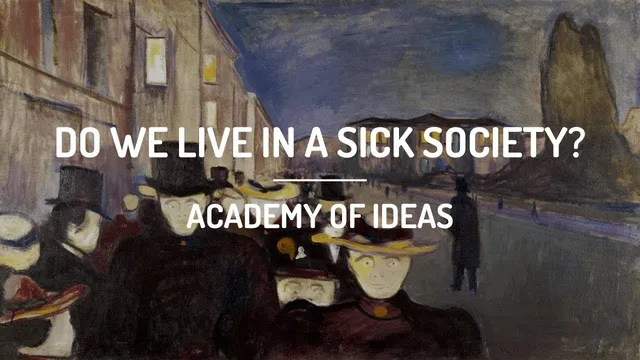
Do We Live in a Sick Society?
Based on Academy of Ideas's video on YouTube. If you like this content, support the original creators by watching, liking and subscribing to their content.
Conformity is portrayed as evolutionarily and psychologically reinforced, but its value depends on whether the surrounding society is healthy.
Briefing
Normality—defined as conformity to a society’s dominant norms—can become a sickness when a culture itself is corrupted. The core claim is that “psychological normality” is often treated as a synonym for mental health, but that assumption breaks down in unstable, declining societies where adapting to warped standards produces rigidity, anxiety, and even institutionalized deviation from human flourishing.
The argument starts with why conformity is so powerful. Across time and place, what counts as “normal” varies by culture, yet the underlying mechanism is consistent: people tend to accept the status quo, follow majority-approved traits, and avoid social rejection. That pull toward conformity is framed as both evolutionary—conformity helped groups survive and cooperate—and psychological—life is complex, so individuals default to the path of least resistance rather than invent new responses. In stable conditions, some conformity is functional: it supports cohesion and allows societies to develop complexity.
The trouble comes when conformity is overvalued and the surrounding environment becomes unhealthy. The transcript contrasts Benjamin Rush’s view that sanity is regular habits and social “normality,” with later psychological definitions that equate mental health to socially approved functioning. In a flourishing society, those norms might align with well-being. In a sick society, however, normality can arrest development: it distorts judgment, delays growth, and trains people to mirror social chaos inside their own minds. The result is a reversal—sanity becomes departure from normality, while normality edges toward insanity.
That dynamic is linked to identity and meaning during social upheaval. When familiar orders collapse, people lose continuity in self-worth, community membership, and personal identity, creating a sense-making crisis. In such moments, widespread groupthink and panic can spread—especially through social media—because insecurity pushes people toward mass clustering for “gregarious security.” The transcript points to contemporary symptoms often associated with collective dysfunction: high rates of anxiety disorders, depression, suicide, and widespread abuse of drugs and alcohol.
A further test of Western “normality” is whether the typical person looks like a strong individual capable of meeting life’s challenges, or instead appears “hunted,” sheep-like, and easily induced into fear. The transcript argues that the most dangerous mental illness may be found among those who seem most normal—because their perfect adjustment to an abnormal society becomes evidence of sickness.
Finally, the discussion identifies a deeper cultural failure: Western conceptions of normality allegedly neglect fundamental human drives, especially Nietzsche’s “will to power.” Powerlessness, it claims, fosters envy, victimhood, apathy, and mental illness at the individual level, and enables tyranny at the societal level. The promised next step is an exploration of the psychology of power, tying human flourishing to healthier outlets for agency rather than mere compliance with corrupted norms.
Cornell Notes
The transcript argues that “normality” is often treated as mental health, but conformity can become harmful when a society is corrupted or unstable. Conformity is attractive because it supports survival, social cohesion, and reduces the effort of improvising in complex life. Yet when norms are distorted, adapting to them can produce psychological rigidity, identity crises, and collective panic—symptoms reflected in anxiety, depression, suicide, and substance abuse. In that setting, sanity may mean deviating from what society calls normal. A key proposed cause is that Western normality fails to provide adequate outlets for fundamental drives, especially the will to power, which links personal agency to both individual well-being and resistance to tyranny.
Why does conformity feel so compelling, even when it may be unhealthy?
What’s the central reversal claim about sanity and normality?
How does social instability turn conformity into a psychological problem?
What evidence is used to argue that “normality” doesn’t equal mental health?
Why does the transcript claim Western normality fails at a deeper level?
What is the promised next topic, and how does it connect to the will-to-power claim?
Review Questions
- How does the transcript distinguish between functional conformity in stable conditions and harmful conformity in corrupted or unstable societies?
- What mechanisms link social upheaval to identity crisis and group panic in the transcript’s account?
- According to the transcript, why does the will to power matter for mental health and social order, and what happens when it is suppressed?
Key Points
- 1
Conformity is portrayed as evolutionarily and psychologically reinforced, but its value depends on whether the surrounding society is healthy.
- 2
Treating socially approved “normality” as mental health can fail when cultural norms become corrupted and development is arrested.
- 3
In social instability, people may lose identity continuity, making them vulnerable to groupthink, panic, and mass insecurity.
- 4
The transcript links collective dysfunction to observable outcomes such as anxiety, depression, suicide, and substance abuse.
- 5
A key critique is that Western normality allegedly neglects fundamental human drives, especially the will to power.
- 6
Powerlessness is framed as psychologically corrosive for individuals and politically enabling for tyranny.
- 7
Sanity is presented as potentially requiring deviation from what society calls normal when norms no longer serve human flourishing.