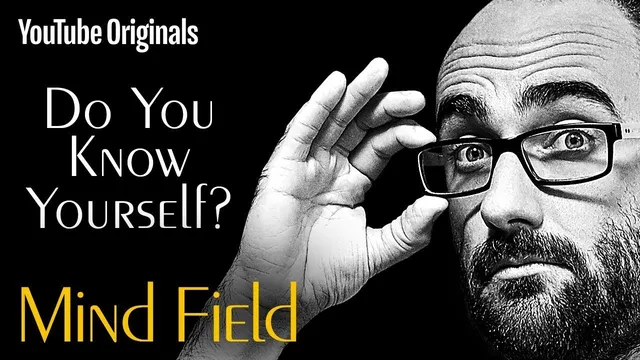
Do You Know Yourself? - Mind Field (Ep 8)
Based on Vsauce's video on YouTube. If you like this content, support the original creators by watching, liking and subscribing to their content.
Memory is reconstructive: people can adopt fabricated details and later experience them as genuine recollections.
Briefing
People don’t just forget their past—they can confidently rebuild it. A set of experiments staged “Who You Were,” planting a childhood hot-air-balloon story that never happened and then watching how details either fail to take hold or grow into vivid, personalized memories. The takeaway is unsettling: memory isn’t a playback system; it’s a reconstruction process that can be nudged by suggestion, context, and even sensory cues.
The episode begins with a familiar question—who are you?—and quickly pivots to how unreliable self-knowledge can be. Mirror images and selfie cameras are used to show that even something as basic as appearance is filtered through reversal and preference. From there, the focus shifts to memory as the “common thread” that seems to remain. But the show argues that the thread can be rewoven. False memories are “frighteningly easy” to create, especially when the brain is given plausible seeds and realistic scaffolding.
In the “Who You Were” game, contestants are interviewed about early life events drawn from parents and then confronted with a fabricated memory: around age four or five, they supposedly rode in a hot-air balloon and dropped something. One participant, Timothy DeLaGhetto, reacts with skepticism and ultimately shows little susceptibility—after a day-long delay and a trip to Echo Park (the supposed location), he still cannot recall the balloon ride. Another participant, Dylan, doesn’t remember the event either at first, but later begins to generate a detail (“possibly dropped a Superman cape”), suggesting the planted idea is gradually being adopted as personal history.
Victoria’s case shows the most dramatic transformation. With added prompts and sensory imagination—smells, height, wind, mist—her false memory expands into a full childhood episode: the red balloon, the view over water, the dropped item, and even a post-ride treat. She merges the suggestion with her own pleasant childhood associations, turning a single planted claim into a coherent narrative.
The episode then broadens from autobiographical memory to decision-making and self-justification. In a workplace “first impressions” task, a magician swaps faces after participants choose which person they’d prefer to work with. Many participants later provide confident reasons for choices they never actually made—an effect labeled “choice blindness.” Even when the underlying selection is changed without awareness, people defend the altered outcome with explanations that feel authentic.
Finally, the episode confronts what happens when memory fails at a biological level. Scott, who has retrograde amnesia after a head injury, describes losing autobiographical and historical memories while retaining procedural skills like riding a bike. He experiences identity as something he must accept and rebuild from others’ accounts, raising the question of whether selfhood is anchored in memory at all.
The episode closes by tying these findings to real-world consequences: faulty eyewitness memory is cited as a major contributor to wrongful convictions overturned by DNA evidence. In the end, the question “who are you?” lands less on a stable identity and more on the stories the mind constructs—sometimes from truth, sometimes from suggestion, and sometimes from both at once.
Cornell Notes
The episode argues that memory and self-knowledge are reconstructive, not exact recordings. In “Who You Were,” participants are given a plausible childhood story (a hot-air-balloon ride with a dropped item) that never happened; some remain skeptical, while others gradually adopt the suggestion as real. Victoria’s false memory grows into a detailed, personalized childhood episode by blending prompts with sensory imagination and existing life associations. A separate workplace study shows “choice blindness,” where people justify decisions they didn’t actually make after faces are swapped without their awareness. Together, the experiments suggest identity can shift when the brain fills gaps—sometimes confidently—using incomplete or misleading cues.
Why do mirror images and selfies matter to the episode’s argument about self-knowledge?
How does the “Who You Were” experiment create false memories?
What happened with Timothy DeLaGhetto compared with Dylan and Victoria?
What is “choice blindness,” and how is it demonstrated?
How does retrograde amnesia complicate the question “who are you?”
What real-world risk does the episode connect to these memory effects?
Review Questions
- How do sensory prompts and realistic context influence whether a planted false memory becomes a detailed personal narrative?
- In what ways does “choice blindness” show that confidence in an explanation doesn’t guarantee the decision was actually made?
- What distinguishes autobiographical memory from procedural memory in retrograde amnesia, and how does that distinction affect identity?
Key Points
- 1
Memory is reconstructive: people can adopt fabricated details and later experience them as genuine recollections.
- 2
Mirror and selfie distortions demonstrate that even appearance-based self-knowledge can be filtered by perception habits.
- 3
Planting a plausible childhood event can lead to anything from skepticism to fully formed, personalized false memories.
- 4
Sensory imagination (smells, wind, mist) can accelerate the brain’s acceptance of suggested events.
- 5
Choice blindness shows that people often justify outcomes they didn’t actually choose, even when the swap happens during the task.
- 6
Retrograde amnesia can erase autobiographical history while leaving skills intact, forcing identity to be rebuilt from external accounts.
- 7
Faulty eyewitness memory has measurable legal consequences, including convictions overturned by DNA evidence.