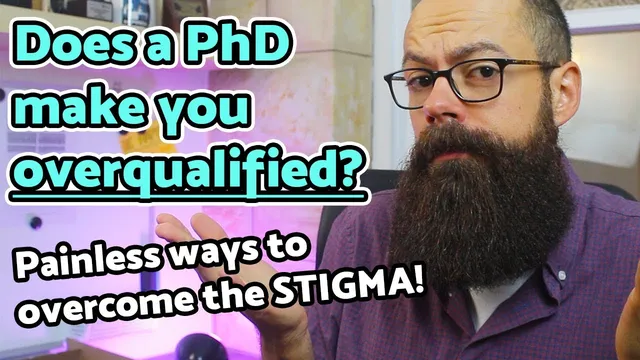
Does a PhD make you overqualified? How to overcome the stigma!
Based on Andy Stapleton's video on YouTube. If you like this content, support the original creators by watching, liking and subscribing to their content.
A PhD can look like “overqualification” to non-academic employers because academic signals don’t automatically translate into workplace competencies.
Briefing
A PhD can make job candidates look “overqualified” to employers outside academia—not because the skills are lacking, but because the signals don’t translate. Hiring managers often assume a highly specialized researcher won’t adapt to their project, won’t be interested in the role, or will keep chasing something more academic. The practical fix is to repackage PhD achievements into the kinds of evidence employers actually recognize: communication, problem-solving, and job-relevant execution.
The stigma starts with misunderstanding. People unfamiliar with academia may view PhD holders as “nerds” who can produce results in theory but struggle to deliver in real-world settings. Overqualification, in that context, usually means employers fear the candidate is too narrow, too focused on the next publication, or too likely to leave once a more prestigious opportunity appears. The core challenge isn’t the PhD itself; it’s that outside academia, papers, grant metrics, and the number of publications often mean little. Even conference participation can be misread or undervalued because the outside world doesn’t automatically connect it to skills like public speaking, persuasive presentation, and the ability to condense complex technical information.
To overcome that perception, the most important step is customizing the CV so it doesn’t resemble an academic CV. Instead of leading with “12 papers” or “14 papers,” candidates should translate outputs into workplace competencies. Publishing becomes evidence of technical writing and communicating research clearly. Conference experience becomes evidence of presentation skills, PowerPoint and Microsoft Office proficiency, and the ability to persuade an audience. The same principle applies across the application: list achievements in a way that makes the underlying capabilities obvious to a non-academic reader.
A second lever is building skills alongside the PhD that can be demonstrated outside academia. The transcript highlights communication as an example: writing a blog that led to outlets like ScienceAlert and Cosmos Magazine, plus column work for Australian Quarterly. The point isn’t just to “do extra work,” but to create a portfolio of evidence—tangible proof of skills—that can be handed to employers. Learning platforms such as Udemy are presented as a practical route to acquire additional capabilities like coding, animation, and copywriting. Even when courses don’t produce formal certificates, they still help candidates show what they can do.
Finally, the advice pushes candidates to start with the end in mind. A PhD can close doors due to perception, but it can also open them when the employer values the credential—such as roles in R&D where most team members hold PhDs. The broader takeaway is strategic: don’t pursue a PhD by default or “path of least resistance.” If the goal is industry or a specific career, candidates should ensure they have the specialized skills and explicit evidence employers need, whether those skills come from a PhD or from structured learning and real-world projects.
Cornell Notes
A PhD can trigger “overqualified” bias in non-academic hiring because employers often don’t value academic signals like publication counts or grant activity. The remedy is translation: customize the CV so achievements map to workplace skills such as technical writing, communication, presentation, problem-solving, and adaptability. Candidates should also build additional, job-relevant skills during the PhD and collect proof—through portfolios like science communication writing, blogs, and course-based learning (e.g., Udemy). Starting with the end goal matters: a PhD may be unnecessary if the same specialized skills and evidence can be built elsewhere, and it can help most when employers already understand what PhD training delivers.
Why do employers outside academia label PhD holders as “overqualified” even when the candidate is competent?
How should a PhD candidate change their CV to reduce overqualification concerns?
What does “build skills alongside your PhD” look like in practice?
How can short courses contribute to employability without relying on certificates?
When might a PhD actually make hiring easier rather than harder?
Review Questions
- What specific parts of an academic CV tend to lose meaning for non-academic employers, and what workplace skills should replace them?
- Give two examples of how PhD-related activities (like publishing or conferences) can be reframed as job-relevant competencies.
- Why does “start with the end in mind” change whether a PhD is the best path to a target career?
Key Points
- 1
A PhD can look like “overqualification” to non-academic employers because academic signals don’t automatically translate into workplace competencies.
- 2
Overqualification bias often reflects fear of mismatch—too specialized, too academic in mindset, or too likely to leave—rather than a lack of ability.
- 3
Customize the CV so it reads like a real-world document, translating publications and conference work into communication, writing, presentation, and problem-solving skills.
- 4
Build additional, demonstrable skills during the PhD (e.g., science communication work) to create a portfolio of evidence beyond the thesis.
- 5
Use learning resources like Udemy to acquire practical capabilities (coding, animation, copywriting) and show what those skills enable you to do.
- 6
Consider whether a PhD is necessary for the career goal; specialized skills and evidence can sometimes be built outside academia.
- 7
A PhD can open doors when the employer already values the credential and the role aligns tightly with the candidate’s expertise.