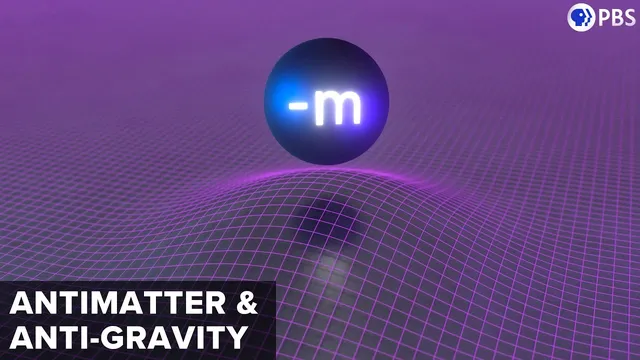
Does Antimatter Create Anti-Gravity?
Based on PBS Space Time's video on YouTube. If you like this content, support the original creators by watching, liking and subscribing to their content.
Antimatter anti-gravity would require a sign change in gravitational response—often framed as negative gravitational mass while keeping inertial mass positive.
Briefing
Antimatter does not appear to fall upward. Results from CERN’s ALPHA-g experiment—dropping magnetically trapped anti-hydrogen in a vacuum chamber—show the atoms accelerating downward, consistent with ordinary gravity rather than “anti-gravity.” That finding matters because it directly tests whether antimatter’s gravitational behavior differs from matter’s, a question tied to the deepest symmetry principles in physics.
The underlying physics starts with a distinction that is usually blurred: inertial mass (how strongly something resists acceleration) versus gravitational mass (how strongly it responds to gravity). In Newtonian gravity, if inertial and gravitational mass are equal, they cancel in the acceleration calculation, which is why objects fall at the same rate regardless of mass. Gravity is normally attractive because gravitational “charge” (mass) is positive. If gravitational mass could be negative while inertial mass stays positive, then a positive-and-negative pair would repel gravitationally—leading to the headline idea that “negative mass” would fall upward.
General relativity complicates the picture but keeps the same theme: gravity comes from spacetime curvature, and the motion of particles follows geodesics that depend on the gravitational field’s structure. In the GR framework, changing the sign of gravitational mass flips how the gravitational field interacts with the moving object, producing repulsion in the “negative gravitational mass” scenario. The question then becomes whether antimatter could effectively behave like negative gravitational mass.
Antimatter is not made of negative mass in any straightforward way; it has the same mass as its matter counterpart but differs in quantum properties. Still, some theoretical arguments connect antimatter to negative gravitational mass through symmetry reasoning. Physics often assumes CPT symmetry—charge conjugation (C), parity inversion (P), and time reversal (T)—should hold for the laws of nature. Under CPT, the equations governing motion can remain consistent, which would imply antimatter and matter gravitate the same way. But if CPT symmetry is applied only to part of the system—turning one object into antimatter while leaving the other unchanged—some analyses predict sign changes in the geodesic equation that are mathematically equivalent to making one gravitational mass negative. That interpretation is contested, yet it motivates the experimental test: does antimatter fall up or down?
CERN’s experiment tackles the practical obstacles. Antimatter annihilates upon contact with normal matter, so researchers can only work with small numbers of anti-hydrogen atoms. Gravity is also extremely weak at the scale of single particles, making the signal hard to separate from electromagnetic noise and other perturbations. ALPHA produces and magnetically traps hundreds of stable anti-hydrogen atoms (a positron bound to an anti-proton). ALPHA-g then releases them into free fall inside a vacuum chamber and measures how many reach the top versus bottom over time, comparing the results to ordinary hydrogen.
The first ALPHA-g runs indicate downward acceleration—“almost certainly not falling up.” There is tentative evidence that anti-hydrogen might fall slightly slower than hydrogen, with a reported gravitational acceleration around 0.75 ± 0.13 times that of regular matter. But the result is below the threshold for a definitive discovery (less than 3 sigma), so it could be statistical noise. The immediate takeaway is sobering for anti-gravity dreams, but the longer-term payoff is clear: improving the measurement will either strengthen the case that CPT symmetry holds in gravity or reveal a genuine matter–antimatter difference that could reshape fundamental physics.
Cornell Notes
CERN’s ALPHA-g experiment tests whether antimatter experiences “repulsive” gravity by measuring how anti-hydrogen falls in Earth’s gravitational field. The experiment releases magnetically trapped anti-hydrogen atoms into a vacuum chamber and tracks how many reach the top versus bottom, extracting the relative gravitational acceleration compared with hydrogen. The early results show downward acceleration, making an upward-falling (anti-gravity) outcome unlikely. A preliminary hint suggests anti-hydrogen could fall slightly slower (about 0.75 ± 0.13 times the acceleration of hydrogen), but the significance is not strong enough to claim a real difference. Future runs aim to tighten the statistics and either confirm equal gravitational behavior or uncover a CPT-violating discrepancy.
Why does the idea of “anti-gravity” depend on separating inertial mass from gravitational mass?
How does general relativity change the story compared with Newton’s equations?
What role does CPT symmetry play in expectations for antimatter’s gravitational behavior?
Why is measuring gravity on antimatter so difficult in practice?
How does ALPHA-g infer the gravitational acceleration of anti-hydrogen?
What do the current results imply about antimatter and CPT symmetry?
Review Questions
- What are inertial mass and gravitational mass, and how does their equality lead to the same acceleration for different objects in Newtonian gravity?
- Describe the experimental chain from ALPHA’s anti-hydrogen production to ALPHA-g’s free-fall measurement, and explain what is actually counted in the chamber.
- Why would a confirmed difference in gravitational acceleration between antimatter and matter be interpreted as evidence for CPT symmetry breaking?
Key Points
- 1
Antimatter anti-gravity would require a sign change in gravitational response—often framed as negative gravitational mass while keeping inertial mass positive.
- 2
In Newtonian gravity, inertial and gravitational mass cancel in the acceleration calculation when they are equal, explaining why objects fall at the same rate.
- 3
General relativity models gravity via spacetime curvature; allowing negative gravitational mass flips interaction signs and can produce gravitational repulsion.
- 4
CPT symmetry is a central theoretical constraint; if it holds in gravity, antimatter should fall like matter, but some interpretations suggest CPT-violating sign changes could mimic negative gravitational mass.
- 5
CERN’s ALPHA-g experiment measures anti-hydrogen’s free-fall by tracking how many atoms reach the top versus bottom of a vacuum chamber over time.
- 6
Early ALPHA-g results show anti-hydrogen accelerating downward, making upward-falling antimatter unlikely.
- 7
A preliminary hint of weaker gravity for anti-hydrogen (about 0.75 ± 0.13 of hydrogen’s acceleration) is not yet statistically decisive; more data is needed to confirm or refute it.