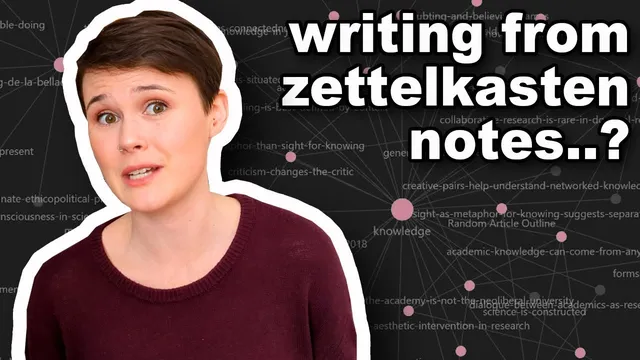
does my zettelkasten make writing... harder?
Based on morganeua's video on YouTube. If you like this content, support the original creators by watching, liking and subscribing to their content.
A slip-box system can strengthen idea synthesis, but it can make linear academic drafting feel harder because notes are non-hierarchical and self-contained.
Briefing
A knowledge-management system built for non-linear thinking can make writing feel harder—not because it fails to generate ideas, but because it clashes with the linear, tone-specific, sentence-level demands of academic prose. The core tension comes from using Obsidian with a Zettelkasten-style “slip box” (titled “tuttlecasten” in the transcript) where each note is an atomic, self-contained thought connected by identifiers. That structure is excellent for synthesizing across interviews, books, and personal experience—especially for a PhD researcher trying to build an original contribution by connecting ideas across fields. But when the time arrives to turn those interconnected notes into a dissertation or academic article, the system’s non-hierarchical layout stops mapping cleanly onto the hierarchical order required for a conventional argument.
The transcript lays out three specific friction points. First is voice and style: notes are written in different tones depending on the eventual paper, and the writer can’t simply copy and paste note text into a formal draft without risking awkward phrasing or “plagiarizing” themselves by reusing earlier wording. Worse, once something has been written in one form, switching to a new tone or emphasis becomes difficult—so even AI assistance (including ChatGPT) doesn’t feel like a reliable shortcut.
Second is writing as discovery. Even with an outline assembled from linked notes, drafting can reveal new claims midstream. That creates a workflow dilemma: pause to capture new insights back into the slip box and update the outline, or keep drafting and risk losing the new material—or derailing the outline entirely. The writer identifies as a “discovery writer,” describing how the act of writing can generate knowledge rather than merely transmit it.
Third is linearity itself. In the slip-box model, there’s no single “correct” order for thoughts; notes are complete on their own, and the graph of connections makes it feel like everything is happening at once. That non-linear mental habit conflicts with the school-taught expectation of point-by-point argumentation. The writer admits they still prefer linear reading and linear writing—being carried through a text by an author—so the system’s node-and-link worldview becomes frustrating when deciding what should come first in an essay.
Rather than offering a full solution, the transcript proposes practical workarounds. One approach is to convert the non-linear note network into a hierarchical outline: start with a loose outline, drag in the linked notes as “topic-sentence” nodes (often named after each note’s core thesis), then paste the note content into a “zero draft.” From there, the writer adds transitions, an introduction, and rewrites for voice. When ordering feels impossible, the writer recommends making a decision anyway, then adjusting later during drafting. For tone problems, they describe finishing the rough pasted draft and then rewriting from a blank page so the voice can emerge naturally.
Finally, the transcript introduces a strategy for handling new ideas: distinguish between indirectional notes (captured for storage) and directional notes (made for a specific project). By periodically checking an “outlines/themes” folder and inserting indirectional notes into any outline where they fit, future drafts can gradually assemble themselves over time—turning the slip box back into a writing engine without forcing linearity too early.
Cornell Notes
The slip-box system in Obsidian is highly effective for capturing and connecting knowledge, but it can complicate the transition to linear academic writing. The transcript identifies three main obstacles: (1) notes and papers require different tone/voice, making copy-paste drafting awkward; (2) writing is a discovery process, so new ideas appear during drafting and disrupt outlines; and (3) non-hierarchical note networks don’t naturally suggest the order required for conventional arguments. The proposed workflow is to convert linked notes into a hierarchical outline, paste note content into a rough “zero draft,” then rewrite for transitions and voice. A longer-term tactic is to classify notes as indirectional vs directional and let indirectional notes “fill” project outlines over time.
Why does a Zettelkasten-style slip box feel great for research but frustrating for dissertation writing?
How do tone and voice differences between notes and papers create a drafting problem?
What does “writing as discovery” change about the outline workflow?
What is the linearity conflict, and why does it matter even for someone who likes linear writing?
What workflow turns non-linear notes into a linear draft?
How do indirectional and directional notes help future writing projects?
Review Questions
- What specific aspects of academic writing (tone, discovery drafting, linear argument structure) conflict with a non-hierarchical slip-box note model?
- Describe the step-by-step process proposed for converting linked notes into a linear “zero draft” and then into a publishable draft.
- How would you apply the indirectional vs directional note distinction to a new writing project you’re planning?
Key Points
- 1
A slip-box system can strengthen idea synthesis, but it can make linear academic drafting feel harder because notes are non-hierarchical and self-contained.
- 2
Tone and voice mismatch between research notes and final academic prose can make copy-paste drafting ineffective and force full rewrites.
- 3
When writing functions as discovery, outlines built from existing notes may need to be revised because new claims emerge during drafting.
- 4
Non-linear note graphs don’t automatically provide an argument order; deciding an order early—even imperfectly—can unblock drafting.
- 5
A practical workaround is to build a hierarchical outline from note links, paste note content into a rough zero draft, then add transitions, introductions, and voice through rewriting.
- 6
Finishing a rough draft and then rewriting from a blank page can help restore the intended writing voice when notes were written in different tones.
- 7
Treating notes as indirectional vs directional can let future project outlines grow over time by automatically placing stored notes into relevant themes/outlines.