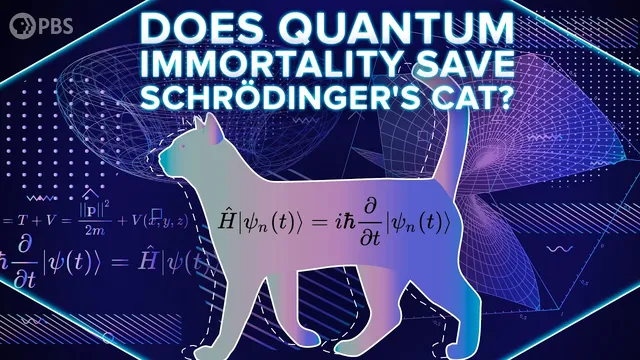
Does Quantum Immortality Save Schrödinger's Cat?
Based on PBS Space Time's video on YouTube. If you like this content, support the original creators by watching, liking and subscribing to their content.
Decoherence explains why different wavefunction branches stop interfering, but it does not by itself explain why only one macroscopic outcome is observed.
Briefing
Quantum decoherence alone doesn’t settle why measurements yield one definite outcome. Decoherence mainly prevents different “branches” of the wavefunction—often described as alternate histories—from interfering with each other. To say what happens to those branches after measurement, the discussion has to lean on an interpretation of quantum mechanics, such as Copenhagen (other branches effectively disappear at measurement) or Many Worlds (all branches persist, with observers ending up in one branch). That interpretive gap is where a thought experiment called “quantum immortality” enters.
“Quantum immortality” adapts Schrödinger’s cat into a survival test. In the classic setup, a radioactive atom has a 50–50 chance to decay within a time window, which splits the atom’s wavefunction into decayed and not-decayed states; the cat’s fate becomes correspondingly dead or alive. Under Copenhagen, opening the box selects a single realized outcome and the other branch vanishes. Under Many Worlds, both outcomes continue, and the physicist’s own wavefunction splits too—so there should always be a branch where the physicist survives.
The proposed experiment makes survival probabilities brutally lopsided. Instead of one atom triggering poison release, the poison is linked to 100 polonium-212 atoms, each with a half-life of 300 microseconds. If any atom decays, the poison is released; the experiment ends after 300 microseconds when the connection is cut. The chance that none of the 100 atoms decay is (0.5)^100, essentially zero. Repeating the experiment would make survival overwhelmingly unlikely in any interpretation that produces a single outcome per quantum event. But Many Worlds predicts that even if survival is astronomically rare, there will still be at least one branch where the physicist crawls out—because all branches persist.
That “test” is more philosophical than practical: it requires that the surviving branch be inaccessible to everyone else, meaning other observers would likely conclude the apparatus failed. Still, it reframes the measurement problem as a question about which interpretation can accommodate a guaranteed survival branch.
The transcript then adds two caveats. First, death is not a single quantum event but an incremental process; the closer someone is to death, the fewer Many Worlds branches include their continued survival. Second, even if rare branches extend life, the observer’s consciousness would have to experience the bad future timelines along the way—so the moral advice remains conventional: quit smoking and take care of health.
After that, the discussion pivots to a separate “Doomsday Challenge” probability puzzle. Assuming a person is the 100 billionth human born and that population doubles every 100 years, the calculation places the person among the earliest ~0.6% of all humans who will ever exist if humanity lasts to the year 3000. Integrating exponential birth rates over roughly 1000 years yields an estimate of about 17–18 trillion people having lived by then, leading to a survival probability under 1%—and even more elaborate Bayesian or “observer-year” approaches keep the chance at about a percent or lower. The segment closes by addressing audience questions on decoherence, quantum erasers, and double-slit experiments, emphasizing that erasers can reverse decoherence only when full environmental decoherence hasn’t occurred.
Cornell Notes
Decoherence explains why quantum branches stop interfering, but it doesn’t by itself explain why a single outcome is observed. To fill that gap, the argument turns to interpretations like Copenhagen (non-observed branches vanish at measurement) versus Many Worlds (all branches persist). “Quantum immortality” applies this to a modified Schrödinger’s cat: link poison release to 100 polonium-212 atoms (half-life 300 microseconds). Survival in a single-outcome interpretation is effectively impossible because the probability that none decay is (0.5)^100, yet Many Worlds predicts at least one surviving branch. The practical limitation is that only the surviving physicist would know, while everyone else would likely assume the experiment failed. The segment also revisits a Doomsday Challenge, estimating a sub-1% chance of reaching the year 3000 under typical assumptions.
Why doesn’t decoherence by itself solve the measurement problem?
How does the “quantum immortality” thought experiment modify Schrödinger’s cat?
Why is survival probability effectively zero in single-outcome interpretations?
What does Many Worlds predict that changes the conclusion?
What does the Doomsday Challenge calculation conclude about reaching the year 3000?
Review Questions
- In what specific way does decoherence fail to determine which measurement outcome an observer experiences?
- Compute the probability that none of 100 independent atoms decay if each has a 50% chance to decay within the relevant time window.
- Why does the Doomsday Argument’s probability depend on the assumed distribution of who counts as a “typical” observer?
Key Points
- 1
Decoherence explains why different wavefunction branches stop interfering, but it does not by itself explain why only one macroscopic outcome is observed.
- 2
Copenhagen and Many Worlds differ on what happens to unobserved branches at measurement: disappearance versus persistence.
- 3
“Quantum immortality” uses a many-atom Schrödinger’s cat variant to make survival astronomically unlikely under single-outcome interpretations.
- 4
With 100 polonium-212 atoms (half-life 300 microseconds), the chance that none decay is (0.5)^100, effectively zero for repeated trials.
- 5
Many Worlds predicts at least one surviving branch even when survival is extraordinarily rare, but other observers would not be able to verify it.
- 6
The Doomsday Challenge estimates a sub-1% chance of reaching the year 3000 under assumptions like population doubling every 100 years and typicality of the observer’s birth rank.
- 7
Even if rare branches extend life, death is treated as incremental, so survival beyond a point becomes less likely as one approaches death.