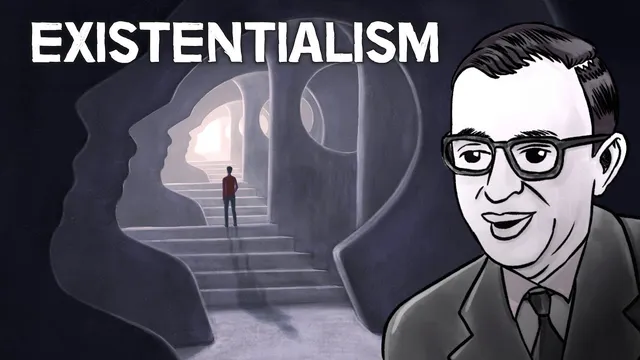
Don’t Let Others Define You | Sartre’s Existentialism
Based on Einzelgänger's video on YouTube. If you like this content, support the original creators by watching, liking and subscribing to their content.
Sartre’s central claim is that humans have no predefined essence; identity is created through action, summarized as “existence precedes essence.”
Briefing
Existence precedes essence: humans arrive in the world without a predefined purpose, and identity is built through choices—so freedom always carries responsibility. Sartre’s existentialism draws a sharp line between objects with fixed functions (like a fork or a train) and people, who are not “designed” for a single role. A fork can’t question why it exists; a train can’t reflect on its purpose. Humans, by contrast, are “thrown” into life without a God or higher authority handing down meaning or instructions, leaving the universe silent on the question of why anyone is here.
Sartre grounds this in a theory of consciousness. Consciousness is always directed toward something—an object, another person, or even an imagined scenario—so it doesn’t sit as a self-contained thing. It also becomes aware of itself, echoing Descartes’ certainty of consciousness (“Cogito ergo sum”). But Sartre rejects the idea of a stable inner self (a “transcendental ego”). Instead, consciousness is “nothingness”: it has no fixed content and molds itself by reaching outward. That emptiness matters because it makes self-creation possible. With no predetermined essence, life becomes an “empty canvas”—no final rules, no universally right path, and no absolute moral blueprint. Ethics and morals are human-made, shaped by what people choose to do with their freedom.
Sartre distinguishes two modes of being. “Being-in-itself” describes things whose essence is fixed and unreflective—forks and trains simply are what they are. “Being-for-itself” describes humans as constantly becoming, defining themselves through action and self-reflection. Even so, humans aren’t blank slates: “facticity” includes uncontrollable facts like biology, skin color, country of birth, and family circumstances. Those facts don’t determine identity; actions do. The result is radical possibility—small decisions and major life turns alike—yet the same openness raises a practical moral question: if nothing is predetermined, can anyone just do harm and walk away?
Sartre’s answer is no, because freedom is inseparable from responsibility. Without God or an external authority, people are accountable not only for deliberate acts but for the totality of their lives, including what they do—or fail to do—in difficult circumstances. Inaction counts. Sartre also emphasizes responsibility toward others by insisting that other people’s consciousness is unavoidable and formative. Through what he calls “the Look” or “the Gaze,” others judge and shape how individuals see themselves. “Hell is other people” captures the discomfort of being viewed from the outside, not the idea that others are inherently evil.
Choices also matter beyond the individual: people represent what they stand for, setting examples that echo across “mankind as a whole.” Yet many try to escape this burden by denying their freedom through “bad faith”—self-deception that pretends there’s no real alternative. Working a hated job because “you have no choice,” or claiming you only followed orders, are Sartrean examples of bad faith: acknowledging pressure doesn’t erase freedom. Living in bad faith is inauthentic because it blocks the core human capacity to create meaning through one’s own decisions. The takeaway is blunt: don’t let others—social roles, authorities, or excuses—define what a life becomes.
Cornell Notes
Sartre’s existentialism centers on “existence precedes essence”: humans are not born with a fixed purpose or inner essence. People are “thrown” into a world without divine guidance, so identity is made through actions. Sartre links this to consciousness as “nothingness”—a flexible awareness that has no stable content and forms itself by directing outward. Humans do have “facticity” (uncontrollable circumstances like biology and birth), but facticity doesn’t determine who someone becomes; choices do. Because there’s no external authority to blame, freedom brings responsibility for deliberate acts and even inaction, including how one treats others and how one’s example affects humanity.
How does Sartre’s “existence precedes essence” use the fork-and-train analogy to explain human freedom?
What does Sartre mean by consciousness being “nothingness,” and why does that matter for ethics?
What are being-in-itself and being-for-itself, and how do they connect to responsibility?
How does Sartre’s idea of facticity limit freedom without removing it?
Why does Sartre say freedom requires responsibility even when there is no God?
What is “bad faith,” and how do examples like hating a job or “following orders” fit it?
Review Questions
- How does Sartre’s view of consciousness as “nothingness” support the claim that humans can create their own essence?
- What distinguishes facticity from freedom in Sartre’s framework, and why doesn’t facticity determine identity?
- In Sartre’s account, why does inaction count as responsibility, and how does the presence of other people (“the Look”/“the Gaze”) intensify that responsibility?
Key Points
- 1
Sartre’s central claim is that humans have no predefined essence; identity is created through action, summarized as “existence precedes essence.”
- 2
Consciousness, for Sartre, lacks fixed content (“nothingness”) and forms itself by directing outward, making self-creation possible.
- 3
Humans share uncontrollable “facticity” (biology, birth circumstances), but facticity does not determine who someone becomes.
- 4
Freedom is inseparable from responsibility: without God or external authority, people are accountable for deliberate choices and even inaction.
- 5
Sartre treats other people’s consciousness as unavoidable and shaping through judgment and expectations, captured by “the Look” or “the Gaze.”
- 6
Choices also function as examples for humanity, so personal decisions carry broader moral weight.
- 7
“Bad faith” is self-deception that denies freedom—such as claiming there’s no alternative in a hated job or using orders as an excuse for harm.