Einstein's Biggest Blunder, Explained
Based on minutephysics's video on YouTube. If you like this content, support the original creators by watching, liking and subscribing to their content.
General relativity replaces Newton’s gravity by relating mass and energy to spacetime curvature, reproducing Newtonian results in weak fields and explaining Mercury’s orbital anomaly.
Briefing
Einstein’s “biggest blunder” wasn’t a wrong theory of gravity—it was a fix he added to his equations to force the universe to stay static. In 1915, Einstein’s general relativity replaced Newton’s law of gravitation by linking mass and energy to the curvature of spacetime. The compact field-equation line hides a much larger system: ten coupled, second-order partial differential equations that determine how spacetime curvature responds to matter and energy. When those equations are simplified for weak gravity and slow speeds, they reproduce Newton’s predictions and even explain Mercury’s long-standing orbital anomaly.
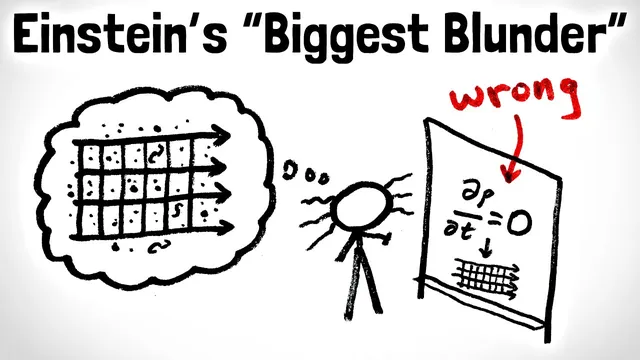
But when Einstein tried to apply the same framework to the universe as a whole, he ran into a problem. Approximating the cosmos as uniform in density and the same in every direction, the simplified equations implied a universe with effectively zero density—an outcome incompatible with the existence of matter. To avoid that, Einstein introduced an extra term, now known as the cosmological constant. Mathematically, it changes the “density equals zero” result into a relationship where the density can be nonzero, provided the new term takes an appropriate value. Crucially, this term also affects the universe’s large-scale dynamics: it can counteract the gravitational tendency of matter to pull everything inward.
There was, however, another valid path through Einstein’s equations—one that didn’t require adding the cosmological constant. Alexander Friedmann found solutions that drop the assumption that the universe is unchanging. With a non-static universe, the equations again reduce to two key relations: one ties the universe’s density to how its size changes over time (expansion lowers density), and the other links the acceleration or deceleration of expansion to the competition between self-gravity and the cosmological constant. Without Einstein’s constant being large enough to dominate, gravity should slow expansion and could even lead to contraction.
At the time, Einstein’s static-universe assumption aligned with prevailing expectations, and a technical mistake in his own calculations contributed to him missing Friedmann’s expanding-universe solutions. Later astronomical measurements settled the issue: the universe is expanding, with distant galaxies receding from us and from each other. Even more, the expansion rate is not merely constant within error bars—it is accelerating. That discovery, made in 1998, revived the importance of Einstein’s constant, but in an ironic twist: it doesn’t stabilize a static cosmos. Instead, it helps explain why expansion speeds up, implying a universe very different from the one Einstein originally tried to engineer.
Einstein’s cosmological constant thus became a symbol of a misstep that was corrected by both theory and observation—first by Friedmann’s overlooked solutions, and later by data showing acceleration. Physicist George Gamow later described it as Einstein’s “biggest blunder,” and Einstein’s own reported reactions—“away with the cosmological term,” “I found it very ugly,” and “unjustified”—capture how strongly he felt the addition lacked motivation. Yet the universe ultimately gave the term a role, even if not the one Einstein intended.
Cornell Notes
General relativity links mass and energy to spacetime curvature, and it reproduces Newtonian gravity in weak-field conditions while explaining Mercury’s orbit. When Einstein applied the equations to a uniform, directionless universe, the simplified math implied zero density, contradicting the existence of matter. To fix that, he added the cosmological constant, which allows nonzero density and can counteract gravity’s tendency to slow or reverse expansion. Alexander Friedmann later found expanding-universe solutions by removing the assumption that the cosmos is static, showing how density and expansion dynamics relate without needing Einstein’s extra term. Observations then confirmed expansion and, in 1998, acceleration—giving the cosmological constant a real physical role, though in a very different cosmological scenario than Einstein envisioned.
Why did Einstein’s original cosmology calculation imply “density equals zero”?
What did the cosmological constant change in Einstein’s equations?
How did Friedmann’s approach differ from Einstein’s?
What do the two key Friedmann relations say about expansion?
How did later observations overturn the static-universe picture?
Why is the cosmological constant described as both a blunder and ultimately important?
Review Questions
- In Einstein’s static, uniform-density model, what mathematical outcome forced the introduction of the cosmological constant?
- What changes in the Friedmann framework when the assumption of a static universe is removed?
- How do observations of accelerating expansion connect back to the cosmological constant’s role in the equations?
Key Points
- 1
General relativity replaces Newton’s gravity by relating mass and energy to spacetime curvature, reproducing Newtonian results in weak fields and explaining Mercury’s orbital anomaly.
- 2
Einstein’s simplified static-universe calculation implied zero density, contradicting the existence of matter.
- 3
The cosmological constant was introduced to allow nonzero density in a static, uniform model by modifying the density-curvature relationship.
- 4
Alexander Friedmann found alternative solutions by dropping the assumption that the universe is static, yielding equations that describe expansion dynamics directly.
- 5
Friedmann’s relations predict that self-gravity should slow expansion unless the cosmological constant is large enough to counteract it.
- 6
Astronomical data confirmed the universe is expanding and later showed the expansion is accelerating, giving the cosmological constant a real physical role.
- 7
Einstein later expressed strong dissatisfaction with the cosmological constant, even as later observations made it central to modern cosmology.