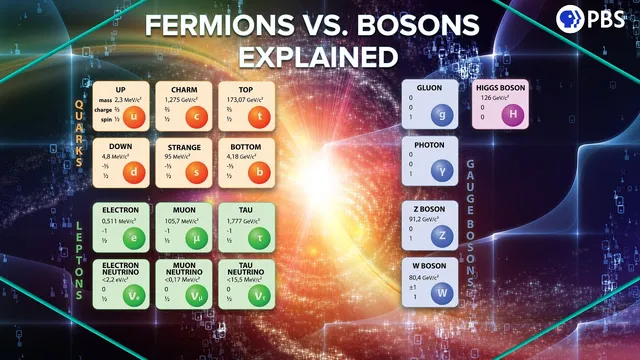
Fermions Vs. Bosons Explained with Statistical Mechanics!
Based on PBS Space Time's video on YouTube. If you like this content, support the original creators by watching, liking and subscribing to their content.
Statistical mechanics derives thermodynamic behavior by counting microstates that correspond to the same macrostate of observable properties like temperature, pressure, and volume.
Briefing
Statistical mechanics turns the messy motion of countless particles into a counting problem: the macroscopic “rules” of thermodynamics emerge because systems overwhelmingly favor the macrostate that corresponds to the largest number of microscopic possibilities. The core insight is that what looks random at the particle level becomes predictable at the level of temperature, pressure, and volume—not because particles follow a simple script, but because some distributions are far more numerous than others.
The explanation starts with a cosmic version of dice. If one ball’s position is unknown, every location becomes effectively equally likely at the micro level, yet some overall patterns are far more common than others simply because there are vastly more ways to realize them. With many balls, “random-looking” arrangements dominate: dividing space into boxes shows that a smooth spread across boxes is vastly more probable than all balls landing in one box. Translating this to air molecules, each specific arrangement of particle positions is a microstate, while the coarse, observable thermodynamic conditions form a macrostate. Entropy then becomes a measure of how close a macrostate is to the maximum number of microstates—so systems naturally drift toward high-entropy macrostates.
From there, the focus shifts from positions to energy. When particles can exchange energy through collisions, the relevant microstates are the ways particles can be distributed among energy bins, while the macrostate is the overall shape of the energy distribution. Energy is conserved, so not every energy distribution is allowed; the most probable one is the Maxwell–Boltzmann distribution, which depends on temperature and yields the familiar Maxwell velocity distribution. The dice analogy returns: different dice outcomes correspond to different numbers of microstates, and the most common macrostate is the one with the most underlying combinations—producing the characteristic “bell curve” rather than a flat spread.
The story then splits based on a quantum twist: whether particles are distinguishable or not. For bosons—particles that obey Bose–Einstein statistics—swapping identical particles does not create new microstates, and there is no limit to how many particles can occupy the same energy bin. At sufficiently low energies, this enables the Bose–Einstein condensate, a new collective state that underlies phenomena like superconductivity and superfluidity.
Fermions—particles obeying Fermi–Dirac statistics—also treat identical particles as indistinguishable, but quantum mechanics imposes a strict occupancy rule: each energy state can hold at most one fermion. This “no sharing” constraint forces fermions to fill low-energy states in a step-like way, producing effects that shape real matter. It explains why atoms have the size and chemical structure they do (including the role of electron spin allowing two electrons per shell with opposite spins) and why compact stars resist collapse: white dwarves and neutron stars are supported by degenerate matter, and Fermi–Dirac statistics helped determine the mass thresholds for collapse toward black holes.
Across all these cases, the unifying theme is counting: different quantum rules change how many microstates exist for a given macrostate, and the universe’s macroscopic behavior follows from which counts win.
Cornell Notes
Statistical mechanics predicts thermodynamics by counting microscopic possibilities (microstates) that correspond to the same macroscopic observables (macrostates). For ordinary particles, energy distributions follow Maxwell–Boltzmann statistics, producing the Maxwell velocity distribution because that macrostate has the most microstates under the constraint of energy conservation. Quantum indistinguishability changes the counting: bosons follow Bose–Einstein statistics and allow unlimited occupancy of an energy bin, enabling the Bose–Einstein condensate at low energies. Fermions follow Fermi–Dirac statistics and obey the Pauli exclusion principle, so each energy state holds at most one particle, leading to degenerate matter and the stability of white dwarves and neutron stars. These occupancy rules explain why macroscopic behavior differs so dramatically between bosons and fermions.
Why does a “random-looking” distribution of particles become the most likely outcome even when every specific arrangement is treated as equally possible at the micro level?
How does the argument shift from particle positions to energy, and what determines the most probable energy distribution?
What changes in the counting when particles are indistinguishable, and how does that lead to Bose–Einstein statistics?
Why do bosons enable the Bose–Einstein condensate, and what macroscopic phenomena does it connect to?
How does Fermi–Dirac statistics differ from Bose–Einstein statistics, and why does it matter for stars and atoms?
Review Questions
- In the dice-and-bins analogy, what exactly counts as a microstate versus a macrostate, and how does that mapping justify entropy?
- What role does energy conservation play in deriving the Maxwell–Boltzmann distribution, and what would change if energy were not conserved?
- Compare boson and fermion occupancy rules. How do those rules lead to qualitatively different low-temperature behavior?
Key Points
- 1
Statistical mechanics derives thermodynamic behavior by counting microstates that correspond to the same macrostate of observable properties like temperature, pressure, and volume.
- 2
A macrostate becomes overwhelmingly likely when it corresponds to the largest number of microstates, even if individual microstates are treated as equally possible.
- 3
When particles exchange energy, the most probable energy distribution follows Maxwell–Boltzmann statistics, producing the Maxwell velocity distribution under energy-conservation constraints.
- 4
Quantum indistinguishability changes state counting: bosons follow Bose–Einstein statistics and allow unlimited occupancy of an energy bin.
- 5
At very low energies, bosons’ unlimited occupancy enables a Bose–Einstein condensate, linked to superconductivity and superfluidity.
- 6
Fermions follow Fermi–Dirac statistics and obey the Pauli exclusion principle, restricting each energy state to at most one fermion.
- 7
Fermi–Dirac statistics explains atomic structure and the stability of white dwarves and neutron stars through degenerate matter, including mass thresholds for collapse toward black holes.