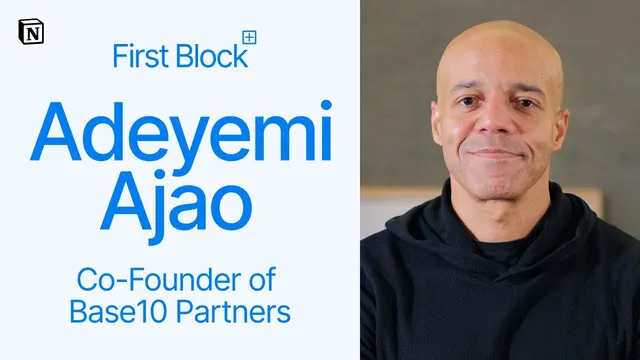
First Block: Interview with Adeyemi Ajao, Co-Founder and Managing Partner of Base10 Partners
Based on Notion's video on YouTube. If you like this content, support the original creators by watching, liking and subscribing to their content.
Ajao credited his immigrant upbringing with sharpening “theory of mind,” helping him anticipate how others interpret and react to ideas—an advantage in product and leadership.
Briefing
Adeyemi Ajao’s career arc—from building social networks in Spain to investing in “automation of the real economy”—hinges on a single through-line: founders must unlearn the culture they grew up in, then build repeatable frameworks for trust, hiring, and community that survive near-death moments.
Growing up across Nigeria and Spain, Ajao described a childhood shaped by entrepreneurship and hands-on tinkering, including installing modems in high school and following early internet figures like Marc Andreessen. When he later studied in Madrid, he saw social life as city-based and friend-driven rather than campus-based. That observation fed the early prototypes that became Tuenti. The decisive push came after an exchange stint in the U.S., during the first year of Facebook’s launch at Emory in Atlanta—seeing a real company behind the idea convinced him it could be more than a side project.
Ajao also framed founder success as partly cultural adaptation. In Spain and Nigeria during the 1980s and 1990s, he said social norms rewarded deference—“know your place,” respect elders, don’t speak too loud. In Silicon Valley, he encountered the opposite: people openly pitch ambitions, ask for what they want, and treat failure as a starting point rather than an endpoint. He described having to “de-program” himself to speak up and to stop silencing his “inside voice.” That mindset shift later showed up in how he thinks about fundraising, leadership, and even how he coaches founders.
On co-founder dynamics, Ajao argued that friendship alone isn’t enough when stakes rise. He described a pattern across multiple startups: co-founders may start as friends, but they must become founders first for the company’s good. To make that work, he relies on frameworks forged by “near death experiences”—moments that clarify what matters: how far the team is from the goal, what resources exist, and how to win together regardless of personal preferences. He said the same mistakes repeat across startups—optimism, ups and downs—so scaling requires repeatedly editing oneself while keeping conviction.
Hiring is another area where he moved from instinct to structure. Early on, he tried to do everything—coding, design, selling—before learning that founders can’t be strong in every role. The better approach: define what the company needs 12, 24, and 36 months out, then hire for that future job, not just the current one. He also emphasized “IC energy” in the first three to six months: even experienced leaders often need to roll up their sleeves and execute directly before building teams. When scaling, he looks at whether a hire is meant to run a known playbook (expanding a market) or tackle true zero-to-one work.
Community building, in his view, is product strategy. Tuenti was invite-only and designed to feel like “your group of friends,” not a feed of strangers. A key metric was engagement, not page views or growth. He credited specific product choices—like integrating with Microsoft for mass photo uploads and adding pictures to invites—for unlocking early momentum.
Finally, Ajao explained why Base10 Partners invests in automation of the real economy and why he shifted from founder to investor. He said acquisitions (Tuenti and Identified) made sense when the goal was 10x scale beyond what Spain or a single vertical could support. Post-acquisition, he learned to translate mission and identity across cultures, even when the role changes from CEO to something closer to product management. As an investor, he gets to “grab coffee” with founders weekly, while also building the fund like a startup—fundraising, processes, brand, and differentiation—without chasing hyperscale. Diversity and immigrant experience feed his “world brain” philosophy: humanity’s collective lenses are a competitive advantage for solving big problems.
Cornell Notes
Adeyemi Ajao’s path ties together founder mindset, team mechanics, and community design. He built Tuenti after seeing Facebook’s early success in the U.S., then credited his immigrant upbringing with sharpening “theory of mind”—the ability to understand how others experience the world. Across multiple startups, he said co-founders must become founders before friends, and near-death crises force teams to adopt frameworks focused on how they will “win together.” Hiring improved when he stopped optimizing for today’s tasks and instead matched candidates to what the company must need 12–24 months out, while preserving scrappy execution in the first months. His move into investing at Base10 reflects a belief in scaling automation for the real economy and funding the next generation of founders through scholarships.
What cultural shift did Ajao say he had to make when moving from Spain/Nigeria to the U.S.?
How does Ajao describe the healthiest co-founder relationship as startups mature?
What hiring mistake did he admit making early on, and what replaced it?
Why did community design matter so much for Tuenti, according to Ajao?
When did acquisitions make sense in his view, and what did he learn afterward?
What is Base10’s investment thesis and how is it tied to founder development?
Review Questions
- Which specific product and metric choices did Ajao credit for Tuenti’s sense of belonging and early engagement?
- How does Ajao’s “IC energy for the first three to six months” principle affect hiring decisions for experienced executives?
- What criteria did Ajao use to decide between continuing to build versus pursuing acquisition?
Key Points
- 1
Ajao credited his immigrant upbringing with sharpening “theory of mind,” helping him anticipate how others interpret and react to ideas—an advantage in product and leadership.
- 2
He said Silicon Valley required him to unlearn deference norms and to pitch openly, including stating quiet ambitions and expected scale.
- 3
Co-founder trust improves when teams adopt frameworks after crises, focusing on distance to goals, resources, and a shared definition of “how we win.”
- 4
Early hiring should match the company’s future needs (12–24 months out), not just current tasks, while preserving scrappy execution in the first months.
- 5
Community design can be a growth strategy: Tuenti’s invite-only, friend-first experience and engagement-first metric helped it feel authentic.
- 6
Acquisitions made sense when a credible 10x scale was possible beyond a local market or vertical, but post-acquisition success requires mission translation and identity adjustment.
- 7
Base10’s thesis centers on automating the real economy and funding the next generation of founders through a scholarship model funded by profits.