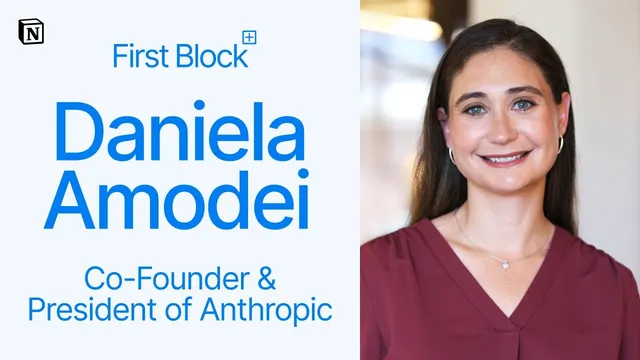
First Block: Interview with Daniela Amodei, Co-Founder & President of Anthropic
Based on Notion's video on YouTube. If you like this content, support the original creators by watching, liking and subscribing to their content.
Anthropic built a research-first foundation for roughly the first year to year and a half, delaying go-to-market until 2023 to preserve a safety-centered culture.
Briefing
Daniela Amodei, co-founder and president of Anthropic, credits the company’s rapid progress in building Claude to a deliberate sequencing of priorities: heavy investment in research before go-to-market, then a second phase focused on bringing safe, high-performing systems to customers without losing the safety mission. She describes Anthropic’s early structure as “building the airplane while it’s taking off,” but with a distinctive twist—no dedicated go-to-market team until 2023—allowing the research group to establish a cohesive culture and shared goals before scaling product and distribution.
Amodei also frames Claude’s core design around the “HHH” standard—helpful, honest, and harmless—assigning different internal teams to each dimension while acknowledging the trade-offs are not cleanly separable. “Honesty” targets hallucinations, “helpfulness” focuses on whether the model actually accomplishes the user’s intent, and “harmlessness” aims to reduce toxic, biased, or harmful outputs. Even when using constitutional AI to push the model toward all three goals at once, she says businesses still face choices: a use case that rewards creativity may tolerate more risk than a use case that demands strict safety, as long as guardrails remain.
Her account of training also highlights how messy early behavior can be even when the destination is a polished product. She compares the pace of improvement across model generations, saying the gap between GPT-2 and Claude 1 feels smaller than the gap between Claude 1 and Claude 2. She recounts examples of early Claude oddities—getting stuck on bizarre “modes” and producing overly concerned responses—underscoring that evaluation is hard because different customers demand different behaviors.
Beyond model training, Amodei connects Anthropic’s approach to company-building and leadership. She says founding is fundamentally different from scaling: early-stage founders must learn operational basics quickly (payroll, office setup during Covid, fundraising, hiring), and with six co-founders the work can be distributed by time horizon—Dario Amodei focusing on a 5–10 year technical vision while she concentrates on 1–2 year execution that turns research into usable products. She describes the co-founder group as unusually pre-aligned, with long-standing relationships that made division of labor easier.
On hiring, she emphasizes Anthropic’s interdisciplinary talent pool, citing backgrounds spanning neuroscience and biology alongside ML/AI researchers, plus product engineering, policy leadership, and operators. As the company grows, she says it has shifted from generalist-heavy early hiring toward more specialists.
Finally, Amodei argues that safety and capability should not be treated as a zero-sum trade. She points to Anthropic’s “responsible scaling policy” as a set of public commitments about training, testing, and what the company will do if safety concerns arise. Looking ahead, she expects Claude to evolve from a “junior assistant” that summarizes and drafts into a more senior productivity partner across sectors like healthcare, legal services, and climate tech—while insisting that societal impact can’t be left solely to corporations, and that policymakers and civil society must stay in the loop.
Cornell Notes
Daniela Amodei describes Anthropic’s path to Claude as a two-stage build: first, invest deeply in research and safety culture before launching go-to-market, then bring the resulting systems to customers while preserving the mission. Claude’s training is organized around “HHH”—helpful, honest, and harmless—handled by different internal teams, with constitutional AI used to raise all three targets together despite unavoidable trade-offs. Amodei says evaluation is especially difficult because users want different behaviors, so “tunable” guardrails matter: some settings may prioritize creativity or usefulness while still maintaining safety constraints. She also ties model work to company leadership—co-founders split responsibilities by time horizon—and to hiring, emphasizing interdisciplinary talent and a shift from generalists to specialists as the company scales.
Why does Amodei say Anthropic delayed go-to-market, and what did that enable?
How does the “HHH” framework map onto concrete training goals for Claude?
What trade-offs remain even when constitutional AI is used to optimize for helpful, honest, and harmless?
What do Amodei’s training anecdotes reveal about evaluation and iteration?
How does Amodei describe the division of labor between co-founders, and why does it matter?
What does Anthropic’s “responsible scaling policy” commit to?
Review Questions
- How does Anthropic’s early sequencing (research-first, go-to-market later) influence its ability to maintain safety culture during scaling?
- In what ways can optimizing for helpfulness, honesty, and harmlessness conflict, and how does constitutional AI help manage those tensions?
- Why does Amodei argue that safety and capability should not be treated as inherently opposed goals?
Key Points
- 1
Anthropic built a research-first foundation for roughly the first year to year and a half, delaying go-to-market until 2023 to preserve a safety-centered culture.
- 2
Claude’s “HHH” targets are operationalized as separate goals: reduce hallucinations (honesty), improve task completion (helpfulness), and limit toxic or harmful outputs (harmlessness).
- 3
Constitutional AI is used to push Claude toward helpful, honest, and harmless behavior simultaneously, but trade-offs still depend on customer use cases.
- 4
Model evaluation is difficult because different users want different behaviors, so tunability and guardrails are essential rather than one-size-fits-all performance.
- 5
Amodei describes co-founder alignment as strengthened by divided ownership: long-horizon technical vision versus short-horizon product execution.
- 6
Founding differs sharply from scaling; early founders must rapidly learn operational basics (payroll, office setup, fundraising, hiring) that later become systems.
- 7
Amodei links safety to capability and points to Anthropic’s responsible scaling policy as a public commitment for training, testing, and escalation when risks emerge.