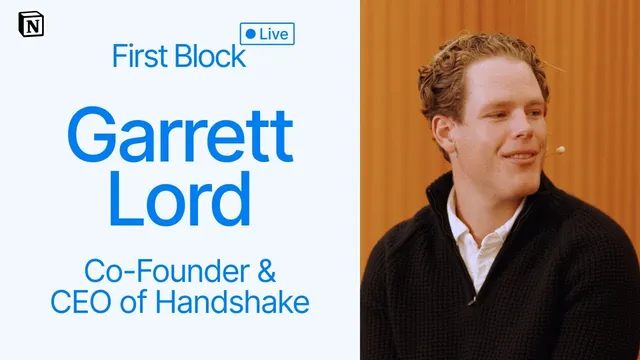
First Block: Interview with Garrett Lord, Co-Founder and CEO of Handshake
Based on Notion's video on YouTube. If you like this content, support the original creators by watching, liking and subscribing to their content.
Handshake’s mission started as a personal effort to democratize college-to-career information so students could access opportunity regardless of school prestige or connections.
Briefing
Handshake’s co-founder and CEO Garrett Lord traces the company’s rise to a simple but demanding idea: college-to-career access improves when teams bring “Olympic” levels of passion and avoid groupthink that waters down decisions. Handshake began with a personal path—from a working-class upbringing in Michigan to software engineering studies at Michigan Tech, then research work at Los Alamos National Laboratories and an internship at Palantir that reframed how job search and product thinking intersect. The early insight was that young graduates needed better, more transparent information to find the right roles, regardless of school prestige or family connections. That belief turned into a network that initially struggled—hundreds of universities said no to the first product—before gaining traction once the first schools joined and the system expanded.
Lord describes the early grind in concrete terms: living out of a Ford Focus, driving between schools across multiple states, and relying on founder-to-founder momentum to pull the team out of “nightmare mode.” Fear was constant—fear of failure, of disappointing friends, and of whether fundraising and customer trust would materialize—but progress came through “stacking days and stacking wins.” Over time, adversity became a kind of mental reprogramming: uncertainty stops feeling like an exception and starts feeling like the job. He credits a father’s example—“you might not know as much as them, but you can outwork them”—as the foundation for that grit.
As Handshake grew, Lord’s advice shifts from perseverance to scaling leadership. He argues founders must focus on what they’re uniquely responsible for as headcount rises: setting high standards, recruiting for talent density, and making culture legible through hard boundaries. At the same time, he warns against micromanagement while still allowing “micro curiosity” and “micro inspection” so executives can lead decisions without losing quality control. The goal is not empowerment without scrutiny; it’s empowerment with inspection on the decisions that matter.
That leadership model shows up in Handshake AI, an “incubation” effort inside the core company. Handshake AI supplies structured human data and expert labor for frontier model post-training—reasoning data, agentic software work, generalist preference ranking, and safety-related tasks—serving seven top frontier labs. The business started after model companies asked for access to Handshake’s experts across domains like biology, chemistry, physics, mathematics, software engineering, music, and educational design. Lord says the marketplace emerged because existing data pipelines were slow, inconsistent in quality, and often failed on basic operational needs like timely payment and effective training.
He frames the marketplace as a win for participants too: professors and professionals can earn more flexibly, students can build resume-boosting skills (including prompt engineering, hallucination spotting, and understanding SFT data versus evals), and the long-term vision is to help universities adapt to the future of education. Internally, Lord’s day-to-day tech stack is practical—Google, Notion, Slack, Zoom, Sheets, Linear, Figma, Salesforce, and Hex dashboards—while sales leadership remains founder-driven, with his co-founder Ben Christensen handling account management after early involvement in cold calling.
The interview ends with two founder lessons: invest early in talent brand and talent density, and define culture through recruiting red lines that encourage self-selection. Rebuilding Handshake today, Lord would “go as big as possible,” betting that AI-driven market shifts reward conviction and speed—stacking days, then taking the risk to scale.
Cornell Notes
Garrett Lord links Handshake’s success to relentless passion and decision clarity—“Olympic pace” without watering down standards through groupthink. The company’s origin grew from a personal mission to democratize college-to-career information, then survived early rejection through persistence (“stacking days and stacking wins”) and founder resilience. As Handshake scaled, Lord emphasized founder focus on talent density, culture boundaries, and hiring, while relying on executives for execution—paired with “micro curiosity” and “micro inspection” rather than micromanagement. Handshake AI extends the same marketplace logic inside the company, supplying structured human data for frontier model post-training to seven labs, built after model companies demanded access to experts and after operational gaps in data pipelines became obvious. The approach aims to improve model capabilities while also improving participant employability and education’s future.
What early problem did Handshake aim to solve, and why did Lord believe it mattered?
How did Handshake survive the “dark times” of early product rejection?
What does Lord say founders must change as a company grows from small teams to hundreds of people?
How did Handshake AI start, and what need did it fill for frontier AI labs?
Why does Lord believe the marketplace model benefits participants beyond the AI labs?
What practical advice does Lord give about culture and recruiting during rapid growth?
Review Questions
- How does Lord connect “Olympic pace” to decision quality and culture, and what does he say happens when standards get diluted by groupthink?
- What operational and human-data gaps did Lord identify as the reason Handshake AI became necessary for frontier labs?
- In Lord’s scaling framework, what should a founder keep doing personally, and what should shift to executives as headcount grows?
Key Points
- 1
Handshake’s mission started as a personal effort to democratize college-to-career information so students could access opportunity regardless of school prestige or connections.
- 2
Early growth required surviving repeated rejection; Lord cites living out of a Ford Focus and driving between universities while stacking daily wins.
- 3
Scaling leadership means shifting from founder-made decisions to executive-led execution while maintaining “micro curiosity” and “micro inspection” on important choices.
- 4
Culture is defined through recruiting boundaries and hard red lines that encourage self-selection, especially during rapid hiring.
- 5
Lord credits early investments in talent brand and talent density as foundational for the next phase of growth.
- 6
Handshake AI emerged from model companies demanding structured human expertise and from the discovery that existing data pipelines failed on speed, volume, quality, and operational basics like timely payment.
- 7
Lord’s current operating approach for growth and AI bets on conviction—“go big or blow a crater”—paired with relentless day-by-day effort.