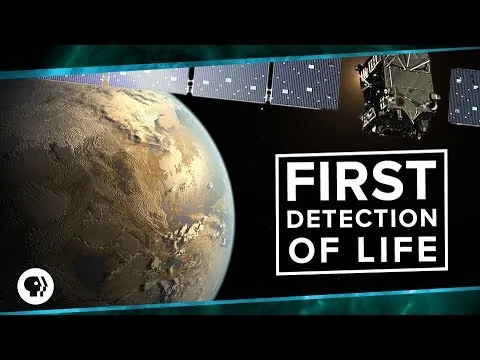
First Detection of Life
Based on PBS Space Time's video on YouTube. If you like this content, support the original creators by watching, liking and subscribing to their content.
A credible search for life in exoplanet atmospheres should focus on disequilibria—chemical compositions that can’t be maintained by ordinary physics alone.
Briefing
The most consequential idea in this account is that “life detection” from afar should rely less on finding familiar molecules and more on spotting atmospheric chemistry that can’t be explained by ordinary physics. In 1990, Carl Sagan and collaborators used NASA’s Galileo spacecraft during a brief Earth flyby to measure our planet’s atmospheric spectrum, images, and radio signals—an early proof-of-concept for detecting life using only data gathered in space. The results, published in Nature in 1993, didn’t just confirm life on Earth; they laid out a practical roadmap for what to look for around other stars.
Galileo’s near-infrared spectrometer recorded deep absorption features—“dips” in the spectrum—caused by molecules absorbing specific wavelengths. Strong signatures of H2O and O2 showed that Earth’s atmosphere contains water and oxygen. But the key lesson is that molecular “shopping lists” aren’t enough. Water, carbon dioxide, and methane can all be produced by non-biological processes, including geology. A credible detection requires a clear departure from thermodynamic equilibrium: a set of chemical abundances that should relax to a predictable balance unless something continuously disrupts it.
Methane provides the clearest example. In an oxygen-rich atmosphere, methane should oxidize quickly into water and carbon dioxide, leaving only trace amounts. Yet the observed methane level is far higher than equilibrium would allow, implying an ongoing source. On Earth, roughly half comes from natural biological systems such as methane-producing bacteria, while the rest is linked to human activity, including fossil-fuel burning and emissions from domesticated ruminants.
Other disequilibria reinforce the same logic. Nitrous oxide appears in amounts inconsistent with how fast it is destroyed by solar ultraviolet radiation (with a half-life of about 50 years). Non-biological production mechanisms like lightning exist, but they don’t supply enough. On Earth, the dominant sources include nitrogen-fixing bacteria and algae. The framework doesn’t require alien life to use Earth’s exact chemistry; different biology could generate different disequilibria. Still, with solid chemistry, geophysics, and exometeorology, scientists can judge whether an atmosphere’s composition looks “out of whack” in ways that ordinary processes can’t sustain.
Beyond disequilibria, the account highlights liquid water as a high-priority target. While water is common as vapor or ice, liquid water is harder to maintain and is central to evolutionary chemistry. Its physical properties—high dielectric constant for dissolving ions, strong solvent behavior, and high heat capacity for temperature stability—make it unusually effective at supporting complex reactions.
Galileo also offered supporting clues: surface spectra and color photographs showing chlorophyll’s signature green land, plus radio detections of modulated narrowband transmissions from a technological civilization. The broader point is that the “Sagan experiment” can be replicated remotely once telescopes can measure exoplanet atmospheres well enough.
That capability is arriving through transit spectroscopy, where a planet passing in front of its star filters a tiny fraction of starlight through the planet’s atmosphere. The account cites examples such as HD 189733b (water, methane, carbon dioxide, but likely too hot for liquid water) and HAT-P-11b (water vapor). The next leap is expected with the James Webb Space Telescope, whose 6.5-meter mirror and sensitive infrared instruments should enable Sagan-style atmospheric tests on more Earth-like worlds. TRAPPIST-1 is singled out: its seven planets offer targets for detecting atmospheric compositions, with three in the habitable zone. If life is common, the first evidence may come from disequilibria—potentially within human lifetimes—rather than from a single “alien molecule” alone.
Cornell Notes
A practical way to detect life on distant worlds is to look for atmospheric chemistry that violates thermodynamic equilibrium. Galileo’s 1990 Earth flyby measured absorption spectra showing molecules like H2O and O2, but the stronger signal comes from disequilibria—combinations of gases that should not persist without continuous replenishment. Methane in oxygen-rich air and nitrous oxide despite rapid UV destruction are examples of Earth’s “out-of-equilibrium” atmosphere. The same logic can be applied to exoplanets using transit spectroscopy, where starlight filtered through a planet’s atmosphere reveals absorption features. The James Webb Space Telescope is expected to make this approach feasible for smaller, more Earth-like targets, potentially including TRAPPIST-1 planets in the habitable zone.
Why are “life-associated molecules” alone considered insufficient for claiming life?
How does methane illustrate the disequilibrium approach?
What makes nitrous oxide a disequilibrium “red flag”?
Why is liquid water treated as a high-priority target even without assuming alien chemistry matches Earth’s?
How does transit spectroscopy replicate the “Sagan experiment” without sending a probe to another star system?
What observational targets and instruments are expected to push this search forward?
Review Questions
- What specific atmospheric criterion distinguishes a credible life detection from merely finding molecules linked to life on Earth?
- Using the methane example, explain why equilibrium chemistry predicts low methane in oxygen-rich atmospheres.
- Describe how transit spectroscopy isolates an exoplanet’s atmospheric absorption features from the much brighter starlight.
Key Points
- 1
A credible search for life in exoplanet atmospheres should focus on disequilibria—chemical compositions that can’t be maintained by ordinary physics alone.
- 2
Molecules like H2O, CO2, and CH4 are necessary ingredients for life-related chemistry but are not unique biosignatures because abiotic processes can produce them.
- 3
Methane is a strong disequilibrium candidate because oxygen-rich atmospheres should destroy it quickly, yet observed methane levels can be far above equilibrium expectations.
- 4
Nitrous oxide is another disequilibrium marker because its UV destruction timescale (~50-year half-life) requires continuous replenishment that abiotic sources may not supply.
- 5
Liquid water is prioritized because it supports reaction networks through solvent properties and temperature stability, even if alien life uses different chemistry.
- 6
Transit spectroscopy enables remote atmospheric measurements by analyzing starlight filtered through a planet during a transit, making Sagan-style tests possible without interstellar travel.
- 7
The James Webb Space Telescope and targets like TRAPPIST-1 are expected to expand the search toward habitable-zone planets where liquid water might exist.