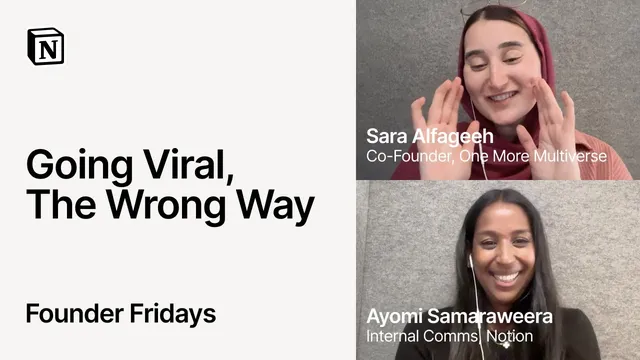
Founder Fridays: Going Viral - The Wrong Way with Sara Alfageeh and Ayomi Samaraweera
Based on Notion's video on YouTube. If you like this content, support the original creators by watching, liking and subscribing to their content.
Virality was defined by conversion: views alone didn’t count unless they led to signups, logins, and engagement.
Briefing
Going viral only counts when it converts into real product traction—signups, logins, and retention—not just high view counts. Sara Alfageeh and Ayomi Samaraweera describe a strict definition of “viral” at One More Multiverse: anything under 750k views didn’t count, and engagement had to be tight (roughly one like per six views). Jokes that spiked in attention but produced no newsletter signups, pre-orders, or new logins were treated as “not going viral” for that month. In a small team, brand awareness wasn’t a luxury; social growth had to be existentially tied to user acquisition.
Their growth system centered on a funnel they tested weekly: TikTok → join Discord → find someone to play with → get into the game. TikTok was the top-of-funnel engine, while Discord held the community together. When TikTok content went viral during the pandemic’s peak (2020 into 2021), new logins rose sharply—an era when game developers hadn’t fully cracked TikTok packaging and pitching, and when the platform wasn’t dominated by commerce like TikTok Shop. The approach was hands-on and founder-led: Alfageeh filmed TikToks herself on an iPhone at home, and even became recognizable to users during onboarding (“You’re Sara from TikTok”). At GDC, other developers reportedly studied the TikToks and strategy, reinforcing the idea that the team had built a repeatable playbook rather than random luck.
A key tactical lesson was that short-form virality could be engineered through restraint. One campaign used a six-second video that “cracked the code” by speaking as if nobody had heard of the game, showing visuals, and saying as little as possible—letting imagination do the heavy lifting. The team also treated content creation as a measurable workflow, with generative AI entering later to accelerate product discovery. While exploring mobile games, internal teams pitched concepts, and Alfageeh generated fake ads using Midjourney and ran paid tests before any real game existed. Within two months, we got clarity on what to build next—characters, title, art style, and color scheme—reducing guesswork.
Now at Notion, the same playbook is being adapted to a harder organic landscape. Social media is treated as constant feedback, but posting schedules can’t assume one global audience; timing and language matter, and replies must be in users’ languages. Notion’s brand footprint has also expanded into multiple accounts (Notion Mail, Notion Calendar, Notion AI, Notion Japan), prompting a shift back toward smaller circles to hear people more directly. The advice that ties it all together is less about chasing metrics and more about authenticity: don’t post without heart, keep reading and responding to comments, and keep iterating—post the weird thing, delete it if needed, and try again. The stakes are low; the learning is the point.
Cornell Notes
Sara Alfageeh and Ayomi Samaraweera describe a “viral” standard that’s tied to conversion, not views: One More Multiverse only counted virality above 750k views and required strong engagement plus downstream actions like signups and logins. Growth depended on a tested funnel—TikTok to Discord to finding a play partner to entering the game—measured weekly to find where users dropped off. Alfageeh became the face of TikTok, using short, low-friction videos (including a six-second format) that showed visuals and let imagination fill in the rest. Later, generative AI and paid tests (with Midjourney-made fake ads) helped the team decide what mobile game to build. At Notion, the same principles shift toward audience-specific timing, multilingual replies, and ongoing community listening.
How did One More Multiverse define “going viral,” and why did that definition matter?
What funnel did the team test to connect TikTok attention to actual gameplay?
Why did TikTok work so well for them during 2020–2021?
What was the “six-second video” lesson, and what made it effective?
How did generative AI change product discovery for their mobile game experiments?
How is the playbook being adapted at Notion now that organic reach is harder?
Review Questions
- What metrics and downstream actions did the team require before calling a post “viral,” and how did that prevent vanity growth?
- Describe the full TikTok-to-game funnel and explain how weekly testing helped identify the biggest drop-off points.
- Why did short, low-explanation creative (like the six-second approach) outperform more detailed pitching in their early growth strategy?
Key Points
- 1
Virality was defined by conversion: views alone didn’t count unless they led to signups, logins, and engagement.
- 2
One More Multiverse tracked a specific funnel—TikTok → Discord → play partner → game entry—and tested it weekly to find drop-offs.
- 3
TikTok drove top-of-funnel discovery while Discord sustained community and helped users progress into gameplay.
- 4
Founder-led content worked because the founder could test hooks quickly and became a recognizable onboarding touchpoint.
- 5
A six-second creative format succeeded by showing visuals, minimizing explanation, and letting imagination do the selling.
- 6
Generative AI accelerated product decisions by enabling fake ad tests (using Midjourney) before any game existed.
- 7
At Notion, audience-specific timing, multilingual replies, and ongoing community listening matter more as organic reach gets tougher.