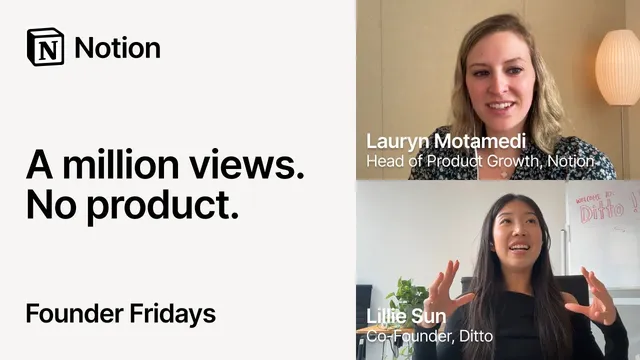
Founder Fridays: Launch where your users scroll with Lillie Sun, Ditto and Lauryn Motamedi, Notion
Based on Notion's video on YouTube. If you like this content, support the original creators by watching, liking and subscribing to their content.
Lily Sun used TikTok virality plus a concrete signup threshold to decide when to build, reaching the trigger within three weeks.
Briefing
Ditto’s rise traces back to a simple bet: if people will share personal, list-based stories publicly—after seeing them on TikTok—then a social network built around that behavior can grow. Lily Sun started by posting “green screen” videos of lists made in her notes app, then set a concrete threshold: when the first video hit a million views and a thousand people signed up for a Google Doc, she would build. That milestone arrived within three weeks, and the early viral hit (a list about why “situationships” aren’t worth it) quickly drove demand for an app where people could create and share more lists.
The first version wasn’t even Ditto. It launched as a web app called Breezy, designed to test only one question: would users post lists publicly? The MVP intentionally skipped the usual growth crutches—no focus on followers, search, or discovery. Users could create a title and list, press post, and land in their account. What mattered was whether the content would feel as personal as it did in private notes. Early users did share, and the lists looked like the same kind of intimate, niche material—advice, regrets, and personal stories—rather than generic topics like restaurants or books. That response became the foundation for building network effects and shifting from “sharing lists” to “social sharing.”
A key theme throughout the conversation is building in public, but with a purpose. Sun argues that posting openly can be a practical advantage when a product asks users for something unusual: to volunteer chaotic, unfiltered stories. By bringing the community along while iterating, the company makes later “asks” easier. She also frames a common fear—someone else copying the product—as less threatening than copying the community’s willingness to share in the same way. The brand itself evolved through user feedback: Breezy’s early Pinterest-like inspiration didn’t resonate with power users, who described what they wanted as closer to “girl Twitter” and the feeling of belonging to a community. That insight helped drive the rename to Ditto, meant to signal a collective experience.
Sun’s founder strategy also leans heavily on personal branding. She initially treated her role as “customer acquisition,” deciding that if she couldn’t build the product herself, she would do everything else to get it off the ground—showing up as the face of the company. Over time, she pivoted her content to embody the kind of user Ditto aims to attract: someone who overshares, champions oversharing, and shares personal lessons rather than only fundraising or product updates.
Looking ahead, the biggest challenge is network effects—especially for a text-based platform where interests are broad (food, travel, relationships, college, city life) but the team is small. Digital marketing can drive fast downloads, yet social networks depend on friend-driven content consumption. To solve that, Ditto is pursuing college campus growth as a repeatable way to seed “weak networks” with enough connected users that sub-communities form naturally. The company is also setting boundaries around AI: it won’t use AI-generated lists or titles, while exploring AI’s role in reasoning and interpreting what lists mean through users’ language over time.
The advice at the end is less technical and more emotional: trust the “13th hour.” After long stretches of rejection, a breakthrough often arrives late—sometimes it works, sometimes it doesn’t—but the mindset is to keep faith through the grind.
Cornell Notes
Ditto grew from a public experiment: Lily Sun posted TikTok videos of list-sharing from her notes app and set a measurable trigger (1M views and 1,000 Google Doc signups). When that happened in three weeks, she built an MVP first as a web app called Breezy to test one behavior—whether people would share personal lists publicly. Users did, and the content matched the intimate, niche tone of private notes, creating a basis for social network growth and network effects. Sun credits building in public and shaping the product and brand through direct user feedback, plus a founder personal brand aimed at attracting the right users. The next bottleneck is network effects, so Ditto is leaning into college campus seeding and rejecting AI-generated lists to preserve authenticity.
Why did Ditto’s early MVP focus on public posting rather than discovery or followers?
What did viral list content reveal about the kind of social network Ditto should become?
How does “building in public” function as more than marketing for Ditto?
How did user feedback change Ditto’s brand direction from Breezy?
What’s the core network-effects problem Ditto is tackling next, and why college campuses?
Where does Ditto draw the line on AI?
Review Questions
- What single user behavior did Breezy’s MVP aim to validate, and how did the product design support that goal?
- How did user descriptions of “what it feels like” influence Ditto’s naming and positioning?
- Why might friend-group seeding on college campuses outperform purely interest-based algorithms for a list-based social app?
Key Points
- 1
Lily Sun used TikTok virality plus a concrete signup threshold to decide when to build, reaching the trigger within three weeks.
- 2
Breezy’s MVP intentionally skipped discovery and follower mechanics to test whether users would share personal lists publicly.
- 3
Early user behavior confirmed that the platform’s value depended on authentic, niche self-expression rather than generic list topics.
- 4
Building in public helped because Ditto asks users to volunteer stories; community trust makes later participation easier.
- 5
User feedback reshaped the brand from a Pinterest-like inspiration toward a community-belonging identity, leading to the name Ditto.
- 6
Network effects are the current bottleneck, so Ditto is pursuing college campus seeding to form friend-driven sub-networks.
- 7
Ditto rejects AI-generated lists to preserve authenticity, while exploring AI for reasoning and interpreting list meaning.