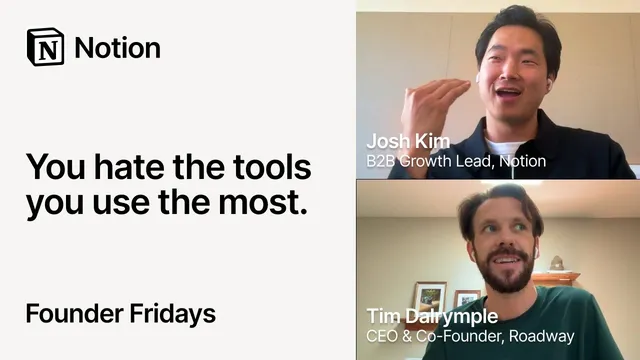
Founder Fridays: Shots on goal matter with Tim Dalrymple, Roadway and Josh Kim, Notion
Based on Notion's video on YouTube. If you like this content, support the original creators by watching, liking and subscribing to their content.
Roadway positions attribution as the foundation for growth marketing optimization, turning cross-channel performance data into actionable full-funnel decisions.
Briefing
Roadway is positioning attribution as the control center for growth marketing—now with an AI layer built to help teams decide what’s working, what’s failing, and what to do next. The pitch is straightforward: growth models go stale quickly when teams can’t measure the right things in the right way, and most growth marketers spend too much time wrestling with data rather than living inside it. Roadway’s “first AI platform for growth marketing teams,” launched alongside its attribution foundation, aims to turn messy, cross-channel performance data into usable, full-funnel attribution and optimization workflows.
The origin story traces back to the recurring attribution problem Tim Dalrymple saw while building growth models at Notion and Web Flow. Those acquisition-loop models—designed with clear assumptions—tend to lose accuracy after a couple of weeks when measurement doesn’t match the model’s structure. The breakthrough came from combining attribution with AI’s ability to interpret data in more structured ways and, crucially, to give teams context that helps them “live in the numbers.” That emphasis on operational fluency—building intuition and nuance internally—also underpins the argument that hiring and training matters more than outsourcing to agencies.
Validation didn’t arrive cleanly at first. Early onboarding delivered value that felt closer to another BI tool than a true attribution system, because the initial product work focused on analytics “table stakes” while the core attribution model and channel-deduplication capabilities were still being built. Over time, the platform evolved from trend-level chart understanding to chart-level analysis, and then toward full-funnel goals, guardrails, and self-serve construction—so growth marketers can build and iterate without waiting on bespoke analysis.
Dalrymple also frames today’s AI marketing landscape as less about replacement and more about applying enduring growth principles to new channels. Panic often comes from FOMO and from trying tools as if they will “replace” established workflows. Instead, AI search should be treated as part of SEO’s evolving ecosystem: consideration may shift into chat interfaces, but the underlying ranking signals and content behaviors remain. Teams that experiment in the “messy middle” without abandoning core principles—especially around distribution loops and evidence—are more likely to win.
A recurring theme is that the barrier to building is falling, but the barrier to quality is rising. AI can speed execution, yet it can also waste time when outputs are wrong—leading to back-and-forth and rework. Roadway’s approach leans on structured data and carefully scoped context rather than brute-force long-context reasoning. The system uses sub-agents with specialized context and passes the right data to each step, with the goal that AI stays “invisible” inside the workflow instead of becoming a separate feature.
Inside Roadway, velocity comes less from tools and more from decision mechanics: project owners drive direction, seek input but avoid consensus, and use a “disagree and commit” culture. That speed is supported by organizational breathing room to test, roll back, and try again. The advice to founders is similarly blunt—nothing is easy, action creates momentum, and conviction beats endless searching for what might resonate. Finally, Dalrymple says Roadway would have started with narrower ICP focus earlier and prioritized fast data connectors sooner, after learning where demand actually clustered.
Cornell Notes
Roadway is built around attribution as the foundation for growth marketing, now paired with an AI platform designed to help teams determine what’s working, what’s not, and what to do next. The motivation comes from growth models at Notion and Web Flow going stale quickly when measurement doesn’t match the model’s structure. Early product validation landed more like a BI tool than a true attribution system, but the platform evolved toward full-funnel goals, guardrails, and self-serve analytics. Dalrymple argues that AI won’t replace core growth principles; instead, teams should apply SEO and distribution-loop thinking to AI search and new channels while maintaining evidence. He also stresses that structured data and correct context matter more than larger context windows, because AI mistakes can create major rework.
Why does attribution matter so much for growth marketing teams, and what goes wrong without it?
What was the early “customer proof” problem with Roadway’s initial product, and how did it change?
How should teams think about AI search compared with traditional SEO?
What’s the “quality” risk of AI, and how does Roadway try to reduce wasted time?
What internal operating principle helps Roadway ship faster—tools or decision-making?
How does ICP focus affect Roadway’s launch strategy and what would change on a relaunch?
Review Questions
- What specific measurement mismatch causes growth models to go stale, and how does attribution address it?
- How does the advice about AI search relate to the idea of keeping core growth principles while changing tactics?
- Why does Roadway emphasize structured data and sub-agent specialization instead of relying on larger context windows?
Key Points
- 1
Roadway positions attribution as the foundation for growth marketing optimization, turning cross-channel performance data into actionable full-funnel decisions.
- 2
Growth models can lose accuracy quickly when measurement doesn’t match the model’s structure, creating a need for attribution that stays aligned with the growth plan.
- 3
Early Roadway onboarding initially resembled a BI tool; the product evolved toward deduplicated attribution and self-serve funnel analytics.
- 4
AI marketing panic is often driven by FOMO and replacement narratives; teams that experiment while keeping core principles (like SEO/distribution loops) are more likely to win.
- 5
AI search should be treated as part of SEO’s evolution: consideration may shift into chat, but ranking signals and evidence-based content still matter.
- 6
AI can speed execution but also wastes time when outputs are wrong; structured data, correct math, and scoped context reduce rework.
- 7
Roadway’s shipping velocity comes from project ownership and a “disagree and commit” culture rather than consensus-building.