Fourier Transform 10 | Fundamental Example for Fourier Series
Based on The Bright Side of Mathematics's video on YouTube. If you like this content, support the original creators by watching, liking and subscribing to their content.
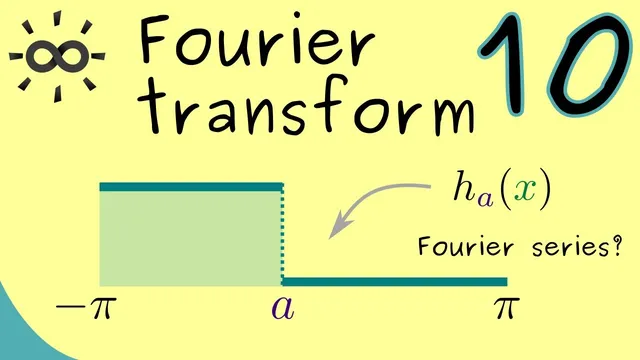
Start with the 2π-periodic step function h_a(x)=1 on (−π,a] and 0 on (a,π), because L2 inner products ignore changes at finitely many points.
Briefing
A single, carefully chosen “step” function is enough to prove Parseval’s identity for all square-integrable (L2) functions—once the Fourier coefficients for that step function are computed and summed correctly. The core move is to start with a 2π-periodic function that equals 1 on (−π, a] and 0 on (a, π), where a can be any point between −π and π. Because changing a function at finitely many points doesn’t affect L2 inner products, this family of step functions becomes the essential test case for the broader theory.
For this step function h_a, the Fourier coefficients c_k are obtained from the standard inner product with the complex exponential basis e^{ikx}. Since h_a is zero on (a, π), the integral collapses to the interval (−π, a). The resulting coefficients split into two cases: when k = 0, the coefficient is proportional to the interval length a − (−π), giving c_0 = (a + π)/(2π). When k ≠ 0, the coefficient becomes a difference of exponentials evaluated at the limits, yielding c_k = (e^{−ika} − e^{ikπ})/(2π(−ik)). This is then translated into the real Fourier series form using the relationships A_k = 2·Re(c_k) and B_k = −2·Im(c_k), which helps visualize convergence.
A numerical visualization (using Python) shows how partial sums approximate the step: low-order truncations miss the jump, while higher orders produce a closer L2 approximation. At large truncation levels, the partial sums oscillate strongly near the discontinuity, yet the overall approximation improves in the L2 sense—consistent with the expected behavior of Fourier series for discontinuous functions.
The proof of Parseval’s identity hinges on summing the squared magnitudes of the coefficients. After computing |c_k|^2, the expression simplifies dramatically into terms involving 1/k^2 and cos(k(a+π))/k^2. The analysis then takes the limit as the truncation index n → ∞, requiring evaluation of two classic cosine-weighted series. A general formula for sums of the form Σ cos(kx)/k^2 (valid for x in [0, 2π]) supplies the needed limits, producing explicit values at x = 0 and x = π + a.
When these limits are substituted back, the algebra collapses so that the final result matches the L2 inner product of the step function with itself: Σ_{k=−∞}^{∞} |c_k|^2 equals ∫_{−π}^{π} |h_a(x)|^2 dx. Since h_a is just 0 or 1, that integral equals the length of the region where h_a = 1, namely a + π. This establishes Parseval’s identity for every step function h_a.
From there, the strategy expands: step functions approximate more general functions in L2, so Parseval’s identity extends from step functions to all L2 functions. The calculation for the single step family is therefore the crucial “first step” that unlocks the full theorem.
Cornell Notes
The central result is that Parseval’s identity for Fourier series can be proved by computing everything for a 2π-periodic step function h_a(x), which equals 1 on (−π, a] and 0 on (a, π). Fourier coefficients c_k come from integrating e^{ikx}h_a(x) over (−π, a), giving a simple closed form for c_0 and c_k for k ≠ 0. Squaring and summing |c_k|^2 reduces to series involving 1/k^2 and cos(k(a+π))/k^2. Using a known cosine-sum formula, the infinite sum matches ∫_{−π}^{π} |h_a(x)|^2 dx = a + π, proving Parseval’s identity for all step functions. Approximation then extends the identity to every L2 function.
Why is it enough to prove Parseval’s identity for the family of step functions h_a(x)?
How do the Fourier coefficients c_k for h_a(x) simplify when h_a is 0 on part of the interval?
What does |c_k|^2 look like after simplification, and why does it matter?
Which known series formula is used to finish the limit as n→∞?
How does the final algebra connect the coefficient sum to an integral of h_a?
Review Questions
- What are the explicit forms of c_0 and c_k (k≠0) for the step function h_a(x), and how does the support of h_a(x) determine the integration limits?
- After computing |c_k|^2, what two types of series appear in the Parseval sum, and how does symmetry under k→−k simplify the summation?
- Which specific cosine-sum evaluations are needed (x=0 and x=π+a), and how do they lead to the final equality with ∫_{−π}^{π} |h_a(x)|^2 dx?
Key Points
- 1
Start with the 2π-periodic step function h_a(x)=1 on (−π,a] and 0 on (a,π), because L2 inner products ignore changes at finitely many points.
- 2
Compute Fourier coefficients c_k by integrating e^{ikx}h_a(x) only over (−π,a), yielding a simple closed form for c_0 and for c_k when k≠0.
- 3
Translate complex coefficients to real Fourier coefficients (A_k and B_k) using A_k=2·Re(c_k) and B_k=−2·Im(c_k) to support intuition about convergence.
- 4
Reduce Parseval’s identity to evaluating Σ|c_k|^2, which simplifies to sums involving 1/k^2 and cos(k(a+π))/k^2.
- 5
Use a known closed-form formula for Σ cos(kx)/k^2 (for x∈[0,2π]) and apply it at x=0 and x=π+a to compute the needed limits.
- 6
Show the infinite coefficient-energy sum equals ∫_{−π}^{π}|h_a(x)|^2dx=a+π, proving Parseval for every step function.
- 7
Extend from step functions to all L2 functions via approximation/density, completing the general Parseval result.