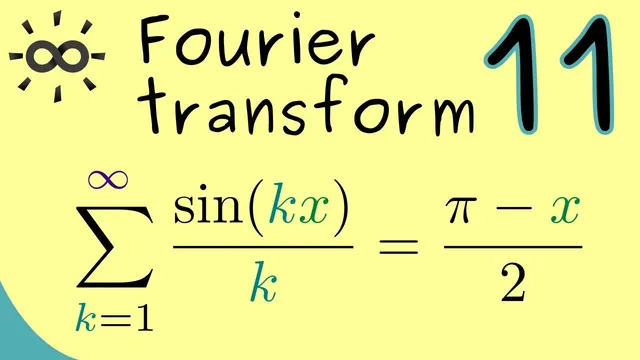
Fourier Transform 11 | Sum Formulas for Sine and Cosine
Based on The Bright Side of Mathematics's video on YouTube. If you like this content, support the original creators by watching, liking and subscribing to their content.
A finite sum of cosines is converted into a closed form by rewriting cosine with complex exponentials and evaluating a geometric series in .
Briefing
A precise closed-form expression for a cosine Dirichlet-type series is derived and then used to extend convergence results all the way to the endpoints of the interval. The payoff is an identity that holds for every real x between 0 and 2π (including 0 and 2π):
That formula matters because it was a crucial ingredient in the earlier step toward proving Parseval’s identity for a particular step function; without it, the chain of Fourier-series arguments can’t be completed.
The derivation starts by proving a finite “sum of cosines” identity. Using the exponential representation of cosine, cos(kx) is rewritten as an average of complex exponentials. The resulting finite sum becomes a geometric series in , which can be evaluated in closed form. After algebraic simplification, the expression is written using the sine function (via terms that appear after converting complex exponentials back to real quantities). A key restriction emerges: the geometric-sum denominator vanishes when is a multiple of 2π, so the finite-sum formula is valid for .
Next comes a lemma that controls a related series involving -type terms divided by . The lemma shows that a sign-function series converges uniformly to a simple limit on any closed subinterval that stays a positive distance away from 0 and 2π. The proof uses the earlier cosine-sum formula by expressing the sign function as an integral of cosine, then applying integration by parts to produce a factor of -type decay. Uniform convergence follows by bounding the supremum norm: the denominator’s sine term stays away from zero on , so the whole expression shrinks uniformly as .
With that lemma in hand, the main theorem is obtained by integrating the sign-series identity. Integration turns the -type structure into the desired cosine series, and uniform convergence justifies exchanging the limit with the integral—an operation that would be risky without uniform control. The remaining challenge is the endpoints x=0 and x=2π, where the earlier lemma didn’t apply directly. To bridge that gap, a Weierstrass M-test argument provides uniform convergence on the full interval, and continuity of the limit function forces the identity to extend to the boundary.
Finally, the constant term is pinned down by integrating both sides over a full period. The cosine terms average to zero over , leaving a simple polynomial integral that determines the constant . The result is a complete, endpoint-valid formula for the cosine series that underpins the Fourier-series proof strategy.
Cornell Notes
The series is evaluated in closed form on . The work begins with a finite cosine-sum identity derived by rewriting cosine using complex exponentials and summing a geometric series, yielding an expression in terms of sine functions (with a restriction excluding multiples of 2π). A key lemma then proves uniform convergence for a related sign-function series on , using an integral representation of the sign function, integration by parts, and supremum-norm bounds. Integrating the lemma produces the cosine series; uniform convergence plus continuity extends the identity to the endpoints. The remaining constant is determined by integrating over a full period, using that cosine averages to zero.
How does the proof turn a finite sum of cosines into a closed-form expression without a summation sign?
Why does the finite-sum formula fail at and other multiples of ?
What is the role of the lemma about sign-function series, and why is uniform convergence crucial?
How does integrating the sign-series identity produce the cosine series?
How are the endpoint values at and justified?
Review Questions
- What geometric-series substitution is used to eliminate the finite cosine sum, and what condition on x prevents division by zero?
- Where exactly does uniform convergence get used in the argument, and what operation would be unsafe without it?
- How is the constant term in determined, and why do cosine terms vanish when integrating over a full period?
Key Points
- 1
A finite sum of cosines is converted into a closed form by rewriting cosine with complex exponentials and evaluating a geometric series in .
- 2
The geometric-sum denominator forces the finite identity to exclude .
- 3
A lemma establishes uniform convergence for a related sign-function series on using an integral representation, integration by parts, and supremum-norm bounds.
- 4
Integrating the sign-series identity upgrades the structure to the target cosine series.
- 5
Uniform convergence on the full interval is extended via a Weierstrass M-test, and continuity then forces the formula to hold at and .
- 6
The constant is determined by integrating both sides over , where cosine terms average to zero over a full period.