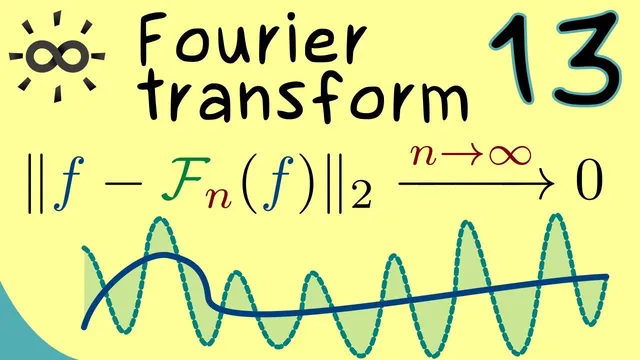
Fourier Transform 13 | Fourier Series Converges in L²
Based on The Bright Side of Mathematics's video on YouTube. If you like this content, support the original creators by watching, liking and subscribing to their content.
Fourier series for 2π-periodic functions in L² converge to the function in the L² norm, meaning ||f−f_n||₂→0 as n→∞.
Briefing
Fourier series for 2π-periodic, square-integrable functions converge in the L² sense: as n→∞, the L² norm of the difference between a function f and its nth Fourier partial sum f_n goes to zero. This is the key result because it upgrades earlier convergence facts from special classes of functions to the full space L², and it is equivalent to Parseval’s identity holding for every L² function—meaning the energy (norm squared) of f can be recovered from its Fourier coefficients.
The proof strategy starts by reframing the goal in Hilbert-space terms. Using the standard inner product on L² over [−π,π], the complex exponentials form an orthonormal system. For each f in L², the Fourier coefficients define an orthogonal projection onto the span of the first 2n+1 exponentials, so the error f−f_n is orthogonal to the projection space. That orthogonality is what later produces a “generalized Pythagorean theorem” inequality that controls the L² error.
The main technical hurdle is extending convergence from step functions (where Parseval’s identity was already established) to arbitrary L² functions. The argument relies on density: continuous functions are dense in L², and then step functions are dense in L² as well. Concretely, given any ε>0 and any f∈L², one first picks a continuous 2π-periodic function G with ||f−G||₂<ε. Because G is continuous on the compact interval [−π,π], it is uniformly continuous. That uniform continuity allows choosing a partition of [−π,π] into finitely many subintervals of length less than some δ so that G varies by less than ε across each subinterval.
From this partition, a step function H is constructed by taking, on each subinterval, the supremum (or equivalently a maximum on a closed version) of G. On almost every point (all but finitely many partition boundaries), the difference |G(x)−H(x)| is bounded by ε. Integrating the squared error then yields ||G−H||₂ bounded by a constant multiple of ε (the transcript gives √(2π·ε)). With the triangle inequality, ||f−H||₂ can be made arbitrarily small, proving step functions are dense in L².
Finally, the Fourier convergence for general f follows from a two-step approximation. Choose H close to f in L². Since Fourier partial sums converge to H in L² for step functions, ||H−f_n(H)||₂→0. For the remaining gap, orthogonality of the Fourier projection gives an inequality: the L² error ||f−f_n(f)||₂ is controlled by ||f−H||₂ plus the vanishing term ||H−f_n(H)||₂. Taking n→∞ and using that ε was arbitrary forces the limit error to be zero. The result is L² convergence (not pointwise), completing the extension of Parseval’s identity to all of L².
Cornell Notes
For 2π-periodic functions in L², Fourier partial sums converge to the function in the L² norm. The proof hinges on two ideas: (1) step functions are dense in L², and (2) Fourier partial sums act as orthogonal projections in the Hilbert space L², giving a generalized Pythagorean control of errors. Density is established by approximating an L² function f by a continuous function G, then using uniform continuity of G on [−π,π] to build a step function H whose values track G on each small subinterval. Once ||f−H||₂ is small and Fourier convergence holds for step functions, orthogonality and the triangle inequality force ||f−f_n||₂→0. This is exactly the L² version of Parseval’s identity for all L² functions.
Why does the argument focus on L² convergence instead of pointwise convergence?
How does density of step functions in L² get proved?
What role does orthogonality play in the final convergence step?
Why is the approximation by a step function H enough to prove convergence for an arbitrary f?
How does Parseval’s identity connect to L² convergence?
Review Questions
- What two density results are used to reduce the general L² case to step functions, and how is uniform continuity used in the step-function construction?
- Where exactly does orthogonality enter the proof, and how does it produce a Pythagorean-type estimate for the L² error?
- Why does the final argument yield L² convergence rather than pointwise convergence?
Key Points
- 1
Fourier series for 2π-periodic functions in L² converge to the function in the L² norm, meaning ||f−f_n||₂→0 as n→∞.
- 2
L² convergence is equivalent to Parseval’s identity holding for all L² functions, linking Fourier coefficients to the function’s energy.
- 3
Continuous 2π-periodic functions are dense in L², so any L² function can be approximated arbitrarily well in L² by a continuous one.
- 4
Uniform continuity of a continuous approximation on [−π,π] enables constructing a step function H whose values track G on each small subinterval.
- 5
A step function H is built by taking the supremum of G on each subinterval, ensuring |G−H| is small except at finitely many boundary points.
- 6
Fourier partial sums act as orthogonal projections in L², and orthogonality yields a generalized Pythagorean control of the approximation error.
- 7
Combining density (f≈H) with Fourier convergence for step functions (H≈f_n(H)) forces the error for f to vanish in the L² norm.