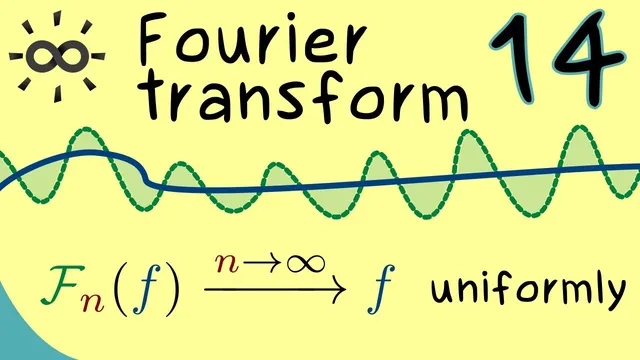
Fourier Transform 14 | Uniform Convergence of Fourier Series
Based on The Bright Side of Mathematics's video on YouTube. If you like this content, support the original creators by watching, liking and subscribing to their content.
Uniform convergence of Fourier series is measured using the supremum norm ∥f − Fn∥∞ = supx∈[−π,π] |f(x) − Fn(x)|, not the L2 norm.
Briefing
Fourier series typically converge in an L2 sense, meaning the “average squared error” over a period goes to zero, but point-by-point convergence is not guaranteed in general. For a special class of functions, that limitation can be overcome: if a 2π-periodic function is continuous and piecewise C1 (with only finitely many points where differentiability fails), then its Fourier series converges uniformly—so the maximum error across the entire interval shrinks to zero.
The discussion starts by contrasting what L2 convergence guarantees with what the eye often suggests. In L2, the quantity ∥f − Fn∥2 → 0 as n → ∞ only controls the integral of the squared difference, not the value at each point. Still, sketches of partial sums often look like they track the function closely almost everywhere, raising the natural question of when stronger convergence can be proven.
Uniform convergence requires working with the supremum (uniform) norm, ∥g∥∞ = supx∈[−π,π] |g(x)|, rather than the L2 norm. The transcript derives a key relationship between these norms for 2π-periodic functions on a bounded interval: the supremum norm dominates the L2 norm. Concretely, because |f(x)| ≤ ∥f∥∞ for all x, the squared integral over a length-2π interval is bounded by 2π∥f∥∞^2, yielding ∥f∥2 ≤ √(2π)∥f∥∞. This inequality shows that uniform convergence is strictly stronger than L2 convergence: if the maximum pointwise error goes to zero, then the L2 error must also go to zero, but not vice versa.
To illustrate the function class needed for uniform convergence, the transcript uses a piecewise C1 example: a function that is smooth on each subinterval but has finitely many corners or nondifferentiable points. The only additional global requirement is continuity across the period boundary—so the function’s value at π matches its value at −π, preventing jumps when the function is extended periodically.
The central theorem is then stated for 2π-periodic f that are continuous on all real numbers and piecewise C1 with finitely many breakpoints inside [−π, π]. Under these assumptions, the Fourier series partial sums Fn satisfy uniform convergence in the supremum norm: ∥f − Fn∥∞ → 0 as n → ∞. The Fourier series itself is framed as an orthogonal projection in L2 onto the span of exponential basis functions ek, i.e., the standard complex exponentials used in Fourier analysis.
Finally, the transcript notes that the theorem’s proof requires leaving the comfortable Hilbert-space geometry of L2 and instead controlling the uniform norm, setting up the next step for a more detailed argument in a follow-up video.
Cornell Notes
Fourier series always have an L2 convergence guarantee for square-integrable functions, but that does not ensure pointwise convergence. Uniform convergence is stronger and is measured using the supremum (uniform) norm, ∥g∥∞ = supx∈[−π,π] |g(x)|. For 2π-periodic functions on a bounded interval, the supremum norm controls the L2 norm (∥f∥2 ≤ √(2π)∥f∥∞), so uniform convergence implies L2 convergence. A key result is that if f is continuous and piecewise C1 with only finitely many nondifferentiable points (and periodic continuity at −π and π), then the Fourier series partial sums converge uniformly: ∥f − Fn∥∞ → 0. This turns Fourier series into a reliable pointwise approximation tool for that function class.
Why doesn’t L2 convergence automatically give pointwise convergence for Fourier series?
What role does the supremum (uniform) norm play in proving stronger convergence?
How does the relationship between ∥·∥∞ and ∥·∥2 clarify why uniform convergence is stronger?
What does “piecewise C1 with finitely many points” mean in the theorem’s assumptions?
What is the Fourier series being used, in terms of basis functions?
Review Questions
- What exactly changes when moving from L2 convergence to uniform convergence in Fourier series?
- How do continuity and finitely many nondifferentiable points combine to make uniform convergence possible?
- Use the norm inequality to explain why uniform convergence automatically implies L2 convergence.
Key Points
- 1
Uniform convergence of Fourier series is measured using the supremum norm ∥f − Fn∥∞ = supx∈[−π,π] |f(x) − Fn(x)|, not the L2 norm.
- 2
L2 convergence controls average squared error over a period and does not guarantee pointwise convergence at every x.
- 3
For 2π-periodic functions on a bounded interval, the supremum norm dominates the L2 norm: ∥f∥2 ≤ √(2π)∥f∥∞.
- 4
If f is continuous and piecewise C1 with only finitely many nondifferentiable points (and periodic continuity at −π and π), then the Fourier series converges uniformly.
- 5
The theorem’s function class allows corners or nondifferentiability, as long as they are finite in number and the function remains continuous across the period boundary.
- 6
Fourier series partial sums are framed as orthogonal projections in L2 onto exponential basis functions, but proving uniform convergence requires stronger norm control than L2 geometry alone provides.