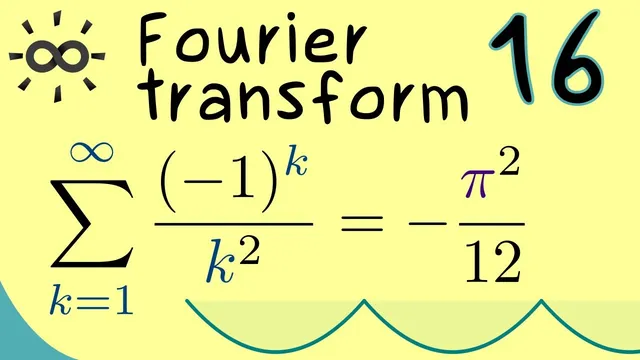
Fourier Transform 16 | Calculating Sums with Fourier Series
Based on The Bright Side of Mathematics's video on YouTube. If you like this content, support the original creators by watching, liking and subscribing to their content.
Extending f(x)=x^2−π^2 periodically with period 2π produces a Fourier series that converges uniformly on [−π,π], enabling pointwise substitution.
Briefing
A carefully chosen 2π-periodic parabola lets Fourier series turn hard-looking infinite sums into clean, closed-form identities involving powers of π. By extending the function f(x)=x^2−π^2 (defined on −π≤x≤π) periodically, the resulting Fourier series converges uniformly (hence pointwise everywhere), so the series can be equated directly to the function at every x in [−π,π]. That pointwise equality becomes a machine for generating sum formulas.
The construction starts by defining f on −π to π as the parabola with zeros at x=±π and a minimum at x=0. With that definition in hand, the Fourier coefficients are computed using the complex form c_k=(1/2π)∫_{−π}^{π} e^{−ikx}f(x)dx. The constant term c_0 comes from integrating x^2−π^2, yielding c_0=−(2/3)π^2. For k≠0, integration by parts repeatedly reduces the coefficient integrals to expressions involving the derivative f′(x)=2x and boundary terms. The periodicity forces one integral term to vanish, leaving a boundary contribution that simplifies using e^{ikπ}=±1. The final result is c_k=2(−1)^k/k^2 for k≠0.
Building the Fourier series and using Euler’s formula e^{ikx}=cos(kx)+i sin(kx), the real-valued identity collapses to a cosine-only series. On −π≤x≤π, the parabola satisfies x^2−(1/3)π^2 = Σ_{k=1}^{∞} (4/k^2)(−1)^k cos(kx), with uniform convergence ensuring the equality holds pointwise.
Plugging in x=0 removes the cosine factor (cos(0)=1), producing an alternating-sum identity: −(1/3)π^2 = Σ_{k=1}^{∞} (4/k^2)(−1)^k. Rearranging gives Σ_{k=1}^{∞} (−1)^k/k^2 = −π^2/12.
A second payoff comes from Parseval’s identity, which relates the L^2 norm of f to the sum of squared Fourier coefficients. After accounting for the exceptional c_0 term, the remaining coefficients contribute Σ_{k=1}^{∞} |c_k|^2 = Σ_{k=1}^{∞} 4/k^4 (since (−1)^k disappears under absolute value). The right-hand side becomes (1/2π)∫_{−π}^{π} (x^2−π^2)^2 dx, which evaluates to (8/15)π^4. Solving for the remaining series yields Σ_{k=1}^{∞} 1/k^4 = π^4/90.
The overall message is practical: once a function meets the Fourier-series regularity conditions, the resulting expansion can be engineered to extract classic constants from infinite sums. The final segment hints at a next step—whether these conclusions survive under weaker convergence assumptions—setting up the next installment.
Cornell Notes
A periodic parabola f(x)=x^2−π^2 (extended with period 2π) has Fourier coefficients c_0=−(2/3)π^2 and, for k≠0, c_k=2(−1)^k/k^2. The Fourier series converges uniformly on [−π,π], so the series equals the function pointwise there. Converting the complex series to a cosine series gives x^2−(1/3)π^2 = Σ_{k=1}^{∞} (4/k^2)(−1)^k cos(kx). Setting x=0 yields the alternating sum Σ_{k=1}^{∞} (−1)^k/k^2 = −π^2/12, and Parseval’s identity then gives the classic result Σ_{k=1}^{∞} 1/k^4 = π^4/90. These identities show how Fourier series can compute nontrivial infinite sums via boundary terms and orthogonality.
How does choosing f(x)=x^2−π^2 on [−π,π] lead to sum identities?
Why do integration by parts and periodicity simplify the coefficient calculation for c_k (k≠0)?
What is the key Fourier-series identity obtained for x in [−π,π]?
How does x=0 produce the alternating sum Σ (−1)^k/k^2?
How does Parseval’s identity produce Σ 1/k^4 = π^4/90?
Review Questions
- What are the explicit Fourier coefficients c_0 and c_k (k≠0) for the periodic extension of f(x)=x^2−π^2, and how does periodicity determine the (−1)^k factor?
- Why is it legitimate to plug x=0 into the Fourier series, and what convergence property makes that step reliable?
- Using the cosine-series identity, derive the alternating sum for 1/k^2 step by step, then check it against the final closed form −π^2/12.
Key Points
- 1
Extending f(x)=x^2−π^2 periodically with period 2π produces a Fourier series that converges uniformly on [−π,π], enabling pointwise substitution.
- 2
The constant Fourier coefficient is c_0=−(2/3)π^2, obtained by integrating x^2−π^2 over [−π,π].
- 3
For k≠0, repeated integration by parts plus the vanishing of ∫_{−π}^{π} e^{−ikx}dx yields c_k=2(−1)^k/k^2.
- 4
Converting the complex series to a real cosine series gives x^2−(1/3)π^2 = Σ_{k=1}^{∞} (4/k^2)(−1)^k cos(kx).
- 5
Setting x=0 turns the cosine series into an alternating sum, giving Σ_{k=1}^{∞} (−1)^k/k^2 = −π^2/12.
- 6
Parseval’s identity converts the L^2 norm of f into Σ |c_k|^2, leading to Σ_{k=1}^{∞} 1/k^4 = π^4/90 after evaluating (1/2π)∫_{−π}^{π} (x^2−π^2)^2 dx.