Fourier Transform 17 | Pointwise Convergence of Fourier Series
Based on The Bright Side of Mathematics's video on YouTube. If you like this content, support the original creators by watching, liking and subscribing to their content.
Fourier series for a 2π-periodic L2 function converge in the L2 norm, but that does not ensure pointwise convergence at every x.
Briefing
Fourier series don’t just converge in an average (L2) sense—they also converge point-by-point under a set of local “one-sided” smoothness conditions. For a 2π-periodic function f that is square-integrable (an L2 function), Fourier series are guaranteed to converge to f in the L2 norm, but that guarantee says nothing about what happens at individual points. Pointwise convergence requires extra structure, and the key insight here is that global continuity and differentiability are stronger than necessary: it’s enough that f behaves well from the left and from the right at the specific point where convergence is being tested.
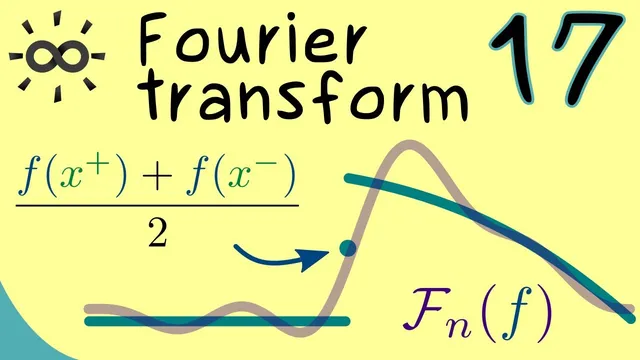
Fix a point x0. The Fourier series at x0 converges if the left-hand and right-hand limits of f exist at x0, and if the corresponding one-sided derivatives also exist. Concretely, the left limit lim_{ε→0+} f(x0−ε) and the right limit lim_{ε→0+} f(x0+ε) must both exist; the function may jump, and the actual value f(x0) itself is irrelevant. The same one-sided requirement applies to the slope: the left derivative computed by approaching from x0−ε and the right derivative computed by approaching from x0+ε must exist as well. Under these conditions, the Fourier series converges pointwise at x0 to a specific number: if f is continuous at x0, the limit equals f(x0); if f has a jump at x0, the Fourier series converges to the midpoint (arithmetic mean) of the left and right limits. This is the classic “Gibbs-style” phenomenon in a precise convergence form: Fourier series can’t detect a single assigned value at a discontinuity, only the limiting behavior from either side.
To make the rule concrete, the discussion builds an explicit 2π-periodic function with a jump of size π at the origin. On one side it is constant, and on the other it is linear: on (0,π) it takes the form π−x, then the function is extended periodically. The jump at x=0 is between the left and right limiting values, and the midpoint prediction says the Fourier series should converge at x=0 to π/2. The transcript then computes the Fourier coefficients. The constant term comes from integrating the function over one period, yielding a0 = π/4. For k≠0, integration by parts produces coefficients of the form c_k involving terms like (−1)^k and 1/k^2, plus an additional factor proportional to 1/k. Using Euler’s formula, the complex Fourier series is rewritten into the standard real form with cosine and sine coefficients (a_k and b_k), where b_k simplifies to 1/k and a_k involves (1−(−1)^k)/k^2.
Finally, the Fourier series is assembled as a finite sum for each n and visualized numerically. The plot and the stated limit behavior confirm the theoretical prediction: as n grows, the partial sums approach π/2 at the origin, while the sine terms vanish at x=0 (since sin(0)=0) and the cosine terms remain. The payoff is twofold: a rigorous pointwise convergence criterion based only on one-sided limits and derivatives, and a practical way to extract explicit infinite-sum identities from Fourier series by evaluating them at special points like x=0.
Cornell Notes
For a 2π-periodic L2 function f, Fourier series always converge in the L2 norm, but pointwise convergence at a specific point x0 needs local conditions. It’s enough that f has both left and right limits at x0 and that the one-sided derivatives from each side exist. The Fourier series then converges at x0 to f(x0) if f is continuous there; if f jumps, the limit equals the midpoint (average) of the left and right limiting values. The actual value assigned to f(x0) itself doesn’t affect the Fourier-series limit at that point. An explicit example with a jump of size π at x=0 predicts and numerically confirms convergence to π/2 at the origin.
Why does L2 convergence not guarantee pointwise convergence for Fourier series?
What local conditions at a point x0 ensure pointwise convergence of the Fourier series?
What value does the Fourier series converge to at a jump discontinuity?
In the worked example, how does the midpoint rule predict the Fourier-series value at x=0?
Why do the sine terms vanish when evaluating the Fourier series at x=0?
Review Questions
- At a point x0 where f has a jump, which quantities determine the Fourier-series limit: f(x0), the one-sided limits, or both?
- What additional requirement beyond existence of left/right limits is needed for the pointwise convergence criterion described here?
- How does evaluating a Fourier series at a special point like x=0 simplify the expression, and which trigonometric terms disappear?
Key Points
- 1
Fourier series for a 2π-periodic L2 function converge in the L2 norm, but that does not ensure pointwise convergence at every x.
- 2
Pointwise convergence at a fixed point x0 depends only on local behavior at x0, not on global continuity.
- 3
If both one-sided limits of f at x0 exist and both one-sided derivatives exist, the Fourier series converges pointwise at x0.
- 4
At continuity points, the Fourier-series limit equals f(x0).
- 5
At jump discontinuities, the Fourier-series limit equals the midpoint (f(x0−)+f(x0+))/2, and the value f(x0) itself is irrelevant.
- 6
In the example with a π-sized jump at x=0, the Fourier series converges to π/2 at the origin.
- 7
Evaluating at x=0 kills all sine terms because sin(k·0)=0, leaving only cosine contributions and the constant term.