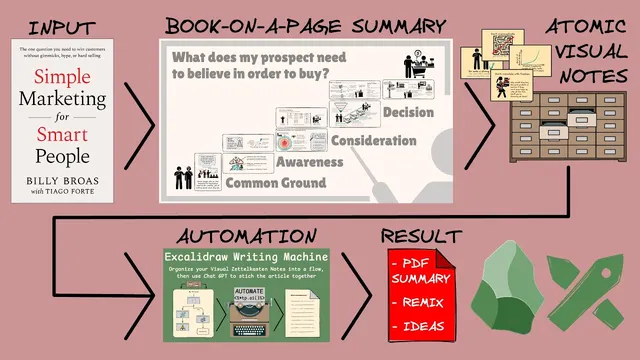
From Simple Marketing for Smart People To Book-on-a-Page and Article with Excalidraw Writing Machine
Based on Zsolt's Visual Personal Knowledge Management's video on YouTube. If you like this content, support the original creators by watching, liking and subscribing to their content.
Treat marketing as teaching by building the specific beliefs prospects need to buy.
Briefing
Marketing for smart people is framed as a form of teaching: businesses should educate prospects about the beliefs they must hold to buy, then guide them through a structured journey from common ground to awareness, consideration, and decision. The practical payoff is time efficiency—when only about 90 minutes per week is available, the highest-leverage work sits “upstream,” focused on core beliefs rather than downstream gimmicks like urgency tactics or flashy channels.
The core mechanism is the Upstream-Downstream approach. Upstream is beliefs building: identify what a prospect needs to believe in order for the purchase to feel like the logical next step. Downstream is everything else—marketing channels such as Facebook or Twitter, and tactics that often get mistaken for the real work. The argument is that if the upstream belief system is correct, the downstream execution becomes easier and sometimes unnecessary.
Thiago Forte’s contribution is the idea that this belief journey can be mapped rather than treated as random messaging. Beliefs build on one another; missing even one link can derail a sale. Prospects can be grouped into four layers: people at the center who are already ready to buy (they know the topic and trust the business), “hot prospects” who understand the problem and solution but need reassurance on value, timing, ease of use, and trustworthiness, “warm prospects” who come from competitors and need a clear explanation of differentiation, and “cold prospects”—described as the vast majority online—who may not even realize they have a problem or know the topic.
To move each group forward, the content strategy starts with common ground: meet prospects where their current beliefs are, then build from there. The transcript highlights three ways to listen for what prospects need. First, “listen for bad questions” that reveal the wrong priority—e.g., asking how to draw prettier pictures instead of how to get thoughts onto paper to spatially organize ideas. Second, use “what and how” questions rather than “why,” which can sound judgmental. Third, “peak into the cycles” of a prospect’s life by identifying habitual patterns that lead to outcomes, then helping them change the process.
As beliefs accumulate, content should match the stage of the ladder. For cold prospects: help them see the problem, learn the basics, understand solution categories, differentiate the product, clarify the full offer (not just price, but services, knowledge, relationship, and conditions), and finally make the timing feel right. The emotional target shifts by stage: awareness content should trigger recognition (“this person gets me”), consideration should position the product as viable while invalidating alternatives, and decision content should reinforce trust and correctness of the choice.
Compelling content is treated like a courtroom case built on claims supported by proof. Three proof modes are emphasized: ethos (authority via testimonials, data, third-party reviews), pathos (emotion via stories, vivid language, symbolic images), and logos (logic explaining how and why the solution works). A common creator trap is relying on topic-based content that attracts the wrong audience; the alternative is message-first, proof-backed writing.
The transcript then demonstrates how these ideas are operationalized using Excalidraw writing workflows inside Obsidian. Visual “cards” store markdown notes with sources, highlights, and summaries; arrows connect them into a storyline; and an “Excalidraw Writing Machine” prompt feeds linked images and text into ChatGPT to generate an article that can be exported to PDF. The creator also outlines upcoming changes to the Visual Thinking Workshop: a course built around Annie Murphy Paul’s “The Extended Mind,” plus a shift in cohorts toward dialogue, joint practice, and creating together—using Excalidraw and Obsidian as free tooling while keeping the approach transferable to other systems.
Cornell Notes
Marketing is presented as teaching: identify the beliefs prospects must hold to buy, then guide them through awareness, consideration, and decision. The Upstream-Downstream method puts most effort upstream on beliefs building, while channels and tactics sit downstream and become easier once the belief chain is correct. Prospects can be segmented into ready-to-buy center users, hot prospects needing value/timing/trust, warm prospects coming from competitors, and cold prospects who may not even recognize the problem. Content should match each stage—evoking “this person gets me” at awareness, proving viability and differentiation at consideration, and reinforcing trust at decision. Proof-driven messaging uses ethos, pathos, and logos, and the workflow is supported by Excalidraw/Obsidian card-to-article generation.
What does “marketing as teaching” mean in practical terms?
How does the Upstream-Downstream framework change what a marketer should do with limited time?
Why does mapping the belief journey matter, and what happens if a belief link is missing?
How should content differ for cold, warm, and hot prospects?
What are the three “listening” approaches for finding the right questions to guide prospects?
How do ethos, pathos, and logos translate into building stronger marketing claims?
Review Questions
- What upstream beliefs must be true for a prospect to buy, and how would you identify them from the questions prospects ask?
- How would you design a content ladder for cold prospects that ends with a decision-ready offer (including timing and trust)?
- Where would you place channels and tactics in your workflow, and what would you do instead if you only had 90 minutes per week?
Key Points
- 1
Treat marketing as teaching by building the specific beliefs prospects need to buy.
- 2
Use the Upstream-Downstream approach: prioritize upstream beliefs building over downstream channels and tactics.
- 3
Map the belief journey as a chain; missing a belief link can break the path to purchase.
- 4
Segment prospects by readiness (center, hot, warm, cold) and tailor content to each stage’s missing beliefs.
- 5
Listen for bad questions, prefer what/how over why, and analyze life cycles to find process changes prospects need.
- 6
Build content like a case using claims backed by ethos (authority), pathos (emotion), and logos (logic).
- 7
Operationalize the workflow with Excalidraw/Obsidian cards that store sources and summaries, connect into a storyline, and generate articles with linked images.