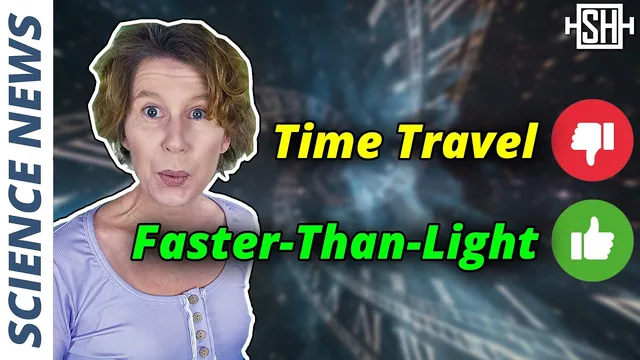
Good news for faster-than-light travel. Bad news for time travel.
Based on Sabine Hossenfelder's video on YouTube. If you like this content, support the original creators by watching, liking and subscribing to their content.
A quantum time loop can be mathematically consistent only if entropy decreases along the loop, implying increasing order.
Briefing
Time travel through a wormhole-like “time loop” runs into a quantum-level constraint: the only consistent past-return scenario requires the system to reverse its entropy—meaning the traveler would effectively have to get younger as they go back. That finding matters because it directly targets the common hope that time travel might work once quantum physics is taken seriously, and it does so by tying the possibility of a time loop to the thermodynamic arrow of time.
In everyday life, time has a clear direction: broken glass doesn’t unbreak, rain doesn’t rise, and people age forward. Physicists often summarize this asymmetry as the “error of time,” typically linked to entropy increasing for large collections of particles. The transcript emphasizes that this arrow of time is not fundamental at the level of individual quantum particles, which don’t inherently distinguish “forward” from “backward.” The new study instead asks what happens when many quantum particles are placed in a spacetime that contains a time loop—something not observed in our universe but mathematically allowed in general relativity.
The analysis considers an object sent through a wormhole into its own past and tracks the entropy behavior of a many-particle quantum system. The result aligns with a “science fiction option” that preserves consistency without allowing the classic paradoxes: you can return to the past only if you already have been there, but with a crucial twist—entropy must decrease along the loop. In the example used to make the idea intuitive, a mixed dough (where stirring normally increases entropy and reduces order) would, under a time loop, “unmix” spontaneously. That reversal is presented as the only mathematically possible way to keep the loop consistent.
The transcript then draws a physical interpretation: if entropy reversal is tied to the same thermodynamic structure that underlies memory and the experienced arrow of time, then a person wouldn’t feel themselves traveling backward. Instead, the loop would manifest as two different routes into the future, not a subjective rewind of experience.
While this is bad news for time travel, it supports a separate claim about faster-than-light travel. Many physicists argue that faster-than-light motion would also enable time travel because different observers can disagree on whether a superluminal trajectory corresponds to moving backward in time. The transcript counters that this inconsistency doesn’t follow if the universe’s entropy-based arrow of time (“error of time”) prevents actual backward-in-time effects. The new quantum time-loop result is presented as additional support for that broader conclusion: faster-than-light travel may be constrained, but it doesn’t automatically generate paradoxical time travel at the quantum level.
Cornell Notes
Quantum time travel via a wormhole-like “time loop” is mathematically possible only if the many-particle system reverses its entropy. That requirement corresponds to a thermodynamic arrow-of-time reversal: order increases and entropy decreases along the loop, like a dough spontaneously unmixing. The scenario matches a consistent “already been there” style of time travel, but with a twist—going back would entail getting younger. Interpreting the entropy reversal as tied to memory and experienced time direction suggests people wouldn’t experience a subjective rewind; instead, the loop yields different paths into the future. The implication is that quantum physics blocks classic paradoxes, undermining the idea that time travel becomes workable once quantum effects are included.
Why do paradoxes arise in popular time-travel stories, and what does the transcript call the everyday source of time’s direction?
What changes when the analysis moves from everyday objects to quantum particles?
What does the new calculation require for a consistent time loop?
How does the transcript interpret the “already been there” solution, and what twist does it add?
Why does the transcript argue that people wouldn’t experience time travel as a personal rewind?
How does this connect to faster-than-light travel and the claim that it would enable time travel?
Review Questions
- In a time loop, what must happen to entropy for the scenario to remain consistent, and why is that requirement central to the argument?
- How does the transcript reconcile the lack of a fundamental time direction for individual quantum particles with the emergence of a macroscopic arrow of time?
- What does the entropy reversal imply about how a traveler would experience time, according to the memory/arrow-of-time connection?
Key Points
- 1
A quantum time loop can be mathematically consistent only if entropy decreases along the loop, implying increasing order.
- 2
Classic time-travel paradoxes are avoided by a “consistent history” structure where the traveler can’t create contradictions.
- 3
The entropy reversal requirement implies a twist: going back in time would correspond to getting younger.
- 4
Because entropy reversal is tied to the thermodynamic arrow that underpins memory, the transcript argues people wouldn’t experience a subjective rewind.
- 5
The “error of time” is treated as a macroscopic, many-particle phenomenon rather than a fundamental quantum rule.
- 6
The result is used to support the idea that faster-than-light travel doesn’t automatically produce paradoxical time travel, since the arrow of time blocks inconsistencies.