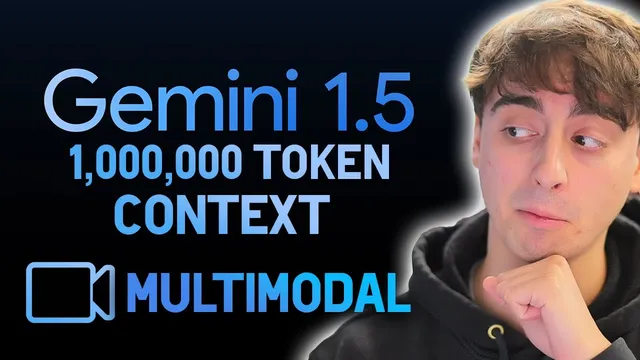
Googles Attempt to take on Open AI
Based on MattVidPro's video on YouTube. If you like this content, support the original creators by watching, liking and subscribing to their content.
Gemini 1.5 Pro is presented as supporting up to a 1 million token context window, enabling reasoning across extremely large multimodal inputs like long videos, books, and massive codebases.
Briefing
Google’s Gemini 1.5 Pro is positioned as a direct leap in long-context, multimodal AI—capable of handling up to a 1 million token context window and ingesting huge real-world inputs like hour-long videos, massive document collections, and long codebases. The practical promise is that models can stay useful when users need reasoning across far more material than typical chat windows allow, reducing the need to chunk information and potentially improving consistency on complex tasks. The stakes are clear: long-context performance is one of the hardest problems in modern LLM systems, and prior attempts have struggled to maintain reliability at extreme context lengths.
The announcement centers on Gemini 1.5 Pro’s multimodal and long-context capabilities, backed by Google’s “mixture of experts” (MoE) approach. Instead of activating one monolithic network, MoE splits the model into smaller expert pathways and selectively activates the most relevant parts for a given input type, improving efficiency for training and serving. Google also frames Gemini 1.5 as “efficient to train and serve,” with infrastructure and foundation-model engineering improvements meant to speed iteration on future versions.
A key comparison point in the discussion is how context windows affect consistency. The transcript contrasts Gemini 1.5 Pro’s claimed 1 million token window with other systems—such as GPT-4 Turbo at 128,000 tokens and Claude 2.1 at 200,000 tokens—arguing that Claude’s larger window can degrade performance because it becomes too much data to process reliably in one go. That sets up the central question for Gemini 1.5 Pro: can it maintain accuracy and avoid breakdowns like hallucinations when pushed to extreme context sizes?
To make the case, the transcript highlights multiple demos from Google: a 402-page Apollo 11 transcript (about 330,000 tokens) where the model identifies comedic moments, extracts quotes, and returns correct time codes; and a 44-minute Buster Keaton film (over 600,000 tokens) where it pinpoints a specific moment and accurately extracts details from a pawn ticket shown in the scene. Additional examples focus on code understanding and multimodal retrieval—such as scanning hundreds of Three.js examples (over 800,000 tokens) to find relevant animation techniques, modify code to add a slider, and locate code matching a screenshot. These demonstrations aim to show not just “reading” long inputs, but performing targeted reasoning and editing across them.
Availability is limited: Gemini 1.5 Pro is described as entering early testing for a limited group of developers and enterprise customers, with up to 1 million tokens offered via private preview in AI Studio and Vertex AI. The transcript also frames the timing as competitive pressure—coming right after OpenAI’s Sora text-to-video model stole attention—while still emphasizing that Google’s long-context work may be a meaningful differentiator.
Beyond Google, the transcript surveys other AI developments from the same day: Meta’s V-JEPA approach for learning physical-world understanding from videos using unlabeled data; an upscaling tool from Krea AI with more adjustable settings and free access; and Lindy opening to the public as an AI agent platform with thousands of integrations (including Gmail, Google Sheets, Outlook, and Slack) and workflows built from triggers and actions. Together, the theme is clear: AI systems are rapidly expanding from short, text-only interactions into long-context, multimodal reasoning and agentic automation.
Cornell Notes
Gemini 1.5 Pro is presented as Google’s major push into long-context, multimodal AI, with a claimed up to 1 million token context window. The model is built for efficiency using a mixture of experts (MoE) architecture, aiming to keep performance usable even when ingesting extremely large inputs. Demos described in the transcript include extracting quotes and time codes from a 402-page Apollo 11 transcript (~330,000 tokens), locating events in a 44-minute Buster Keaton film (>600,000 tokens), and navigating or modifying large Three.js code collections (>800,000 tokens). The practical question is whether reliability holds at extreme context sizes, since other systems can degrade when the window gets too large. Access is limited to early developer and enterprise testing via AI Studio and Vertex AI private preview.
Why does a 1 million token context window matter, and what kinds of inputs does it enable?
What is the main reliability concern with very large context windows?
How does mixture of experts (MoE) relate to Gemini 1.5 Pro’s efficiency and performance?
What do the Apollo 11 and Buster Keaton demos try to prove?
How do the Three.js code demos demonstrate more than “reading” long inputs?
What other AI releases are mentioned, and how do they fit the broader theme?
Review Questions
- What evidence from the Apollo 11 and Buster Keaton examples is used to argue that Gemini 1.5 Pro can retrieve precise details from extremely long inputs?
- How does the transcript connect MoE architecture to the feasibility of training and serving a model with a very large context window?
- What reliability problem is raised when comparing different context windows, and how does that shape expectations for Gemini 1.5 Pro’s 1 million token claim?
Key Points
- 1
Gemini 1.5 Pro is presented as supporting up to a 1 million token context window, enabling reasoning across extremely large multimodal inputs like long videos, books, and massive codebases.
- 2
Google attributes efficiency gains to mixture of experts (MoE), where only relevant expert pathways activate based on the input type.
- 3
A central concern is whether models remain consistent at extreme context sizes, since some systems can degrade when the context becomes too large to process reliably.
- 4
Google’s long-context demos emphasize precise retrieval—correct quotes and time codes in the Apollo 11 transcript and accurate event localization and text extraction in a Buster Keaton film.
- 5
Gemini 1.5 Pro’s code demos aim to show practical engineering value: searching large example libraries, modifying code, and using screenshots to find matching implementations.
- 6
Gemini 1.5 Pro is limited to early testing for developers and enterprise customers, with up to 1 million tokens available via private preview in AI Studio and Vertex AI.
- 7
Other mentioned releases include Meta’s V-JEPA for learning from unlabeled video data, Krea AI’s free upscaling settings, and Lindy’s public AI agent platform with thousands of integrations.