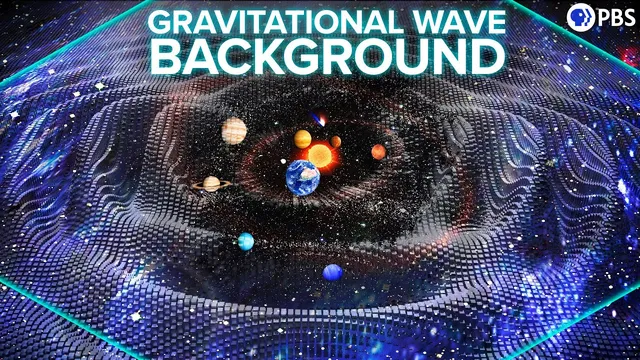
Gravitational Wave Background Discovered?
Based on PBS Space Time's video on YouTube. If you like this content, support the original creators by watching, liking and subscribing to their content.
The gravitational-wave background is the combined, persistent signal from many weak gravitational-wave sources across cosmic history.
Briefing
Gravitational-wave astronomy is moving from detecting individual cosmic collisions to hunting a persistent “background hum” that should permeate the universe. LIGO and Virgo have already recorded dozens of strong gravitational-wave events from merging black holes and neutron stars, but those detections only represent the loudest ripples. The next target is the gravitational-wave background: the combined signal from countless weaker events across cosmic history, potentially carrying clues about the most massive black holes, the evolution of galaxies, and even physics from before the Big Bang.
The challenge is that different gravitational waves stretch and squeeze space on different length scales, which means different detectors are sensitive to different frequencies. LIGO’s four-kilometer arms make it effective for relatively high-frequency waves produced by compact, near-in-time mergers, but it cannot see the much longer-wavelength waves expected from supermassive black hole binaries, cosmic strings, or inflation-era processes. To reach those scales, researchers turn to pulsar timing arrays—galaxy-spanning networks of extremely stable neutron-star clocks. Pulsars emit radio pulses with remarkable regularity, and a passing gravitational wave changes the effective distance to Earth, nudging the arrival times of pulses. A single pulsar can’t distinguish this effect from other disturbances, but an array can: gravitational waves imprint a characteristic correlation pattern across many pulsars depending on where they sit in the sky.
That is where the recent tentative result comes in. The North American Nanohertz Observatory for Gravitational Waves (NANOGrav), a collaboration of more than 100 U.S. and Canadian researchers, reported in early January at an American Astronomical Society meeting that 12.5 years of observations show correlated timing residuals across 47 millisecond pulsars monitored with the Green Bank Observatory and the Arecibo Observatory (before Arecibo’s collapse in December 2020). NANOGrav did not identify a single resolvable gravitational-wave source; instead, it found the kind of subtle, array-wide correlations expected from the gravitational-wave background—an overlapping set of effects too weak to detect individually.
The key scientific payoff is what comes next: the background’s frequency spectrum can help discriminate between possible origins. A spectrum’s shape and slope could point toward contributions from supermassive black hole populations, cosmic strings, or gravitational waves generated during the inflationary epoch, or some mixture of all three. Current sensitivity is not yet enough to measure the spectrum precisely, but the method is designed to improve as more pulsars are added, observations continue longer, and additional radio telescopes join the international pulsar timing array effort. If the signal holds up, it would open a new observational window on the universe’s most extreme events and on fundamental physics beyond today’s imagination.
Cornell Notes
The gravitational-wave background is the universe-wide “sum” of countless gravitational waves too weak to detect one by one. LIGO and Virgo find high-frequency waves from nearby, powerful mergers, but longer-wavelength waves require a different approach. Pulsar timing arrays use millisecond pulsars as extremely stable clocks; gravitational waves slightly change pulse travel times, producing correlated timing residuals across many pulsars. NANOGrav reported tentative evidence for such correlations after 12.5 years of monitoring 47 pulsars, using Green Bank Observatory data and earlier Arecibo observations. If confirmed, the background’s spectrum could distinguish between sources like supermassive black hole binaries, cosmic strings, and inflation-era gravitational waves.
Why can’t LIGO detect the gravitational-wave background directly?
How does a pulsar timing array turn gravitational waves into measurable data?
What makes millisecond pulsars useful as “galactic clocks”?
What did NANOGrav report, and how is it different from detecting a single event?
Why does the background’s spectrum matter scientifically?
What are key astrophysical or instrumental effects that can mimic timing changes?
Review Questions
- Explain how a gravitational wave produces correlated timing residuals in a pulsar timing array, and why correlations across many pulsars are essential.
- Compare the frequency/wavelength ranges to which LIGO and pulsar timing arrays are sensitive, and connect that to the types of gravitational-wave sources each can probe.
- What would measuring the gravitational-wave background spectrum reveal about its likely origins?
Key Points
- 1
The gravitational-wave background is the combined, persistent signal from many weak gravitational-wave sources across cosmic history.
- 2
LIGO and Virgo are optimized for higher-frequency gravitational waves from relatively compact, near-in-time mergers, leaving longer-wavelength backgrounds out of reach.
- 3
Pulsar timing arrays use millisecond pulsars as ultra-stable clocks to detect gravitational waves through correlated changes in pulse arrival times.
- 4
NANOGrav reported tentative evidence for the gravitational-wave background based on 12.5 years of correlated timing residuals across 47 pulsars.
- 5
The Arecibo Observatory’s collapse ended its role, but NANOGrav’s findings rely on earlier Arecibo data alongside Green Bank Observatory observations.
- 6
Future improvements—more pulsars, longer baselines, and additional radio telescopes—should sharpen the signal and enable spectrum measurements.
- 7
The gravitational-wave background spectrum could help distinguish contributions from supermassive black holes, cosmic strings, and inflation-era gravitational waves.