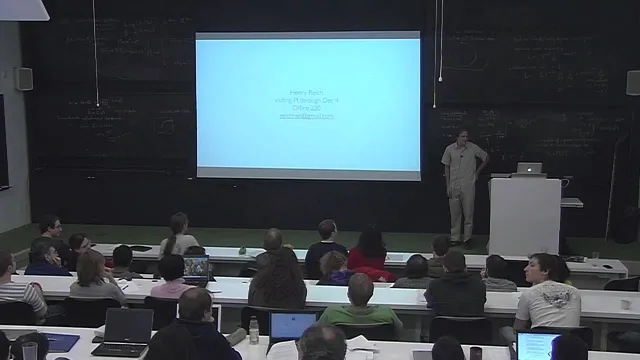
Hour Physics: What makes a good (or bad) youtube science video
Based on minutephysics's video on YouTube. If you like this content, support the original creators by watching, liking and subscribing to their content.
YouTube success depends on building a relationship with an audience (especially subscribers), not just chasing one-time view spikes.
Briefing
A strong science-communication strategy on YouTube isn’t about cramming more information into shorter clips—it’s about matching the content, pacing, and production choices to what an audience can actually absorb while staying engaged. The central lesson from this talk is that effective outreach depends on “unification”: the message, visuals, and audio must work together, and the format must respect the audience’s freedom to leave when interest fades.
The talk begins with a quick origin story for minutephysics, built from film-school animation instincts and a desire to make physics feel approachable rather than intimidating. The channel’s early growth is framed as relationship-building: subscribers matter more than raw views because repeat viewers and notified audiences create momentum. Early success came slowly, then accelerated after external recognition—coverage by outlets like New Scientist and a timely interview with Sean Carroll around a Nobel Prize topic. The broader point is that internet attention behaves differently from classroom attention: online viewers can exit instantly, so creators must size content appropriately and keep it compelling.
From there, the talk turns into a critique of popular science video styles. Khan Academy is praised as a clear, textbook-like learning tool, but criticized for being less effective at sparking excitement. RSA Animate is singled out for a “cardinal sin”: slides that force viewers to read instead of watch and listen, plus an audio-visual mismatch where narration and visuals don’t integrate cleanly. A Stanford AI course is described as professionally packaged but ultimately too much like a recorded lecture—an infrastructure-heavy approach that misses the interactive potential that makes learning feel alive.
Perimeter’s Alice and Bob videos receive a more mixed assessment. The production quality is acknowledged, but the talk highlights two recurring problems: some viewers find the voice off-putting, and the videos grab attention more than they teach, leaving viewers unsure what comes next. The talk also argues that releasing many videos at once doesn’t build an audience the way a steady cadence does; viewers need repeated reasons to return and form a habit.
The talk then broadens into teaching philosophy. It criticizes the way special relativity is often taught—through equations and canonical images—without first connecting to what learners actually picture or feel. Physics education, it argues, should prioritize beauty and understanding over historical discovery-as-presentation. Analogies are defended as a necessary translation layer for people who lack the math, but they must be treated as analogies—not mistaken for science itself.
Finally, the talk offers a practical “grand unified theory” of science communication: respect the audience, choose the right amount of content for the time available, and ensure audio and visuals are unified rather than stitched together. Quality execution—clean sound, legible visuals, and minimal distractions—matters because distractions break concentration. The talk closes by returning to minutephysics’ own best example: an original analogy for distance in space and time that makes special relativity feel intuitive, not forbidding. In short, good science videos don’t just teach facts; they engineer comprehension and curiosity under real online attention constraints.
Cornell Notes
The talk argues that successful science communication on YouTube depends on “unification”: the content must fit the time limit, and the audio, visuals, and pacing must work together so viewers don’t get distracted or bored and leave. Minutephysics grew through slow early relationship-building (subscribers and repeat notifications), then accelerated via external recognition, illustrating how online attention compounds. Several popular formats are evaluated: Khan Academy is effective for learning but less exciting; RSA Animate is visually engaging but can fail when viewers must read off slides; Stanford’s AI course is criticized for being too lecture-like despite strong course infrastructure. Teaching physics also needs better entry points—using beauty, scaffolding, and analogies—while avoiding overconfident simplifications that can confuse learners.
Why does the talk treat “subscribers” as a better success metric than “views”?
What does “unification” mean in practice for science videos?
How does the talk distinguish between outreach that teaches and outreach that mainly hooks?
What critique is made of Khan Academy and Stanford’s AI course?
Why are analogies defended, and what warning is attached to them?
How does the closing minutephysics example illustrate special relativity differently?
Review Questions
- Which elements of “unification” (content sizing, audio-visual integration, pacing, and production quality) most directly affect whether viewers stay engaged?
- How do the critiques of RSA Animate, Alice and Bob, and Khan Academy differ—what specific failure modes are identified?
- What role do analogies play in physics teaching according to the talk, and what boundary keeps analogies from becoming misleading?
Key Points
- 1
YouTube success depends on building a relationship with an audience (especially subscribers), not just chasing one-time view spikes.
- 2
Online viewers can leave instantly, so science content must be sized to the available time and paced to prevent boredom.
- 3
Effective science videos require “unification” so narration, visuals, and audio work together rather than forcing viewers to read or recover from audio/visual mismatches.
- 4
Strong production quality isn’t enough if the format doesn’t teach—curiosity hooks need a clear learning pathway afterward.
- 5
Analogies are a practical translation tool for learners without the math, but they must not be mistaken for scientific claims.
- 6
Teaching physics should prioritize beauty and understanding (scaffolding toward derivations) rather than presenting historical discovery as the default learning route.
- 7
Distractions—bad sound, typos, or unnecessary visual clutter—undermine comprehension even when the underlying physics is correct.