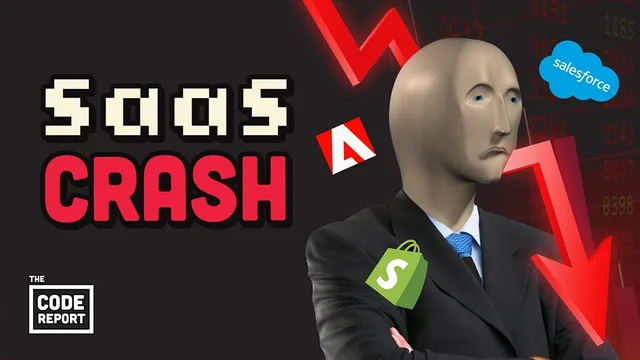
How AI is breaking the SaaS business model...
Based on Fireship's video on YouTube. If you like this content, support the original creators by watching, liking and subscribing to their content.
AI agents are framed as replacing multi-person workflows quickly, weakening the per-seat economics that underpin many SaaS businesses.
Briefing
AI is accelerating the end of the SaaS “seat” model by making software development and operations increasingly automatable—so customers no longer need to rent access to human labor packaged as subscriptions. The transcript links a sharp market shock—roughly $1 trillion in combined market-cap losses across major SaaS firms like Adobe, Salesforce, ServiceNow, and Shopify—to a single driver: AI agents that can replace the work of many employees in minutes. If one agent can do what used to require multiple developers, QA staff, and analysts, the pricing logic behind “pay per user” collapses, and profit margins built on perpetual button-click access become vulnerable.
Several recent releases are presented as evidence that this shift is happening fast. OpenAI’s Codeex app for macOS is framed as a “command center” for agentic workflows, with more than 1 million downloads in its first week. The practical implication is that managers may increasingly build software themselves by prompting agents, then hand off only debugging of large, AI-generated codebases. Underneath that app sits Codeex 5.3, described as faster and more capable at integrating “skills” such as image generation, writing, and research—moving beyond code completion toward end-to-end product responsibilities.
Competition is also portrayed as intensifying. Anthropic’s Claude Opus 4.6.6 is highlighted for strong code generation and a push into enterprise-adjacent domains like legal analysis and financial modeling, which could justify high-priced subscriptions even as coding becomes commoditized. Meanwhile, open-weight models are undermining another SaaS advantage: vendor lock-in. Alibaba’s Qwen 3 Coder Next is described as capable and deployable behind a firewall, enabling companies to self-host a “developer brain” rather than rent multiple tools. Other open model efforts—ZAI’s GLM5 for long-horizon systems engineering and Miniax M2.5 for high reasoning at lower compute costs—are used to argue that top-tier reasoning is becoming portable and increasingly accessible via GPUs rather than corporate budgets.
The transcript then shifts from models to orchestration platforms, arguing that the real battleground is autonomous code orchestration. Microsoft’s GitHub Agent HQ is positioned as an agent orchestration layer that can open issues, generate and merge branches when tests pass, and bundle project management, QA, and DevOps automation. Google is treated more indirectly: while Gemini releases are described as quieter, the Waymo World Model is used to illustrate how simulation and prediction at scale can translate into business functions like forecasting, logistics, risk modeling, and operations—potentially making traditional dashboard-style SaaS feel less necessary.
Even if SaaS declines, the transcript insists developers still have opportunities: mastering modern agent tooling. As an example, Warp’s Oz is presented as a cloud platform for running many coding agents in parallel across multiple repositories, with scheduling, event triggers, and live steering. The overall thesis is blunt: when intelligence becomes abundant, charging per human seat stops making sense—and when the seat dies, the SaaS profit engine loses its foundation.
Cornell Notes
AI agents are rapidly reducing the value of “per-seat” SaaS by automating tasks once performed by multiple employees. The transcript points to new coding-focused releases—OpenAI’s Codeex app and Codeex 5.3, Anthropic’s Claude Opus 4.6.6, and open models like Alibaba’s Qwen 3 Coder Next, ZAI’s GLM5, and Miniax M2.5—as signs that software development and related work are becoming cheaper and more deployable. It argues that vendor lock-in weakens when companies can self-host strong models behind firewalls. The competitive center of gravity shifts toward orchestration platforms such as Microsoft’s GitHub Agent HQ and toward simulation-driven systems like Waymo’s World Model. Even with SaaS disruption, developers can benefit by learning to run and manage agent fleets using tools like Warp’s Oz.
Why does the transcript connect AI progress to a potential “SaaS death spiral”?
What does OpenAI’s Codeex app imply for who builds software inside companies?
How does Codeex 5.3 go beyond basic coding assistance?
Why are open-weight models portrayed as a direct threat to SaaS vendor lock-in?
What shift does the transcript claim is happening from models to platforms?
How does Waymo’s World Model relate to business software beyond cars?
Review Questions
- Which parts of the transcript most directly challenge the “pay per seat” pricing logic, and what mechanism makes that pricing less defensible?
- How do open-weight, self-hostable models change the competitive advantage of SaaS vendors compared with closed, hosted-only offerings?
- What capabilities differentiate an “agent orchestration platform” from a basic coding model in the transcript’s framework?
Key Points
- 1
AI agents are framed as replacing multi-person workflows quickly, weakening the per-seat economics that underpin many SaaS businesses.
- 2
Major SaaS market-cap declines are attributed to AI-driven expectations that customers will need fewer (or no) seats.
- 3
OpenAI’s Codeex app and Codeex 5.3 are positioned as moving from coding help toward end-to-end agentic development with integrated skills.
- 4
Open-weight models like Alibaba’s Qwen 3 Coder Next reduce vendor lock-in by enabling self-hosted “developer brains” behind firewalls.
- 5
Competition is shifting toward orchestration platforms that manage autonomous coding tasks, testing, and merges—exemplified by GitHub Agent HQ.
- 6
Simulation-driven AI systems like Waymo’s World Model are presented as a path to replacing dashboard-style software with decision-capable models.
- 7
Developer opportunity is reframed around learning to run, schedule, and steer fleets of agents using tools such as Warp’s Oz.