How are holograms possible?
Based on 3Blue1Brown's video on YouTube. If you like this content, support the original creators by watching, liking and subscribing to their content.
Holograms reconstruct 3D scenes by recording interference between a laser object wave and a coherent reference wave on a 2D film.
Briefing
Holograms work because a flat recording can store the full “light field” around a scene—not just brightness from one viewpoint—by encoding both the amplitude and the phase of light. The core trick is interference: a laser “object wave” that has interacted with the scene is recorded together with a coherent “reference wave” on a 2D film. Where the two waves add, the film darkens; where they cancel, it stays lighter. That interference pattern is not a picture of the scene so much as a map of how the scene’s light wave would have behaved in space.
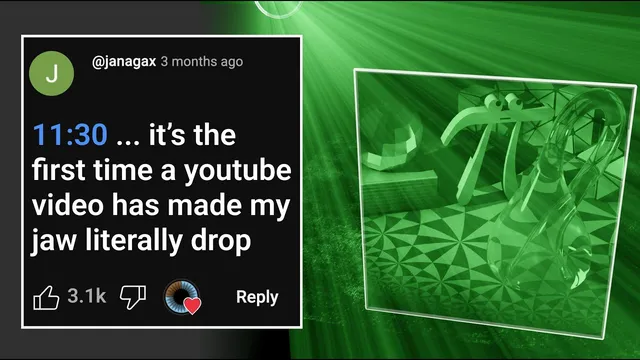
The explanation starts with a deliberately surreal setup: behind a piece of glass there’s nothing but a laser beam and an exposed film. Yet when the film is illuminated correctly, observers see a 3D object floating behind the glass, with light seeming to refract and scatter as if the original object were still present. The mechanism becomes clearer by comparing holography to pinhole photography. A pinhole camera throws away almost all angular information about the light field by letting only one narrow viewing direction reach the film. Holography aims to reconstruct the entire light field, meaning it must capture how light varies with angle around the scene.
Capturing that angular information requires more than intensity. Ordinary photography is insensitive to phase: shifting a sinusoidal wave by half a cycle doesn’t change exposure much. Holography is engineered to be phase-sensitive by using interference with a reference beam. The recording is made with a laser split into two paths: one beam illuminates the scene (the object wave), and the other bypasses the scene and hits the film directly (the reference wave). Because both beams share the same frequency, their relative phase determines the local exposure pattern. Even tiny motion—on the order of a fraction of a wavelength—can drastically alter the interference fringes, which is why the recording process demands extreme stillness.
The talk then zooms into the simplest possible case: a single point in 3D space. The object wave spreads outward, and when it interferes with a plane reference wave, the film records concentric rings known as a Fresnel zone plate. Each ring corresponds to locations where the object wave and reference wave are in phase or out of phase. Crucially, when the object is removed and only the reference wave illuminates the recorded pattern, the film acts like a diffraction element that recreates the wavefronts that would have existed if the point were still there.
From there, the explanation generalizes: a real hologram is effectively a superposition of many such point encodings. The film’s interference pattern can be thought of as containing a “zone plate” for each point, and illuminating it reconstructs a 3D distribution of light rays. Higher diffraction orders can create artifacts like the “twin image,” which can be separated by adjusting the reference beam angle.
Finally, the practical constraint becomes explicit: holograms require extremely fine spatial resolution. The recorded fringes correspond to tiny phase changes, so the film must resolve thousands of lines per millimeter—far beyond typical instant film. The payoff is that holography isn’t just a visual trick; it’s a wave-interference method capable of recreating the scene’s light field, including how light would interact with complex optics like a Klein bottle’s glass surface. The underlying physics traces back to Dennis Gabor’s 1947 principle, with lasers and later developments making practical holography possible.
Cornell Notes
Holography reconstructs a 3D scene by recording the interference between two coherent laser beams on a 2D medium: an object wave (light that has interacted with the scene) and a reference wave (light that bypasses the scene). The film’s exposure depends on both amplitude and phase, unlike ordinary photography, which mostly ignores phase. For a single point in space, the recorded interference pattern becomes a Fresnel zone plate (concentric rings), and illuminating that pattern with the reference wave recreates the original wavefronts—so the point appears to exist behind the glass. A real hologram is a superposition of many such point encodings, which is why it can recreate the full light field from many viewing angles. This demands extremely high resolution because the fringes correspond to very small phase differences.
Why does holography need phase information, not just brightness?
How does a hologram create a 3D point behind the glass after the object is removed?
What’s the role of the “light field” idea in holography?
Why is recording so sensitive to motion during exposure?
What are Fresnel zone plates and how do they connect to diffraction orders?
Why does holography require extremely high-resolution film?
Review Questions
- In holography, what physical quantity does the film exposure depend on when the reference beam interferes with the object beam, and why is that different from pinhole photography?
- For a single point source, what pattern appears on the film, what optical role does it play during reconstruction, and how does it relate to the idea of wavefronts?
- Why do higher diffraction orders produce artifacts like the twin image, and how can reference-beam geometry mitigate that?
Key Points
- 1
Holograms reconstruct 3D scenes by recording interference between a laser object wave and a coherent reference wave on a 2D film.
- 2
The film’s exposure pattern depends on relative phase, not just intensity, making holography fundamentally phase-sensitive.
- 3
The goal is to reconstruct the full light field around the scene so the image shifts correctly with viewer position.
- 4
A single 3D point records as a Fresnel zone plate; illuminating it later recreates the point’s wavefronts behind the recording surface.
- 5
Recording is extremely sensitive to motion because phase changes on the order of fractions of a wavelength can alter the interference pattern.
- 6
Artifacts such as the twin image arise from additional diffraction components; using a tilted reference beam can help separate them.
- 7
Practical holography demands very high spatial resolution because the fringe spacing encodes extremely fine phase differences.