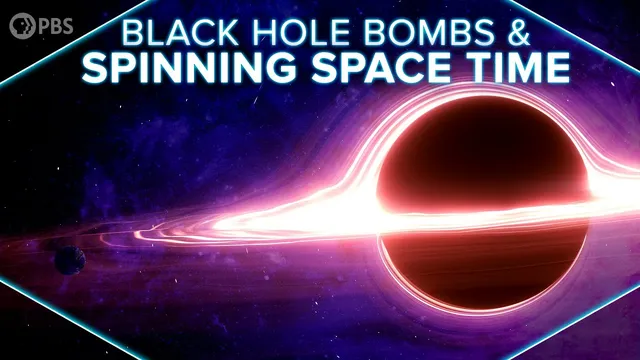
How Black Holes Spin Space Time
Based on PBS Space Time's video on YouTube. If you like this content, support the original creators by watching, liking and subscribing to their content.
Real black holes are expected to rotate because they inherit angular momentum during collapse and from later infalling matter, consistent with the no-hair theorem’s mass–charge–spin framework.
Briefing
Rotating black holes don’t just spin—they drag spacetime itself into a whirlpool, creating a special region outside the event horizon where energy can be extracted. That frame-dragging reshapes what stable orbits look like, forces even light to co-rotate inside the ergosphere, and enables mechanisms that could power some of the universe’s most extreme phenomena, from relativistic jets to gamma-ray bursts.
In the non-rotating case, Schwarzschild’s solution predicts a spherical event horizon and a simple picture of time stopping at the horizon for outside observers. Real astrophysical black holes, however, almost certainly rotate because angular momentum is inherited from the collapsing star and from any later material that falls in—sometimes with partial cancellation, but rarely with zero net spin. The first full rotating solution to Einstein’s equations came in 1963 with Roy Kerr’s Kerr metric, which describes a black hole with mass and rotation but essentially no electric charge.
What rotates in a Kerr black hole is not a physical object trapped behind the horizon. Instead, the gravitational field and its rotation are properties of spacetime itself. Near the black hole, “frame-dragging” pulls freely falling trajectories in the direction of the black hole’s spin. Earth’s frame-dragging is measurable but extremely weak (as confirmed by Gravity Probe B), while a Kerr black hole’s effect becomes dominant close to the horizon.
That dominance changes orbital physics. For a non-rotating black hole, stable circular orbits exist only down to about 3 Schwarzschild radii; closer in, matter must spiral. Rotation shifts the boundary inward: if orbiting in the same direction as the spin, stable orbits can approach the event horizon, while counter-rotating orbits lose stability much farther out—within roughly 9 Schwarzschild radii there are no stable counter-rotating circular orbits. The innermost stable circular orbit (ISCO) matters observationally because gas spiraling down to it is expected to create a dark feature in the center of the bright accretion disk; direct detections remain elusive, though gravitational lensing studies of quasars provide tentative hints.
Above the horizon lies the ergosphere, a “pumpkin-shaped” region where frame-dragging becomes so extreme that space itself forces motion in the direction of rotation. In this region, the usual roles of space and time in the Kerr geometry swap: the angular coordinate behaves like a time-like direction, making resisting co-rotation effectively impossible. The ergosphere reaches down to the event horizon, which itself becomes squashed at the poles, with more spin producing greater squashing.
The ergosphere also enables energy extraction. Penrose’s process imagines dropping a body into the ergosphere and splitting it so one fragment falls in with negative energy while the other escapes with more kinetic energy—potentially up to about 20% more than the original bound energy of the infalling mass. A related phenomenon, superradiance, allows amplified outgoing light when it is sent through the ergosphere in the direction of rotation; in principle, this points toward near-100% efficiency. Surrounding the black hole with mirrors could, in theory, create a runaway “black hole bomb.”
In the real universe, the Blandford–Znajek process is a leading candidate for jet power: magnetic fields anchored in accretion disks tap the black hole’s rotational energy, accelerating charged particles that radiate intensely. Such jets from fast-rotating black holes are also linked to gamma-ray bursts—especially when relativistic beaming makes them appear dramatically bright from billions of light-years away. Rotating black holes therefore sit at the intersection of astrophysical power and theoretical tension, raising concerns about deeper “weirdness” like time-travel-like effects and naked singularities once one crosses into the Kerr interior.
Cornell Notes
Kerr’s solution shows that a rotating black hole drags spacetime around it via frame-dragging, turning the region outside the event horizon into a forced co-rotation zone called the ergosphere. Inside the ergosphere, the geometry effectively swaps the roles of space and time so that resisting rotation becomes impossible—even light must move with the spin. Rotation also shifts where stable circular orbits can exist: co-rotating orbits can survive much closer to the horizon than counter-rotating ones, down to the ISCO. The ergosphere enables energy extraction through mechanisms like the Penrose process, superradiance, and the Blandford–Znajek process, which may power jets and gamma-ray bursts. These effects make rotating black holes central to both high-energy astrophysics and open questions in fundamental physics.
What does “frame-dragging” mean around a Kerr black hole, and how is it different from the non-rotating case?
Why does the ergosphere force co-rotation, and what “space-time flip” is being described?
How do rotation and direction (co-rotating vs counter-rotating) change the innermost stable circular orbit (ISCO)?
How does the Penrose process extract energy from a rotating black hole?
What are superradiance and the Blandford–Znajek process, and how do they connect to jets and gamma-ray bursts?
Review Questions
- How does the Kerr metric change the location and shape of the event horizon compared with the Schwarzschild case?
- What physical or geometric reason makes negative-energy states possible in the ergosphere, enabling the Penrose process?
- Why would an ISCO be expected to leave an observable signature in an accretion disk, and why is direct detection still difficult?
Key Points
- 1
Real black holes are expected to rotate because they inherit angular momentum during collapse and from later infalling matter, consistent with the no-hair theorem’s mass–charge–spin framework.
- 2
Kerr’s solution treats rotation as a property of spacetime itself, producing frame-dragging that drags nearby free-fall trajectories in the direction of spin.
- 3
Stable circular orbits extend closer to a rotating black hole’s event horizon for co-rotating motion, while counter-rotating stable orbits disappear much farther out (around 9 Schwarzschild radii).
- 4
The ergosphere forces co-rotation because the Kerr geometry makes the angular direction effectively time-like, preventing motion against the spin.
- 5
Energy extraction becomes possible in the ergosphere via the Penrose process and superradiance, where negative-energy states allow outgoing matter or light to gain energy.
- 6
Magnetic fields in the Blandford–Znajek process can tap rotational energy to power jets, which may contribute to gamma-ray bursts when viewed along the jet direction.
- 7
Crossing from the event horizon into deeper Kerr regions is where the physics becomes even more extreme and potentially destabilizing for current theories.