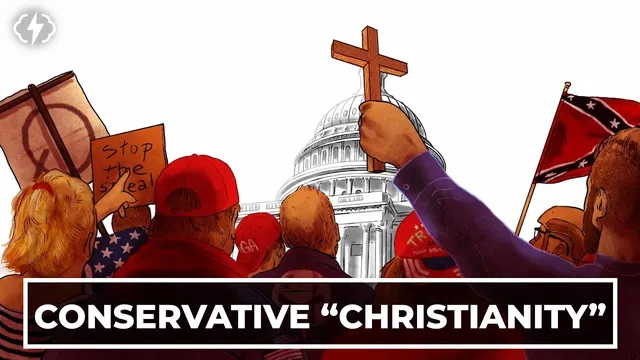
How Conservatives Co-Opted Christianity
Based on Second Thought's video on YouTube. If you like this content, support the original creators by watching, liking and subscribing to their content.
The transcript argues Christianity’s conservative U.S. political identity is a modern development rather than a timeless feature of the faith.
Briefing
Christianity’s tight association with American conservatism is a relatively recent political construction—built largely in the late 20th century—rather than an original feature of the faith. Early Christians and later American Christian movements often emphasized communal responsibility, care for the needy, and skepticism toward wealth hoarding. Over time, progressive currents within Christianity shaped major U.S. reforms, from the Social Gospel to civil-rights-era activism. The modern “Christian right” identity, however, took shape through a different pathway: media strategy, culture-war framing, and political coalition-building that turned religion into a partisan weapon.
The story begins with the claim that Christianity’s earliest interpretations leaned egalitarian. The transcript points to early church figures such as Basil of Caesarea and John Chrysostom as living in ways aligned with what would now be called socialist principles—common property, community support for the needy, and criticism of those who accumulate wealth from labor. As Christianity spread and diversified, left-leaning Christian groups remained visible across the world, and in the U.S. a particularly influential strand emerged in the early 1900s: the Social Gospel. In 1917, Walter Rauschenbusch attacked capitalist exploitation, imperialism, war, and economic oligarchy through Christian ethics, arguing they were incompatible with capitalism. That moral framework, the transcript says, helped shape the New Deal and the civil-rights movement, with Martin Luther King Jr. as a vivid example of religious conviction aligned with leftist politics.
So when did Christianity become synonymous with conservatism? The transcript traces a turning point to the 1920s, when “higher criticism” gained traction in German academic circles and spread—challenging biblical inerrancy and infallibility. As debates over scripture intensified, public schooling and Darwin’s theory of evolution became flashpoints, culminating in the 1925 Scopes “Monkey Trial.” Even though John T. Scopes lost, the schism between modernist mainline Protestants and conservative white evangelicals hardened. That conflict, the transcript argues, pushed conservative evangelicals toward mass media as a way to regain influence beyond church walls.
A central figure in that media shift was Aimee Semple McPherson, whose anti-evolution celebrity and later radio-driven evangelism helped fuse conservative Christianity with American patriotism and fear of communism. Her sermons framed the U.S. as a uniquely blessed Christian stronghold under threat from foreign forces, immigration, and atheistic communist ideology. The transcript then links this template to later televangelists—Billy Graham, Oral Roberts, Pat Robertson, and Jerry Falwell—who used television to expand Christian nationalism.
Cold War anxieties and the Reagan era accelerated the political payoff. Falwell’s creation of the Moral Majority is described as a turning point: evangelicals exchanged a large voting bloc for a comprehensive agenda inside the Republican Party, pressing on abortion, LGBTQ rights, the Equal Rights Amendment, and social and foreign-policy stances. The transcript credits evangelical-backed Reagan-era policies with outcomes including tax cuts for the wealthy, increased military spending, deregulation, and a hard line on LGBTQ progress.
Today, the transcript claims, white evangelical voters remain a powerful electoral force—overrepresented relative to their population share—and have largely supported Donald Trump in recent elections. It also argues that the Christian left is reemerging through organizations such as Christians for Socialism and the Institute for Christian Socialism, alongside Black Christian voters who often anchor Democratic victories. The closing message is that many politicians—on both parties—use “Christian morality” as branding while ignoring policies that would help the poor and vulnerable, and that religious Americans must reclaim Christianity’s egalitarian core from those who have turned it into a partisan weapon.
Cornell Notes
The transcript argues that Christianity’s close alignment with U.S. conservatism is not an original religious truth but a political development—especially since the 1980s. It contrasts early and progressive Christian traditions (communal responsibility, care for the needy, and opposition to wealth hoarding) with the later rise of conservative evangelical power built through media and coalition politics. Key catalysts include the 1925 Scopes “Monkey Trial,” which deepened splits over biblical authority and evolution, and the emergence of televangelism, with Aimee Semple McPherson as an early model. The Moral Majority and the Reagan-era agenda then helped lock evangelicals into Republican power, shaping policy on abortion, LGBTQ rights, and related issues. The transcript ends by pointing to a revival of the Christian left and calls for reclaiming Christianity’s egalitarian teachings.
What does the transcript claim about early Christianity’s political and economic instincts?
How does the transcript connect the 1920s to the later rise of conservative evangelical influence?
Why is Aimee Semple McPherson treated as a pivotal figure in the transcript’s timeline?
What role does the Moral Majority play in the transcript’s explanation of political power?
What does the transcript say about the outcomes of evangelical influence during the Reagan era?
How does the transcript describe the current political landscape for Christians on the left and right?
Review Questions
- What mechanisms does the transcript use to explain how conservative Christianity gained political power (media, trials, coalition-building), and which one is portrayed as most decisive?
- How does the transcript reconcile its claim of early Christian egalitarianism with the later dominance of conservative evangelical politics in the U.S.?
- Which specific policy areas does the transcript link to evangelical influence inside the Republican Party, and what does it say those policies produced?
Key Points
- 1
The transcript argues Christianity’s conservative U.S. political identity is a modern development rather than a timeless feature of the faith.
- 2
It contrasts early Christian and Social Gospel traditions—communal responsibility and opposition to wealth hoarding—with later conservative evangelical politics.
- 3
Higher criticism and the evolution debate are presented as major catalysts for a lasting split between progressive mainline Protestants and conservative evangelicals.
- 4
The Scopes “Monkey Trial” is portrayed as a turning point that helped conservative evangelicals shift from church-based influence to mass media strategy.
- 5
Aimee Semple McPherson is described as an early architect of conservative Christian celebrity, using radio and sermon-centered messaging to fuse patriotism with anti-communist fear.
- 6
The Moral Majority is framed as the political conversion of evangelical voting power into a comprehensive Republican agenda, influencing issues from abortion to LGBTQ rights.
- 7
The transcript claims the Christian left is reemerging and argues that many politicians use “Christian morality” as branding while neglecting policies that would help the poor and vulnerable.