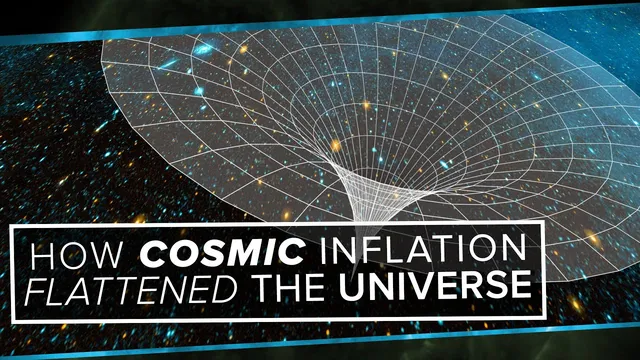
How Cosmic Inflation Flattened the Universe
Based on PBS Space Time's video on YouTube. If you like this content, support the original creators by watching, liking and subscribing to their content.
Inflation is the leading mechanism for explaining why the CMB is smooth across regions that should not have been in causal contact under a simple Big Bang timeline.
Briefing
Cosmic inflation is the leading explanation for why the observable universe looks both causally connected and nearly perfectly flat—despite those features being hard to achieve in a simple Big Bang picture. The core problem starts with scale: the universe we can observe spans about 93 billion light-years across, yet the most distant regions would never have had time to exchange information. Still, the cosmic microwave background (CMB) looks remarkably smooth, implying those regions were once close enough to “mix” into a uniform state. That mismatch is the horizon problem, and inflation was designed to fix it.
A second, equally sharp issue comes from the CMB’s tiny temperature fluctuations, which act like the endpoints of enormous triangles in the early universe. By measuring the apparent angular size of the characteristic CMB features—set by how far sound waves could travel before the CMB formed—cosmologists infer the geometry of space. The result is strikingly close to what a flat Euclidean universe would predict: the relevant angle is about 1 degree, and current precision places curvature within roughly 0.4% of perfect flatness. The catch is that an expanding universe does not naturally preserve flatness. Even a minuscule initial deviation from flat geometry would grow rapidly, meaning the universe would have had to be fantastically close to flat at the earliest moment—on the order of one part in 10^62.
Inflation addresses both problems with one mechanism: a brief period when the universe was so compressed that the entire region that later becomes observable was causally connected, followed by an ultra-rapid expansion that effectively stretched space faster than light. During this burst, neighboring regions get pulled apart so dramatically that what later appears as widely separated patches were once part of the same small, well-mixed domain. Crucially, inflation also smooths and flattens the universe on small scales: even if the pre-inflation state was “blotchy” and curved, the inflated outcome retains the subatomic smoothness and flatness of a tiny seed region.
For inflation to work quantitatively, the expansion must grow the universe by at least a factor of 10^26 in under 10^-32 seconds, then stop so the universe transitions to ordinary Hubble expansion. The driving physics is often tied to a form of energy associated with empty space—mathematically captured by Einstein’s cosmological constant. In general relativity, adding this constant supplies an energetic term that acts like a repulsive effect, increasing with more space and therefore driving expansion. Inflation is also notable for its “end”: once the inflationary phase stops, the universe slows from exponential growth to the standard expansion rate.
Accepting inflation reshapes what “the Big Bang” means. Instead of requiring an initial singularity, the end of inflation can be treated as the moment our observable universe comes into being, with time possibly not beginning at the Big Bang itself. The transcript also gestures toward bolder extensions—like eternal inflation and a multiverse—where inflation may not end everywhere. The result is a cosmological picture in which the universe’s large-scale uniformity and near-flat geometry are not accidents, but the expected outcome of a short, extreme early expansion.
Cornell Notes
Inflation is a short period of extremely rapid expansion in the early universe that solves two major puzzles from the cosmic microwave background: the horizon problem (distant regions look too uniform to have been in causal contact) and the flatness problem (space appears nearly flat to within about 0.4%, even though flatness would otherwise be unstable). Inflation works by starting from a tiny, causally connected region and then expanding it faster than light for less than 10^-32 seconds, by at least 10^26, before switching to normal Hubble expansion. The mechanism is often modeled using a vacuum-energy-like term related to Einstein’s cosmological constant, which drives expansion because it behaves like energy inherent to space itself. Inflation also changes how the Big Bang is interpreted, making the end of inflation akin to the “initial kick” for our observable universe.
What observational facts force cosmologists to go beyond the simplest Big Bang model?
How does inflation simultaneously address the horizon and flatness problems?
What quantitative requirements does inflation need to meet?
Why does Einstein’s cosmological constant matter for inflation?
How does inflation change the meaning of the Big Bang?
Review Questions
- How do CMB measurements translate into constraints on spatial curvature, and why does that create a flatness problem?
- Describe the two-step inflation scenario (causally connected small region → rapid expansion → stop) and explain how it fixes both horizon and flatness issues.
- What role does vacuum energy (modeled via the cosmological constant) play in driving inflation, according to the transcript?
Key Points
- 1
Inflation is the leading mechanism for explaining why the CMB is smooth across regions that should not have been in causal contact under a simple Big Bang timeline.
- 2
The flatness problem arises because the universe’s near-zero curvature today implies an extraordinarily precise flatness requirement at the earliest moment—about one part in 10^62.
- 3
Inflation works by expanding a tiny, causally connected patch exponentially faster than light for less than 10^-32 seconds, then ending so normal Hubble expansion resumes.
- 4
A successful inflationary phase needs at least a 10^26 growth factor, followed by a transition to the standard expansion rate observed in the universe.
- 5
The cosmological constant provides the mathematical form of a vacuum-energy-like term that can drive expansion because it behaves like energy inherent to space.
- 6
Accepting inflation reframes the Big Bang: the end of inflation can be treated as the effective “beginning” of our observable universe rather than requiring an initial singularity.
- 7
Uncertainty remains about when inflation began or whether it is eternal in parts of a larger multiverse.