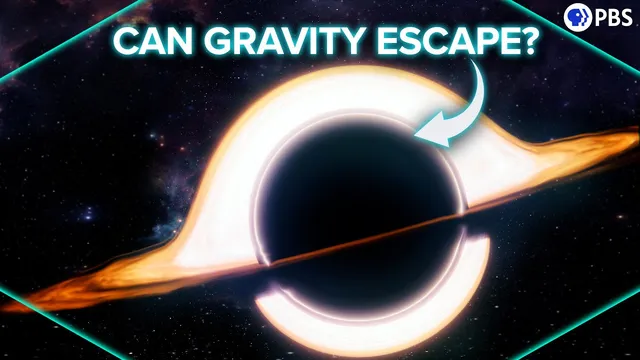
How Does Gravity Escape A Black Hole?
Based on PBS Space Time's video on YouTube. If you like this content, support the original creators by watching, liking and subscribing to their content.
General relativity treats gravity as spacetime curvature, so the outside gravitational field doesn’t require a force to travel out from the singularity.
Briefing
A black hole’s gravity can influence the outside universe without any “signal” escaping the event horizon, because gravity is tied to what happened in the past—not to what’s happening at the singularity now. In general relativity, the gravitational field is not a force that must travel outward from the hidden mass; it is the curvature of spacetime itself. That curvature at any location depends on the local spacetime geometry, which is shaped by the history of the collapsing matter that formed the black hole. As a result, the event horizon acts less like a wall that blocks gravity and more like a boundary that prevents new information from reaching the outside.
The puzzle starts with three facts that seem to clash: all mass in an idealized black hole is concentrated at a central singularity; every singularity is surrounded by an event horizon that nothing can cross and return from; and gravity propagates at the speed of light in Einstein’s framework. If gravity must travel at light speed, then hiding all mass behind the horizon should prevent the outside universe from feeling it. The resolution comes from reframing what “escape” means. In Einstein’s picture, spacetime curvature exists independently of the singularity’s immediate location. When Earth feels the Sun’s pull, it responds to the gravitational field in its vicinity, not to a direct interaction with the Sun’s interior. Likewise, the region outside a black hole responds to the curvature produced by the black hole’s past mass distribution.
Einstein’s equations also imply that changes in gravitational fields propagate at light speed, a point illustrated by gravitational waves. Ripples in spacetime produced by violent motions travel at light speed, and observations—such as gravitational waves from colliding neutron stars arriving alongside electromagnetic signals—support that. But even with that “speed of gravity,” the outside universe can still be affected because the relevant information about the collapsing star’s mass reaches observers before it becomes trapped. A collapsing star appears to freeze at the event horizon from a distant viewpoint due to time dilation, and its emitted light becomes stretched and dimmed. Yet faint signals continue to leak out over extremely long times, meaning the outside universe remains causally connected to the star’s earlier state.
The transcript then extends the logic into speculative quantum gravity. In quantum field theory, forces are mediated by particles; electromagnetism uses virtual photons, and quantum gravity would likely use a graviton. The event horizon still doesn’t “block” the gravitational influence in this framework because virtual particles are not localized messengers traveling along definite paths. Their effects arise from the summed interactions across the surrounding quantum fields, so the gravitational field outside can be sustained by virtual gravitons already present in the region. Even so, the horizon still prevents real, usable information from escaping—consistent with the idea that the cosmic speed limit is fundamentally about information, not just energy.
Finally, the discussion ties the same causal principle to black hole charge and to the meaning of mass in general relativity. The outside universe interacts with the past charge and past mass that generated the external fields, not with the singularity’s present state. By the end, the event horizon is portrayed as a one-way causal boundary for information and matter, while gravity’s reach is anchored in spacetime curvature and the history encoded on (and outside) the horizon.
Cornell Notes
The apparent paradox—how gravity can affect the outside universe if all mass is hidden behind a black hole’s event horizon—resolves once gravity is treated as spacetime curvature tied to causal history. In general relativity, the gravitational field at any point depends on the local geometry shaped by the past collapse, not on a force that must escape from the singularity. Even though gravitational effects propagate at light speed, observers can still feel the influence because information about the collapsing mass reaches them before it becomes trapped. Quantum-gravity ideas reach a similar conclusion: virtual gravitons need not travel through the horizon to generate the external field, and the horizon still blocks real information. The key takeaway is that black holes don’t “send gravity out” so much as they leave an external gravitational imprint from their past.
Why doesn’t the event horizon stop gravity in general relativity?
How can gravity propagate at the speed of light if the mass is hidden?
What role do gravitational waves play in the argument?
How does the quantum-gravity/virtual-graviton picture avoid the need for gravitons to cross the horizon?
Why can’t someone send an SOS message from inside a black hole using the virtual-particle idea?
What does it mean that black holes can have electric charge, according to the causal argument?
Review Questions
- What distinction between “propagation of gravitational changes” and “causal access to the source’s past” resolves the gravity-escape paradox?
- In the general-relativity picture, why does the outside gravitational field not require direct interaction with the singularity?
- How does the transcript’s explanation of virtual particles prevent the event horizon from acting like a simple barrier to gravitational influence?
Key Points
- 1
General relativity treats gravity as spacetime curvature, so the outside gravitational field doesn’t require a force to travel out from the singularity.
- 2
The event horizon blocks new information and matter from escaping, but it does not erase the causal history of the collapsing mass that already influenced the outside region.
- 3
Gravitational waves propagate at light speed, consistent with observations where gravitational and electromagnetic signals from the same event arrive together.
- 4
In quantum field theory, virtual particles are not localized messengers with definite trajectories, so virtual gravitons need not cross the event horizon to sustain the external field.
- 5
Even if virtual interactions contribute to the gravitational field, the horizon still prevents real, usable information from escaping, because causality and the information speed limit remain in force.
- 6
The outside universe interacts with the past mass/charge that generated external fields, which is why black holes can carry electric charge and still affect the surroundings.
- 7
Mass in general relativity is subtle because the gravitational field itself carries energy; a consistent definition involves contributions from the field at large distances, making “mass everywhere” consistent with gravity escaping the horizon.