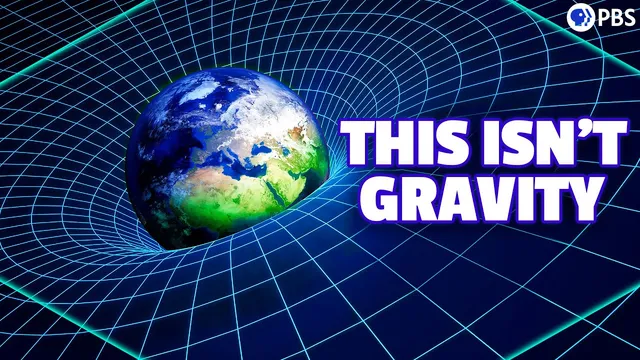
How Does Gravity Warp the Flow of Time?
Based on PBS Space Time's video on YouTube. If you like this content, support the original creators by watching, liking and subscribing to their content.
Clocks in stronger gravitational fields run slower, producing measurable lifetime differences such as about a second between feet and head on Earth.
Briefing
Gravity doesn’t just pull objects—it also changes how fast time flows. Clocks closer to Earth’s gravitational field tick more slowly than clocks higher up, a difference so small over a day that it’s easy to miss, yet large enough over a lifetime to amount to about a second between a person’s feet and head. The deeper payoff is that this “gravitational time dilation” isn’t an isolated curiosity: it helps explain why gravity behaves like a force at all, tying the experience of weight to the geometry of spacetime.
The argument starts with Einstein’s equivalence principle, framed through his “happiest thought” about falling observers. In free fall, a gravitational field becomes locally indistinguishable from the absence of gravity—meaning no experiment can tell whether someone is in a gravitational field or in a windowless lab floating in space, as long as air resistance is negligible and the observer hasn’t hit the ground. That principle links gravity to acceleration. If acceleration makes time dilation happen in special relativity, then gravity must do the same.
To build the case, the discussion first revisits time dilation from motion using a gedankenexperiment: a photon clock. The clock consists of two perfectly reflective mirrors with a photon bouncing between them; each full bounce cycle counts as one tick. In special relativity, the speed of light is measured the same by all observers. When the photon clock moves relative to a stationary observer, the photon follows a longer path during each tick, so the moving clock’s tick takes longer from the outside perspective. The effect is symmetric—each observer can view the other’s clock as running slow—until one observer changes direction.
That symmetry-breaking is illustrated with a rotating ring-shaped space station producing artificial gravity. A physicist floating at a fixed point on the rotating station is in an inertial frame locally, while the lab rotates. Over a small interval, the situation resembles straight-line motion, and both sides see the other’s clock as slowed. But after a full revolution, the rotating lab’s worldline forms a helix (or a sine wave in a reduced slice), and the shifting notion of “now” causes the stationary clock to tick more overall. The same outcome occurs if rockets provide linear acceleration: the photon in the accelerating clock must travel farther between mirrors overall, so the accelerated clock runs slow.
With acceleration and gravity declared experimentally indistinguishable by the equivalence principle, gravitational fields must also slow time. The transcript emphasizes that this isn’t a coincidence: the matching results from special-relativistic reasoning with “artificial gravity” and from general relativity’s gravitational time dilation point to a shared underlying cause.
Yet the explanation still feels incomplete, because it shows that time slows without fully answering why. The discussion closes by reframing the question: instead of asking why gravity slows time, it asks why slowed time produces gravity. Curvature in space alone doesn’t account for the strength of the effect; the key is curvature in time. The claim is that the sensation of being held down comes from parts of the body ticking at different rates—feet faster than head—so gravity is ultimately tied to how spacetime’s “now” sweeps and how clocks evolve in a curved spacetime.
Cornell Notes
Gravitational fields slow the passage of time: clocks lower in a gravitational potential (like near Earth’s feet) tick more slowly than clocks higher up. The transcript derives this using two pillars: special relativity’s constancy of the speed of light and the equivalence principle, which makes acceleration and gravity locally indistinguishable. A photon-clock thought experiment shows that when motion or acceleration forces light to travel a longer path between mirrors, the clock’s ticks take longer, so time dilation appears. Replacing acceleration with gravity via the equivalence principle implies gravitational time dilation must occur. The discussion then pivots to a deeper question: gravity may be less about “time slowing” and more about how differences in time flow generate the force we feel.
How does a photon clock demonstrate time dilation in special relativity?
Why does time dilation stop being symmetric when an observer changes direction (rotating lab vs inertial observer)?
How does artificial gravity connect to gravitational time dilation?
What role does the equivalence principle play in turning acceleration results into gravity results?
Why does the transcript suggest the “why” question should be reversed?
Review Questions
- What assumptions are needed to conclude that gravitational fields must slow time?
- In the photon-clock argument, what changes when the clock is accelerating or rotating, and how does that lead to slower ticks?
- How does the transcript connect curvature in time to the sensation of weight?
Key Points
- 1
Clocks in stronger gravitational fields run slower, producing measurable lifetime differences such as about a second between feet and head on Earth.
- 2
Einstein’s equivalence principle links gravity to acceleration by making them locally indistinguishable for experiments in free fall.
- 3
A photon clock shows time dilation because light must travel a longer path when observers disagree on simultaneity while keeping light speed constant.
- 4
Rotation (or acceleration) breaks the symmetry of time dilation seen in straight-line relative motion, explaining why one observer ages less in related scenarios.
- 5
Artificial gravity setups (rotating stations) reproduce the same time-dilation behavior expected from real gravity, matching general relativity’s predictions.
- 6
The transcript argues that gravity’s true origin is tied to curvature in time, not just curvature in space.
- 7
The discussion reframes the causal question from “why gravity slows time” to “why slowed time produces gravity.”