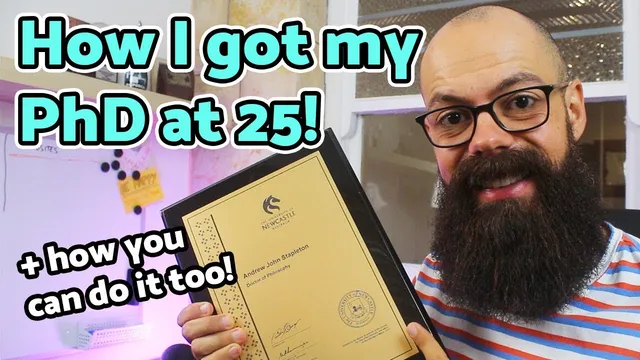
How I got my PhD at the age of 25 | 4 things for doing it too!
Based on Andy Stapleton's video on YouTube. If you like this content, support the original creators by watching, liking and subscribing to their content.
Choose an education route that allows direct progression into a PhD when possible, such as an “undergraduate master” track that condenses time.
Briefing
Finishing a PhD by age 25 comes down to compressing the timeline before the doctorate even starts, then removing the usual “extra months” that quietly expand the degree. Andy Stapleton submitted his thesis at 25 years, 3 months, and 25 days, with an additional six months for the submission period over Christmas. He credits that outcome to a set of practical constraints and supports—timing, financial stability, fast feedback from supervisors, and a hard deadline—that kept his work moving instead of drifting.
The first lever was timing through an unusual education path. Rather than taking a gap year, he went straight from high school into a four-year master’s program (an M Chem, positioned between a bachelor’s and a full master’s). That structure condensed what would normally be longer undergraduate time, with the final year combining independent research, thesis write-up, and coursework/exams. Crucially, his university system allowed a direct jump into a PhD after this “undergraduate master” track—something that isn’t universal across fields, so he urges prospective students to check whether their program permits the shortcut.
He then made the doctorate itself shorter by choosing a three-year PhD route tied to international-student rules in Australia. Extending beyond three years would have triggered substantially higher costs, forcing a strategic plan from the start. He also highlights that credit for prior work and other forms of recognition can shave months, but the core idea is to treat program selection as a scheduling tool, not just an academic choice.
The second major factor was financial pressure—or rather, the absence of it. With parents covering most undergraduate costs, he entered the PhD with only student loan debt, no credit card debt, and no need to work. He also secured two scholarships: one covering international fees and another for living expenses (about 20,000 Australian dollars at the time). That combination reduced mental load, letting him focus on research instead of balancing survival logistics.
Third came supervision quality and responsiveness. He describes supervisors as decisive for outcomes, not just academically but operationally—returning drafts quickly and providing feedback on a schedule. His own supervisor returned chapter drafts within two days, which he attributes partly to shared clarity about the three-year finish line. He adds a blunt standard: supervisors who let chapters sit for months undermine a student’s trajectory, regardless of personal rapport.
Finally, he argues that a hard deadline is the psychological engine that prevents “creep.” For him, missing the submission date would have cost 20,000 Australian dollars in tuition because there was no waiver beyond three years. When the dean suggested workarounds, he chose not to pursue them, keeping the deadline real. He also recommends making the deadline explicit to supervisors and aligning career milestones—he had job interviews and a role lined up so everyone understood he had to finish on time. The overarching message is that the PhD lengthens when students treat it as open-ended; a concrete finish date, backed by accountability, keeps the work bounded and sign-off achievable by 25.
Cornell Notes
Finishing a PhD by age 25 hinges on compressing the path into the doctorate and then preventing the degree from stretching. Stapleton credits his timeline to a four-year “undergraduate master” route that allowed a direct jump into a PhD, plus a three-year Australian PhD that carried major cost consequences if it ran long. Financial stability—scholarships covering international fees and living expenses—reduced the mental burden of working or managing debt. Fast, accountable supervisors who returned drafts quickly helped keep momentum, and a hard submission deadline created urgency that blocked “six more months” thinking. He also recommends communicating the deadline to supervisors and aligning job plans so the finish date stays non-negotiable.
What education-path choice helped Stapleton shorten the time before his PhD?
How did international-student rules shape the length of his PhD?
Why does financial stability matter for finishing faster, according to his experience?
What does “good supervision” mean in his framework?
How did a hard deadline prevent his PhD from stretching?
What career-planning tactic did he use to reinforce the submission date?
Review Questions
- Which parts of Stapleton’s timeline were shortened before the PhD began, and which were shortened during the PhD itself?
- How do scholarships and debt (or the lack of them) change the day-to-day mental workload of doing research?
- What specific behaviors from supervisors and students help prevent a PhD from “creeping” into extra months?
Key Points
- 1
Choose an education route that allows direct progression into a PhD when possible, such as an “undergraduate master” track that condenses time.
- 2
Select a PhD program length that is structurally bounded by rules or costs (for example, international-student conditions that penalize extensions).
- 3
Reduce financial pressure by securing fee and living support; debt and work obligations can drain attention from research.
- 4
Prioritize supervisors who deliver fast, consistent feedback and treat turnaround time as part of their responsibility.
- 5
Use a hard submission deadline with real consequences to stop “six more months” thinking from taking over.
- 6
Communicate the deadline to supervisors and align external milestones (like job start dates) so the finish date stays enforceable.