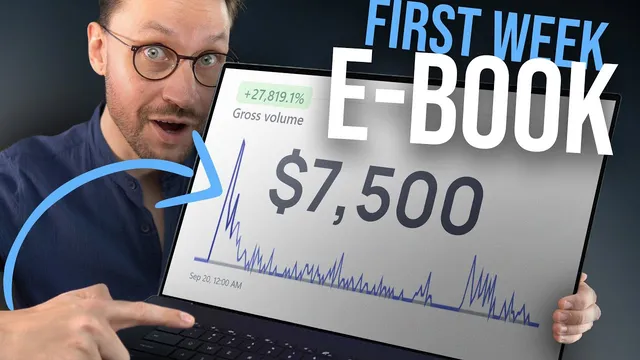
How I Made $7,500 in ONE WEEK Selling an E-Book
Based on Simon Høiberg's video on YouTube. If you like this content, support the original creators by watching, liking and subscribing to their content.
Treat marketing and distribution as the main work for an ebook launch, not a last-minute step after writing and uploading.
Briefing
A first-time ebook launch can generate real money quickly—but only when marketing and distribution are treated as the core product work, not an afterthought. Simon Høiberg reports making more than $7,500 in the first week selling his ebook “Javascript in the industry,” then continuing to earn about $2,500 per month. The takeaway is blunt: many creators pour dozens of hours into writing and editing, upload to platforms like Coursera, Udemy, or Gumroad, share a link once, and then wait for sales that rarely arrive. High earners instead build launch machinery—audience access, email capture, paid promotion, and affiliate-style reach—long before the first sale.
Høiberg contrasts two paths. The common approach narrows a topic, writes and proofreads, uploads, and posts on social media, often resulting in “almost no money at all.” The more profitable approach spends years preparing distribution: building community, owning sales channels, growing email lists, running paid ads, setting up affiliate programs, and giving away knowledge for free before asking for payment. He frames this as the difference between “random chance” and repeatable demand generation.
To make the case concrete, he breaks down his own numbers and time. He spent about 40 hours total to create and launch the ebook—16 hours writing a 71-page book with illustrations, about 10 hours building a website and integrating Strive checkout for payments, roughly four hours creating email launch offers and drip sequences, and four hours on additional marketing tasks. He also spent $531 in the first week on production and promotion: $47 for an ebook cover, $52 for proofreading via Fiverr, $182 to promote the ebook on an Instagram account with nearly a million followers, and about $250 on paid ads across Facebook and Twitter.
Sales came through a discounted launch offer priced at $19 and a $9 group offer for selected buyers. He sold 480 copies, generating $7,980 in gross revenue; after expenses and fees, profit landed around $7,450. The strategy behind those sales centered on acquisition channels rather than writing alone.
His first major tip is to avoid using the ebook as a chance to learn something new. Instead, choose a topic so familiar it can be written “in your sleep,” because marketing is the real bottleneck. He then lays out acquisition options: influencer marketing (paying influencers or offering revenue shares), pre-launch charging on discounted offers before the ebook is finished to test demand and build suspense over 1–2 months, and retargeting existing leads.
For retargeting, he describes a specific lead-gen move: three months before launching, he created a quick free ebook compiling code snippets he’d shared on Twitter and LinkedIn. In under two hours of work, it attracted more than 10,000 downloads, building authority and—critically—an email list. He also recommends paid ads using platforms like Facebook/Instagram (including Messenger and WhatsApp) and Google’s network, arguing that targeting and cost control make ads accessible even without huge budgets.
In his summary of the full funnel, he combines a free authority asset to collect emails, a monetized ebook with a Strive checkout website, influencer agreements for retweets and promotion, discounted offers sent to the email list, and ad campaigns across Twitter, YouTube, and Facebook—resulting in $7,500 in the first seven days and ongoing monthly sales. He signals that part two will focus on the email drip sequence (four emails driving more than two-thirds of sales) and the mechanics of conversion campaigns and launch posts that convert.
Cornell Notes
The core lesson is that ebook sales depend less on writing quality alone and more on distribution systems built before launch. Simon Høiberg reports earning over $7,500 in his first week from “Javascript in the industry,” then about $2,500 per month afterward. His results came from treating marketing as the main project: spending $531 on cover, proofreading, influencer promotion, and paid ads; building a website with Strive checkout; and using email offers and drip sequences. A key demand-generation step was a free ebook released three months earlier that attracted 10,000+ downloads and collected leads for later monetization. He also recommends choosing a topic you already know well and selecting one or two acquisition channels you can execute consistently.
Why do many ebook launches underperform even when the writing is strong?
What were the concrete financial results from Høiberg’s first week, and what did it cost?
How much time went into creating and launching the ebook, and what portion was marketing?
What acquisition channels does he recommend, and how do they differ?
Why does he advise against using the ebook project to learn something new?
What role did the free ebook play in his monetized launch?
Review Questions
- If an ebook creator spends 20–30 hours writing but only posts a single launch link, which part of the funnel is missing according to this account, and why does that matter?
- How would you decide between influencer marketing, pre-launch, retargeting via a free lead magnet, and paid ads for a new ebook?
- What specific actions in Høiberg’s workflow connect email list building to later conversion (offers, drip sequences, timing)?
Key Points
- 1
Treat marketing and distribution as the main work for an ebook launch, not a last-minute step after writing and uploading.
- 2
Choose a topic you already know deeply so production doesn’t become a distraction from acquisition and conversion.
- 3
Budget for launch execution: cover design, proofreading, influencer promotion, and paid ads can be meaningful even at modest spend levels.
- 4
Use one or two acquisition channels you can execute consistently; spreading across too many channels can create chaos and unclear results.
- 5
Build demand before launch through pre-launch offers and/or a free lead magnet that collects emails.
- 6
Retargeting existing leads can outperform cold outreach because it leverages authority and a prepared audience.
- 7
Email offers and drip sequences can drive a large share of sales when timed to the launch and built around a lead list.