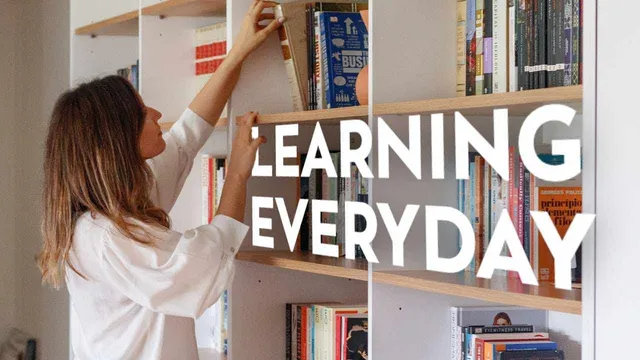
How I Study Every day With a Full Time Job
Based on Mariana Vieira's video on YouTube. If you like this content, support the original creators by watching, liking and subscribing to their content.
Set a clear learning purpose that isn’t tied to job performance or financial outcomes.
Briefing
A full-time job doesn’t have to end serious learning. The core idea is to build a personal, self-directed curriculum that matches limited time and attention—then stick to it with momentum rather than rigid page-count goals. Instead of chasing job-specific upskilling or “hyper-profitable” skills, the creator designs a well-rounded study plan driven by curiosity, using books as anchor texts and supplementing them with critiques and interpretations found online.
The approach starts with clear boundaries and purpose. The goal isn’t to become more specialized in a current career lane; it’s to explore areas that formal education and workplace routines previously funneled away from. With responsibilities spanning a job, a business, and a household, the plan deliberately avoids the “ivory tower” assumption that learning can happen on a fixed academic timetable. Scope is kept broad on purpose: multiple interests get their own space rather than funneling everything into one topic.
Four subject areas become the curriculum’s backbone—economics and politics, literature, psychology, and philosophy. For economics and politics, the anchor text is Thomas Piketty’s “Capital and Ideology,” chosen specifically because the reader is aware of criticisms and wants to confront the original arguments directly. Literature is approached through a classic she hadn’t read before: a multi-volume edition of “Les Misérables” (described as a five-volume set). For psychology, she returns to Carl Jung’s “Essential Works,” which she had started but never studied deeply. Philosophy is anchored with “Beyond Good and Evil.”
A key practical advantage is how easily these books can be supplemented. The internet provides abundant papers, critiques, and discussions, letting the reader compare interpretations, test her own notes, and engage with other scholars’ perspectives while reading.
The learning routine is then translated into a simple, paper-based syllabus. She writes the book titles and tables of contents, then assigns study days across a weekly rhythm from the month of the plan through February 2023. Rather than blocking a calendar with strict instructions, she sets broad goals and keeps the schedule “minimal and laid-back.” The rule is consistency: study each book a few times per week when time allows, without forcing specific chapter or page quotas. The emphasis is on slow absorption, reflection, and connecting ideas over months—so learning compounds instead of arriving as short, exhausting bursts.
To support the process, she partners with Shortform, a service that provides detailed summaries of non-fiction books plus interactive exercises to apply ideas. The pitch centers on using summaries as a way to revisit key points and connect dots across related works—while still planning to buy and read full books when possible. The overall message is that self-learning can be structured enough to sustain, but flexible enough to survive real life.
Cornell Notes
The transcript lays out a method for continuing meaningful learning while working full time: build a personal curriculum with clear purpose and broad scope, anchored by a few main books and supported by external critiques and interpretations. The plan prioritizes curiosity over career-driven specialization, choosing economics/politics, literature, psychology, and philosophy as separate tracks. Study time is organized like a lightweight syllabus—book titles, tables of contents, and a weekly rhythm—without rigid page-count targets. Consistency matters more than speed: reading a few times per week and reflecting helps ideas connect over months. Summaries from Shortform are positioned as a companion tool for revisiting key points and deepening understanding across related books.
How does the curriculum avoid becoming just another job-focused upskilling project?
Why choose multiple subject areas instead of one deep track?
What role do online critiques and papers play in reading the anchor books?
What does the study schedule look like in practice?
What’s the philosophy behind the reading pace?
How does Shortform fit into this system?
Review Questions
- What three constraints (purpose, scope, and time/attention) shape the curriculum, and how does each one change the study plan?
- How does the schedule balance structure (a syllabus-like plan) with flexibility (no page quotas and no calendar blocking)?
- Why does the reader treat online critiques as part of the reading process rather than something to do only after finishing a book?
Key Points
- 1
Set a clear learning purpose that isn’t tied to job performance or financial outcomes.
- 2
Choose a broad scope with multiple interests so motivation doesn’t depend on one topic.
- 3
Anchor each subject with a main book, then use reputable online critiques to test and refine understanding.
- 4
Create a lightweight syllabus on paper (titles, tables of contents, and a weekly rhythm) instead of a rigid calendar.
- 5
Study consistently a few times per week without page-count pressure; prioritize momentum and reflection.
- 6
Use summaries as a revisiting tool to connect ideas across books while still planning to read full texts.
- 7
Aim for slow integration over months so learning compounds rather than staying as disconnected facts.