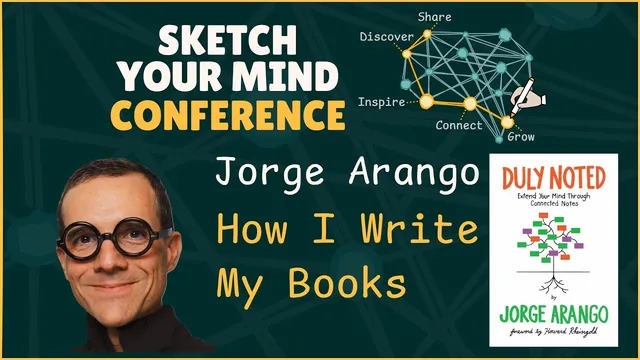
How I Write My Books with Jorge Arango - Sketch Your Mind Conference, 2025
Based on Zsolt's Visual Personal Knowledge Management's video on YouTube. If you like this content, support the original creators by watching, liking and subscribing to their content.
Arango treats writing as three distinct stages—research/incubation, structuring, and drafting—because each stage needs different tools and different kinds of thinking.
Briefing
Jorge Arango’s writing method for non-fiction rests on a single, practical claim: people don’t write by “going from research to a blinking cursor.” They write by thinking with tools—shifting environments on purpose—so each stage of the work gets its own workflow. The payoff is less overwhelm, clearer structure, and fewer dead ends when drafting.
Arango frames writing as three distinct stages: research/incubation, structuring, and the actual writing. Treating these as one continuous process—especially by jumping straight into a word processor—creates a familiar jigsaw-puzzle problem: ideas pile up, but the picture of the book stays out of reach. His alternative starts with the idea that thinking extends beyond the brain. Notes, diagrams, and external artifacts act like “prosthetic memory,” and mind maps or drawings create feedback loops that help ideas gel. That broader philosophy becomes a workflow principle: configure the environment so it supports the kind of thinking required at each step.
In the research/incubation phase, Arango emphasizes fast capture and easy recall. Paper notebooks work well for jotting down learning with no friction, but bound notebooks make random access difficult, forcing an index or other workaround. Digital note systems solve that access problem when paired with deliberate organization such as bottom-up tagging and linking. He points to tools like Obsidian (his primary system) and other PKM platforms as ways to retrieve scattered insights quickly when it’s time to build the book.
The structuring phase is where most writers get stuck, and where Arango’s approach is most distinctive. Instead of drafting prose, he uses an “infinite canvas” to cluster ideas visually—like sticky notes on a wall—so the book’s shape becomes legible. He describes using Tinderbox for this stage: each note can carry metadata, tags, and links, letting him group individual ideas into clusters and map them to emerging chapter groupings. The result is a bird’s-eye view that supports two critical tasks: (1) locating where specific anecdotes belong (for example, assigning material to a particular chapter), and (2) spotting gaps—such as chapters with fewer notes that signal missing research or unresolved positioning.
After that, he still doesn’t move directly into prose. He iterates the layout again using a more accessible infinite-canvas tool (Freeform on Apple devices), especially once a first draft exists and a second draft needs refinement. This board organizes chapters into “beats” with different note colors: framing questions to set reader expectations, story openings to make each chapter engaging, key ideas to elaborate, and exercises aligned with the book’s practical focus on using Obsidian. Empty sticky notes act as placeholders, preventing the “blank screen” paralysis by ensuring there is always something to write next.
Only then does Arango draft in a writing tool designed for authoring at section granularity. He names Scrivener and Ulyses, with Ulyses standing out for native Markdown support and for making word-count targets visible per section—circles that show whether each chapter is on track. He also argues that switching modalities can unlock new thinking even late in the process.
In Q&A, Arango adds that AI can help with tasks like identifying missing elements or generating candidate focusing questions, but he doesn’t recommend letting AI write the book for you; writing is thinking, and dry summarization can undermine voice. He also warns that tool exploration can become “meta work” that steals time from actual drafting. The core message remains: design the structure first, keep the stages separate, and let the right external tools do the heavy lifting so the writing phase becomes a continuation—not a rescue mission.
Cornell Notes
Jorge Arango’s non-fiction writing workflow treats writing as three separate stages—research/incubation, structuring, and drafting—each requiring different tools. The key idea is that people “think with things”: external notes, diagrams, and canvases extend memory and create feedback loops that make ideas easier to organize and sequence. During structuring, he avoids jumping into a word processor and instead uses an infinite-canvas approach (e.g., Tinderbox, then Freeform) to cluster ideas into chapters, map anecdotes to specific sections, and detect missing material by noticing uneven note density. He then drafts in an authoring tool (Ulyses or Scrivener), using visible word-count targets to keep momentum. The method matters because it reduces overwhelm and turns the book’s shape into something you can see and adjust before prose begins.
Why does Arango insist that research, structuring, and writing should be treated as different stages instead of one continuous workflow?
How does Arango use external tools to make “thinking with things” concrete during the structuring phase?
What is the purpose of the “focusing questions” and colored beats on Arango’s chapter layout board?
How does Arango decide what to write in the drafting tool, and what role do word-count targets play?
What does Arango recommend about using AI during the writing process?
Review Questions
- What specific problem does Arango associate with going directly from research to a word processor, and how does his structuring stage prevent it?
- In Arango’s structuring workflow, how do focusing questions and colored “beats” function as constraints on drafting?
- What are the tradeoffs Arango mentions when switching tools (modalities), and why can tool exploration become counterproductive?
Key Points
- 1
Arango treats writing as three distinct stages—research/incubation, structuring, and drafting—because each stage needs different tools and different kinds of thinking.
- 2
“Thinking with things” is the foundation: external artifacts like notes, diagrams, and canvases extend memory and create feedback loops that help ideas form.
- 3
Bound paper notebooks can be fast for capture but slow for random access, so digital systems with tagging and linking are valuable for retrieving ideas later.
- 4
Structuring should happen before prose: visual clustering on an infinite canvas helps map anecdotes to chapters and exposes gaps by uneven note density.
- 5
Arango uses chapter layouts with focusing questions, story openings, key ideas, and exercises to control reader experience and keep drafting aligned to purpose.
- 6
Word-count targets per section (e.g., in Ulyses) help maintain cadence and momentum during drafting.
- 7
AI is best used for support tasks like identifying missing elements or generating candidate questions—not for producing the book’s prose end-to-end.