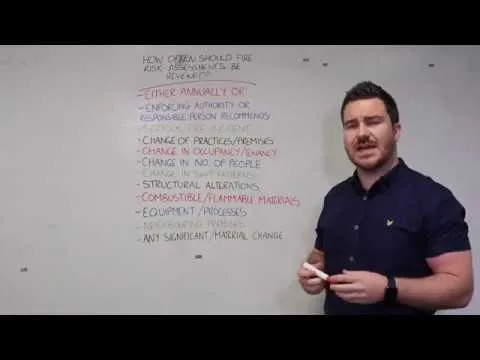
How often should fire risk assessments be reviewed?
Based on Citation Ltd's video on YouTube. If you like this content, support the original creators by watching, liking and subscribing to their content.
Review fire risk assessments at least annually as best practice, because workplace conditions can change within a year.
Briefing
Fire risk assessments should be reviewed at least annually, because conditions in workplaces can change quickly over a 12-month period and those changes can affect fire hazards, control measures, and evacuation arrangements. Annual review is treated as best practice, but a review should also happen sooner whenever specific triggers arise—especially after enforcement scrutiny, serious incidents, or meaningful operational and premises changes.
Beyond the yearly cadence, enforcement authorities are likely to expect an immediate reassessment when regulators or agencies recommend changes. That can follow an investigation by the local fire department or the HSE, where findings point to new risks due to business changes. A serious fire safety incident is another clear trigger: arson, a fire caused by reactions involving chemicals, or any comparable event requires a review not only of the fire risk assessment document, but also of the underlying fire safety processes and controls.
The assessment also needs updating when the premises and how they’re used change. Adding building wings, introducing mezzanine floors, or altering layout and procedures can create new hazards that the risk assessment must explicitly cover. Changes in occupancy and tenancy matter too. As the number of people increases, the evacuation strategy must be rechecked—particularly access routes, the speed and capacity of egress, and whether fire escape mechanisms and doors can move the expected number of occupants quickly enough. In multi-occupancy buildings, fire risk assessments may cover multiple businesses, but they must include scope and coordination so communication between different occupants is built into fire safety planning.
Operational shifts can also change the risk profile. Moving from a standard nine-to-five schedule to later shifts, or introducing overnight work, requires review because different hours can bring different hazards and different control requirements. Structural alterations—such as changes to roof support, adding space, creating additional mezzanine areas, or increasing storage—must be reflected in the assessment, including whether the number of people in those areas and the storage arrangements are appropriate and kept away from ignition sources.
Any change involving combustible materials, chemicals, or substances used or stored on site should prompt review. The location and nature of these materials affect how easily they can ignite and how they might spread fire. The same logic applies to new equipment: introducing devices ranging from everyday appliances like toasters and hot water systems to engineering equipment that can generate sparks adds potential ignition sources and may require reassessing surrounding storage and operating processes.
Finally, changes at neighboring premises can create cross-boundary fire risks, such as increased dust generation or chemical byproducts. Where that happens, the assessment should be updated to consider mitigation controls and communication between neighboring parties. In short: annual review is the baseline, but any significant or material change—especially enforcement findings or reportable incidents—should accelerate the review timeline.
Cornell Notes
A fire risk assessment should be reviewed at least annually, since workplace hazards and controls can shift within a year. Regulators also expect earlier review when enforcement actions, investigations, or serious fire incidents occur, or when the business changes in ways that affect fire safety. Updates are required for changes to premises (like new wings or mezzanine floors), occupancy and staffing levels, shift patterns (including overnight work), structural alterations, and storage of combustible materials or chemicals. New equipment can introduce new ignition sources, so it must be incorporated into the assessment along with nearby storage and operating processes. Even neighboring premises’ activities can require reassessment if they create dust or chemical byproducts that affect shared fire safety risks.
Why is an annual review treated as best practice for fire risk assessments?
What situations require a fire risk assessment review sooner than once a year?
How do changes in occupancy and staffing affect what must be reviewed?
Which premises and operational changes typically require updating the assessment?
How should new equipment, chemicals, and neighboring activities influence review decisions?
Review Questions
- What are the main triggers that justify reviewing a fire risk assessment before the annual review date?
- List at least four types of changes (premises, people, operations, or materials) that require updating the assessment and explain what must be rechecked for each.
- In a multi-occupancy building, what should the fire risk assessment’s scope and communication approach ensure?
Key Points
- 1
Review fire risk assessments at least annually as best practice, because workplace conditions can change within a year.
- 2
Trigger an earlier review after enforcement authority investigations or recommendations, such as findings from the local fire department or the HSE.
- 3
Reassess fire safety processes and controls after serious incidents, including arson or chemical-related fires.
- 4
Update the assessment when premises change (new wings, mezzanines, structural alterations) or when occupancy and evacuation needs change.
- 5
Recheck evacuation capacity and access controls when staffing levels, multi-occupancy arrangements, or shift patterns change, including overnight work.
- 6
Incorporate changes involving combustible materials, chemicals, and storage locations, since combustibility and fire spread risk depend on where and what is stored.
- 7
Review impacts from new equipment and from neighboring premises’ activities (like dust or chemical byproducts), including coordination and communication between parties.