How One Line in the Oldest Math Text Hinted at Hidden Universes
Based on Veritasium's video on YouTube. If you like this content, support the original creators by watching, liking and subscribing to their content.
Euclid’s fifth postulate resisted proof from the first four for more than 2,000 years, pushing mathematicians toward the idea that it may be independent.
Briefing
A single line in Euclid’s “Elements” helped unlock the idea that space might not follow flat, everyday geometry—and modern cosmology is now testing that possibility. Euclid’s fifth postulate, the “parallel postulate,” resisted proof for more than 2,000 years. That long failure turned into a breakthrough: mathematicians eventually showed that the fifth postulate can’t be derived from the other four, meaning multiple consistent “universes” of geometry are possible.
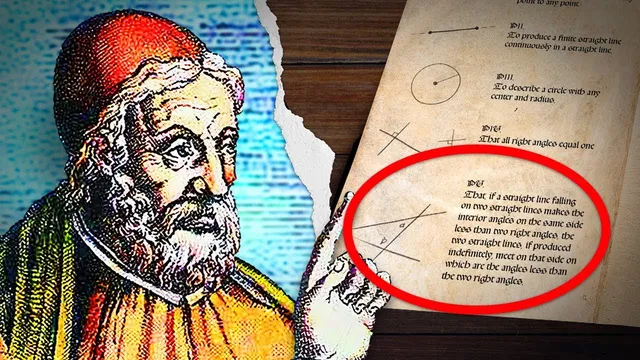
Euclid built “The Elements” as a rigorous system: definitions, a handful of basic postulates, and then hundreds of theorems proved step-by-step from those starting assumptions. The first four postulates are straightforward—draw a line between two points, extend a line indefinitely, construct circles from centers and radii, and treat right angles as equal. Postulate five, however, is different in character. It dictates what happens when a line intersects two others: if the interior angles on one side are less than two right angles, then the two lines must meet on that side. Mathematicians found this oddly specific, and many tried to prove it as a theorem. Attempts often just rephrased it, and even proof by contradiction—assuming the parallel postulate is false and searching for inconsistency—never produced a contradiction.
The breakthrough came when János Bolyai concluded the fifth postulate might be independent. Instead of forcing Euclid’s rule to emerge from the others, Bolyai imagined a world where through a point not on a line there could be more than one parallel line. That “more-than-one-parallel” behavior naturally appears on curved surfaces: the shortest paths between points are geodesics, which look bent on a curved world even when they are “straight” in the geometry’s own rules. This leads to hyperbolic geometry, where triangles have angle sums less than 180 degrees. Bolyai’s work was later echoed by Carl Friedrich Gauss, who privately explored similar non-Euclidean results but avoided publication; Nikolai Lobachevsky independently arrived at related conclusions as well.
Once non-Euclidean geometries were accepted as consistent, the story stopped being purely abstract. Bernhard Riemann generalized geometry further by allowing curvature to vary from place to place, and Eugenio Beltrami later proved hyperbolic and spherical geometries are consistent whenever Euclidean geometry is. That mathematical flexibility became a conceptual tool for physics. Einstein’s general relativity treats gravity as the curvature of spacetime, so “straight lines” become geodesics in a curved geometry. Observations—from gravitational lensing of a supernova to gravitational-wave detections—fit the idea that spacetime is curved.
The modern question is no longer whether alternative geometries can exist, but what geometry the entire universe follows. The angle sum of large triangles distinguishes flat, spherical, and hyperbolic spaces. Because the universe’s curvature shows up only at enormous scales, researchers use the Cosmic Microwave Background. Measurements from the Planck mission match the expectation for a flat universe, with curvature estimated around 0.0007 ± 0.0019—consistent with zero. The result is a rare convergence: a centuries-old dispute over one sentence in Euclid now informs what the cosmos looks like on its largest scales.
Cornell Notes
Euclid’s fifth postulate—the rule governing parallel lines—couldn’t be proved from the other four for over 2,000 years. That failure led János Bolyai to treat the postulate as independent and to build a consistent geometry where more than one parallel line exists. On curved surfaces, “straight” paths are geodesics, producing hyperbolic geometry, where triangle angles sum to less than 180 degrees. Carl Friedrich Gauss and Nikolai Lobachevsky independently explored similar non-Euclidean ideas, and later work by Riemann and Beltrami established these geometries as consistent. General relativity then made curved geometry physically central, and cosmic measurements using the Cosmic Microwave Background (Planck) indicate the universe is very close to flat.
Why did Euclid’s fifth postulate draw suspicion compared with the first four?
What did mathematicians try before Bolyai, and why didn’t it work?
How does “more than one parallel line” connect to curved surfaces and hyperbolic geometry?
What is the Poincaré Disk Model, and why does it matter for understanding hyperbolic space?
How did non-Euclidean geometry become relevant to physics and cosmology?
What does the Planck measurement imply about the universe’s curvature?
Review Questions
- What specific behavior does Euclid’s fifth postulate enforce when a line intersects two lines, and why did that make it feel different from the first four postulates?
- How does the independence of the parallel postulate lead to multiple consistent geometries, and what triangle-angle behavior distinguishes hyperbolic geometry from Euclidean geometry?
- What observational strategy uses the Cosmic Microwave Background to test whether the universe is flat, spherical, or hyperbolic?
Key Points
- 1
Euclid’s fifth postulate resisted proof from the first four for more than 2,000 years, pushing mathematicians toward the idea that it may be independent.
- 2
Direct proof attempts often reduced to restating the parallel postulate rather than deriving it, and proof by contradiction produced no inconsistency.
- 3
János Bolyai’s key move was to construct a consistent geometry where more than one parallel line exists, leading to hyperbolic geometry.
- 4
Hyperbolic geometry can be modeled using the Poincaré Disk Model, where “straight lines” are circle arcs meeting the boundary at right angles.
- 5
Riemann generalized geometry by allowing curvature to vary by location, and Beltrami showed hyperbolic and spherical geometries are consistent if Euclidean geometry is.
- 6
General relativity makes curved geometry physically meaningful by treating gravity as spacetime curvature and motion as geodesics.
- 7
Cosmic Microwave Background measurements from the Planck mission indicate the universe is very close to flat, with curvature estimated near 0.0007 ± 0.0019.