How One Supernova Measured The Universe
Based on Veritasium's video on YouTube. If you like this content, support the original creators by watching, liking and subscribing to their content.
Supernovae are rare and difficult to time precisely, but gravitational lensing can turn an unpredictable event into a forecastable one by producing multiple earlier and later images.
Briefing
A dying star in a distant galaxy—SP1149—was predicted to go supernova in November 2015 with striking timing accuracy, and the payoff was more than a celestial spectacle. The explosion was later seen in four separate, differently delayed images created by gravitational lensing, and the same mass-distribution models that produced those predictions also correctly forecast when the supernova should appear in additional lensed views of its host galaxy. That combination—near-month prediction plus measurable time delays—serves as a rare, high-precision test of how light and gravity work across cosmic distances.
Supernovae mark the end of life for stars more than about eight times the Sun’s mass. When their cores run out of fuel, collapse triggers a violent rebound that can outshine an entire galaxy. Yet supernovae are rare and hard to time: in a typical galaxy with roughly 100 billion stars, only about two occur per century. Even when astronomers can estimate a star’s life stage from mass, luminosity, and color temperature, the exact moment of explosion carries large uncertainty—illustrated by Betelgeuse, which is expected to explode within a window of hundreds of thousands of years.
The breakthrough came from a special kind of cosmic “optical trick.” Scientists used the Hubble Space Telescope to image the region containing galaxy SP1149 about once a month starting October 30, 2015. The first two observations (late October and Nov. 14) showed nothing. The third image (Dec. 11) revealed the supernova exactly where and when it had been forecast. The near-perfect timing wasn’t luck alone: the same event had already been imaged multiple times years earlier—four bright points corresponding to the same supernova seen along different gravitationally lensed paths.
Those multiple images were produced by the galaxy cluster MACS J1149.5+2223, whose ordinary matter and dark matter warp spacetime. As the supernova’s light passed through this cluster, an elliptical galaxy within it focused different bundles of light toward Earth, creating four apparent locations. Because each light path had a different length and also experienced a gravitational “Shapiro” time delay, the images arrived at different times—ranging from about five days to more than three weeks. The event was also the first observed multiply-lensed supernova, making it uniquely useful for measuring relative time delays.
Even more unusually, the lensing models predicted when the supernova should appear in other lensed views of its host galaxy. One predicted appearance was about twenty years earlier (1995), which can’t be directly checked due to missing close-up data. Another predicted appearance was expected about a year later and matched the timing of the Hubble detection. Researchers describe this as a strong confirmation of general relativity and light propagation through a structured universe.
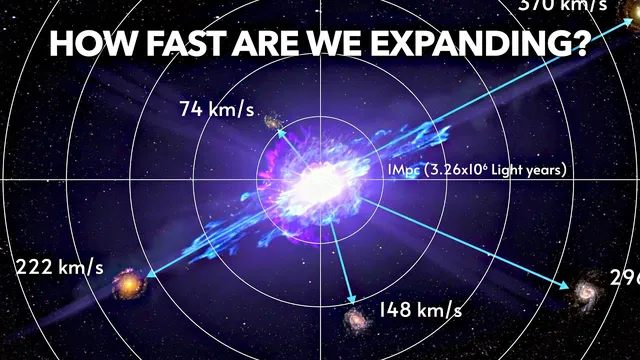
The implications extend into one of astronomy’s biggest disputes: the Hubble constant, H0, which sets the universe’s expansion rate. Traditional “distance ladder” measurements yield about 74 km/s/Mpc, while cosmic microwave background analyses under Lambda-CDM give about 67 km/s/Mpc. Using the time-delay method on multiply-lensed supernovae—first proposed by Sjur Refsdal in 1964—produces a value near 64 km/s/Mpc, with large uncertainties but a closer match to the cosmic microwave background result. In short, Supernova Refsdal doesn’t just validate lensing physics; it offers an independent route to resolving the expansion-rate tension.
Cornell Notes
Supernova Refsdal provided a rare chance to predict and then observe the same distant explosion multiple times. A star in galaxy SP1149 was expected to explode in November 2015, and Hubble detected it on Dec. 11 exactly where models said it would appear. The supernova’s light was split into four images by the gravitational lensing mass distribution of MACS J1149.5+2223, with arrival times delayed by about 5 days to over 3 weeks. Because the supernova’s light curve is distinctive, those delays could be measured and used to test general relativity and lens models. The same time-delay technique also offers an independent estimate of the Hubble constant, yielding about 64 km/s/Mpc—closer to cosmic microwave background results than to the distance ladder value.
Why was predicting the supernova’s timing unusually hard, and what made this case different?
How did gravitational lensing create four separate images of the same supernova?
What explains the different arrival times (days to weeks) of the multiple supernova images?
What made the December 2015 detection a test of lensing models beyond just finding the supernova?
How does a multiply-lensed supernova help measure the Hubble constant?
Why does the Hubble constant matter in the broader “crisis” debate?
Review Questions
- What two physical contributions determine the time delays between multiple lensed images of the same supernova?
- How did earlier Hubble observations of SP1149 enable a later near-month prediction of the November 2015 supernova appearance?
- Compare the distance ladder and cosmic microwave background approaches to H0, and explain where the multiply-lensed supernova time-delay method fits among them.
Key Points
- 1
Supernovae are rare and difficult to time precisely, but gravitational lensing can turn an unpredictable event into a forecastable one by producing multiple earlier and later images.
- 2
The SP1149 supernova was detected by Hubble on Dec. 11, 2015, matching predictions about both position and timing.
- 3
MACS J1149.5+2223—through its ordinary matter and dark matter—split the supernova’s light into four apparent locations and multiple arrival times.
- 4
Measured delays (about 5 days to over 3 weeks) come from both different path lengths and gravitational time delay (Shapiro delay) predicted by general relativity.
- 5
The same lensing models also predicted when the supernova should appear in other lensed views of its host galaxy, including a successful match for a later reappearance.
- 6
Time-delay measurements from multiply-lensed supernovae provide an independent estimate of the Hubble constant, yielding about 64 km/s/Mpc for Supernova Refsdal.
- 7
The lensing-based H0 estimate is closer to cosmic microwave background results than to the distance ladder value, feeding the ongoing expansion-rate tension debate.