How Perspective Shapes Reality
Based on minutephysics's video on YouTube. If you like this content, support the original creators by watching, liking and subscribing to their content.
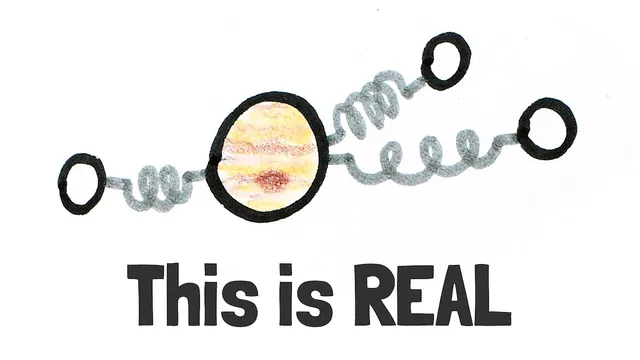
Galileo’s Jupiter observations produce sine-wave motion, which matches the time behavior of a mass on a spring with a linear restoring force.
Briefing
Galileo’s telescope view of Jupiter’s moons didn’t just reveal new objects—it highlighted how the same physical motion can look like different underlying mechanisms depending on perspective, and how multiple mathematical models can be equally predictive. In 1610, Galileo observed bright points that shifted back and forth night after night. When those motions are plotted over time, they trace a sine wave, matching the mathematically identical behavior of a mass bouncing on a spring with a linear restoring force. From a side-on viewpoint, circular orbital motion projects into a one-dimensional back-and-forth pattern, so “orbiting in circles” and “springing on coils” become two different pictures of the same underlying dynamics. The spring image isn’t a literal claim about invisible hardware; it’s a valid model because it produces the same predictions for the moons’ motion and can be transformed into the gravity-based description.
That theme—different stories, same outcomes—extends beyond celestial mechanics. On Earth, forces such as the Coriolis effect bend moving objects like projectiles and reorganize atmospheric flows like storms. From an external frame, the Earth’s rotation can make it seem as though the ground moves under otherwise straight-line paths. Yet the alternative description, using apparent deflections caused by rotation, also yields correct predictions when applied carefully. In both cases, the choice of description shapes intuition: one framing emphasizes “straight motion with a moving reference,” while another emphasizes “curving motion due to a real force.”
Quantum mechanics pushes the idea further. The same experimental results can be reproduced by at least three distinct mathematical frameworks: a particle guided by a spread-out “pilot wave,” a probability wave that collapses to a single point, and a particle that effectively explores all possible paths while interfering with itself. Each framework encourages a different way of picturing what is “actually” happening, but the shared agreement with experiments suggests that none of the pictures is uniquely privileged as the literal description of reality. The key implication is not that incorrect ideas should be embraced, but that equally correct models can lead to radically different mental images.
The practical takeaway is about intellectual discipline. Models are powerful because they give digestible pictures—moons orbit, atoms bond, electrons behave like probability clouds—but they can also overstay their welcome in the mind. A person might ask whether Jupiter’s moons truly “spring” under an invisible force, whether gravity holds them in orbits, or whether their paths are helical in curved spacetime. The video’s central message is that the way reality is described influences the way it is imagined, even when multiple descriptions are mathematically consistent. Sometimes the right next step is to notice a different correct picture that hasn’t been considered yet.
Cornell Notes
Jupiter’s moons can be described in multiple mathematically equivalent ways: circular orbits project into back-and-forth motion that matches the sine-wave behavior of a mass on a spring. The same pattern appears in Earth dynamics, where the Coriolis effect can be framed as curved motion due to rotation or as straight motion relative to a rotating Earth—both can predict outcomes correctly. Quantum mechanics intensifies the point: different models (pilot-wave guidance, probability-wave collapse, and path-interference) produce the same experimental predictions while implying different “what’s really happening” pictures. The lesson is to treat models as predictive tools rather than literal mental portraits, because different correct descriptions can shape intuition in conflicting ways.
How can Galileo’s observations of Jupiter’s moons connect to spring motion?
Why does the video treat “different models” as more than just different explanations?
What role does the Coriolis effect play in shaping competing pictures of motion?
What are the three quantum models mentioned, and what do they share?
What is the central caution about using models to understand reality?
Review Questions
- When does circular orbital motion look like spring-like back-and-forth motion, and what mathematical feature (e.g., sine-wave behavior) supports that connection?
- How can two different descriptions of the same Earth-based phenomenon (Coriolis framing vs rotating-reference framing) both yield correct predictions?
- Why does the existence of multiple quantum models with identical experimental predictions undermine the idea that one picture must be the literal “truth”?
Key Points
- 1
Galileo’s Jupiter observations produce sine-wave motion, which matches the time behavior of a mass on a spring with a linear restoring force.
- 2
Side-on perspective turns circular orbits into an apparent one-dimensional oscillation, making “spring” and “orbit” mathematically interchangeable for predictions.
- 3
The Coriolis effect illustrates how rotation can be described either as a force-like deflection or as straight motion relative to a rotating Earth—both can be predictive.
- 4
Quantum mechanics can be modeled in multiple ways (pilot wave, probability-wave collapse, and path-interference) that agree on experimental outcomes while implying different intuitions.
- 5
Equally correct models can lead to conflicting mental pictures, so predictive success should not automatically be treated as proof of a literal mechanism.
- 6
A useful mindset is to treat models as tools for forecasting and understanding, while staying alert to alternative correct descriptions that challenge intuition.